

You noticed a bump on the back of your wrist. It wasn’t there last month. Now it’s firm, round, and slightly uncomfortable – and you’re not sure what to make of it.
Before you spiral into worry, here’s what you need to know: this is most likely a ganglion cyst. It is the most common soft tissue lump in the hand and wrist. It is not cancer. In many cases, it does not require any treatment at all.
But some ganglion cysts do need medical attention – particularly when they cause pain, press on a nerve, limit your grip, or affect how you use your hand. Knowing the difference matters.
This guide covers everything you need to know about ganglion cysts – what they are, what causes them, where they appear, how they are treated, and when to see a specialist.
Table of Contents
What Is a Ganglion Cyst?
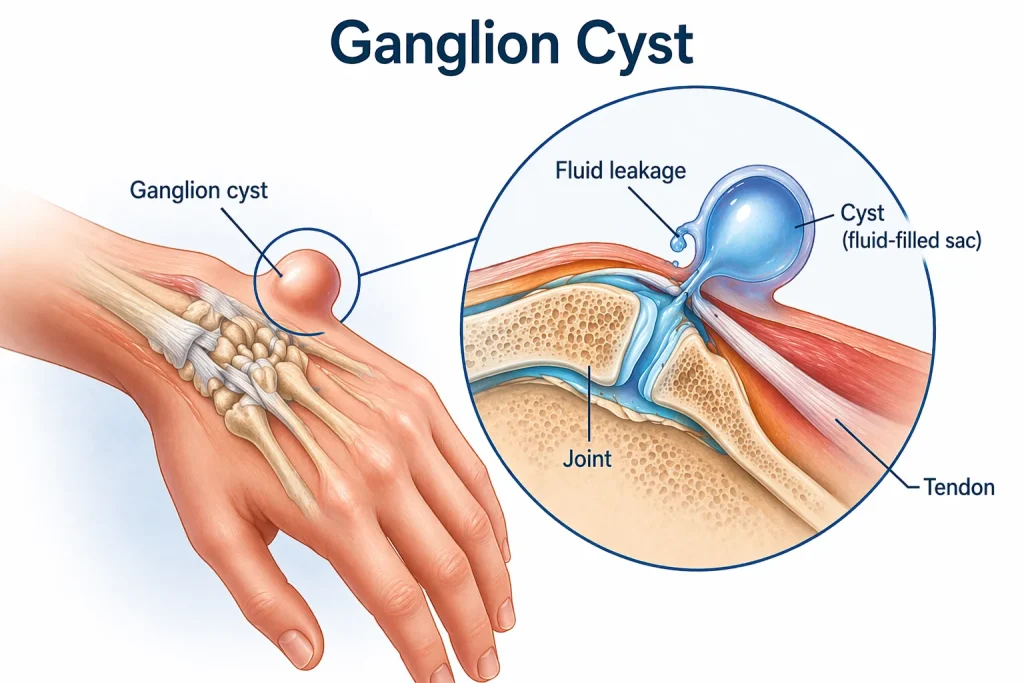
A ganglion cyst is a fluid-filled sac that forms near a joint or tendon. Think of it like a small balloon attached to a thin stalk, growing out of the joint tissue just beneath your skin.
Inside the cyst is a thick, gel-like fluid – very similar to the synovial fluid that naturally lubricates your joints. This fluid is not harmful, but the pressure it creates inside the cyst can sometimes cause discomfort, especially if the cyst presses on a nearby nerve.
Ganglion cysts are:
- Non-cancerous (benign) – they will not spread or become malignant
- Fluid-filled – not solid like a bone growth or tumour
- Variable in size – they can grow, shrink, or disappear on their own
- Common – they account for the majority of lumps found on the hand and wrist
The word “ganglion” comes from the Greek word for a knot of tissue. In older times, these cysts were sometimes called a bible cyst or bible bump – because people used to attempt to treat them by smashing them with a heavy book (do not try this).
Is a Ganglion Cyst Dangerous?
No. A ganglion cyst is not dangerous in the medical sense. It is benign, meaning it has no potential to become cancerous or spread to other parts of the body.
However, a ganglion cyst can affect your quality of life. It may:
- Cause persistent wrist or hand pain
- Create numbness or tingling if it presses on a nerve
- Limit your grip strength or range of motion
- Causes anxiety or self-consciousness due to its appearance
If any of these apply to you, it is worth consulting a specialist – not because the cyst is dangerous, but because effective treatment options are available.
Where Do Ganglion Cysts Appear?
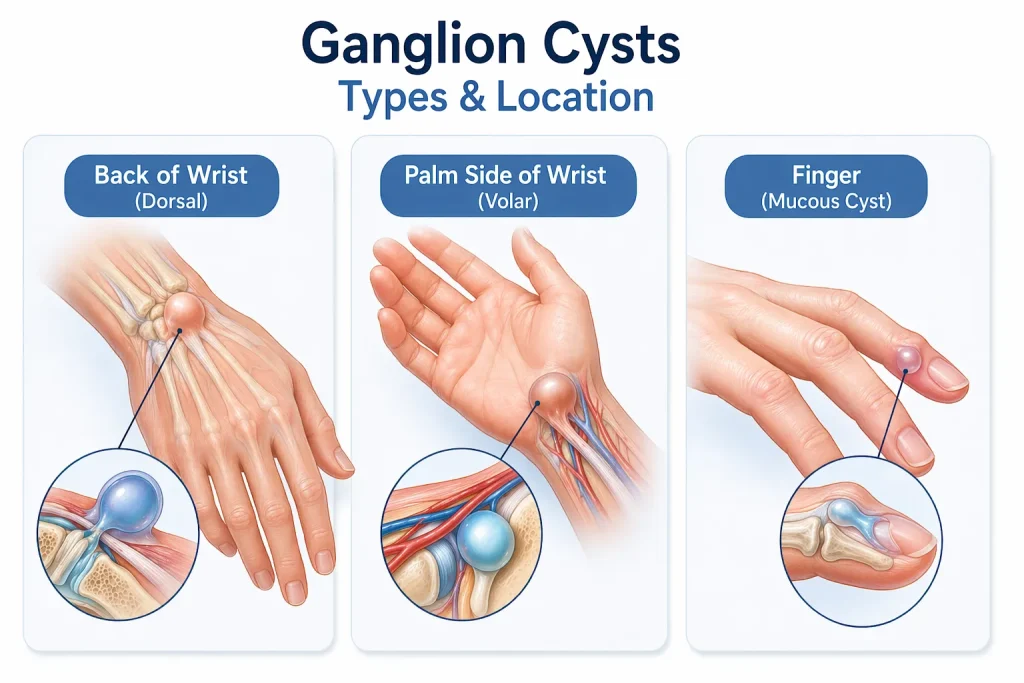
Ganglion cysts can develop at several locations in the hand and wrist. The location matters because it influences both the symptoms you experience and the treatment approach your doctor recommends.
Dorsal Wrist Ganglion
This is the most common type. A dorsal wrist ganglion appears on the back (top) of the wrist, typically between the tendons leading to the thumb and index finger. It is usually round, smooth, and firm to the touch.
Dorsal ganglion cysts are most often connected to the ligament between two small wrist bones (the scapholunate ligament). They tend to be the easiest to diagnose and treat.
Volar Wrist Ganglion
A volar ganglion cyst appears on the underside (palm side) of the wrist, near the radial artery – the pulse point you can feel at your inner wrist. These are the second most common type.
Because of their location near major blood vessels and nerves, volar ganglion cysts require more care during aspiration and surgery. A specialist with experience in hand surgery should manage these.
Ganglion Cyst on Finger and Palm
- Ganglion cyst at the fingertip joint: These are called mucous cysts. They typically appear on the nail side of the end joint of a finger and are strongly linked to arthritis in that joint. They are more common in women between 40 and 70 years of age.
- Ganglion cyst at the base of the finger: These appear on the palm side, near the base of the finger. They are usually small – about the size of a pea – but can cause sharp pain when gripping objects.
- Ganglion cyst on the palm of the hand: Less common, but possible. Often linked to tendon sheath irritation.
Other less common locations include the elbow, ankle, foot (ganglion foot), forearm, and occasionally the knee – where they may be detected on MRI as an ACL ganglion cyst.
What Causes a Ganglion Cyst?
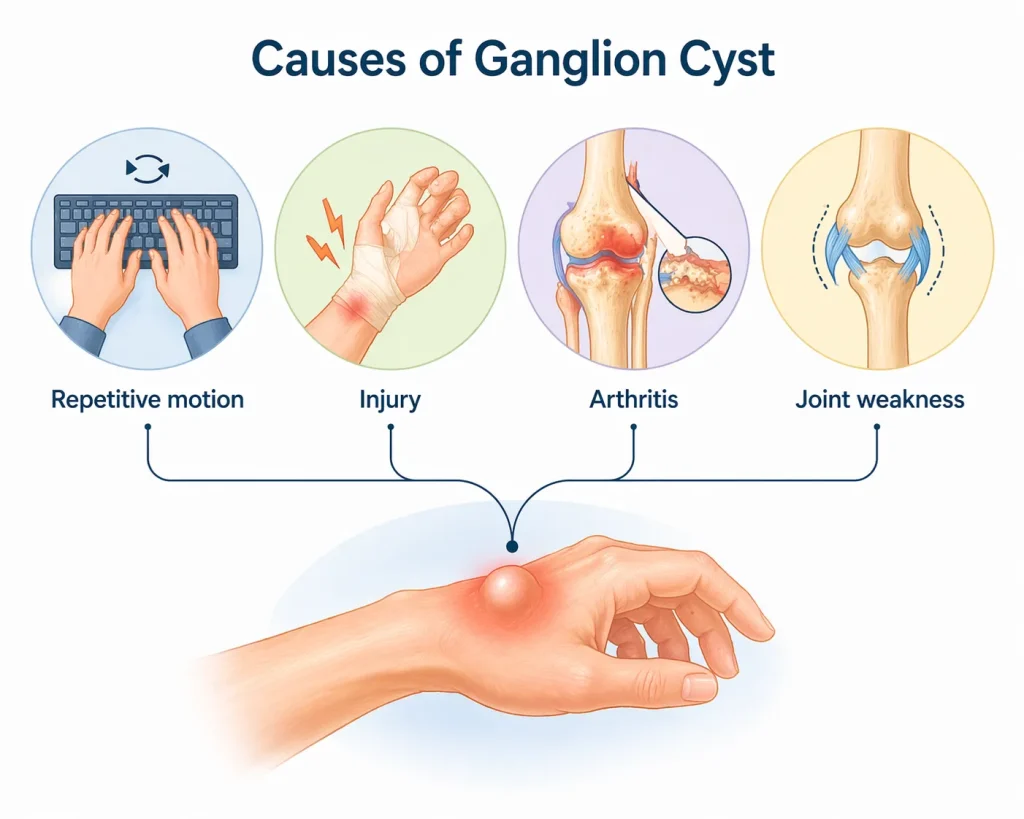
The exact cause of ganglion cysts is not fully understood. They appear to form when the tissue surrounding a joint or tendon sheath breaks down slightly, allowing joint fluid to leak out and pool into a sac-like structure.
Several factors are associated with a higher likelihood of developing a ganglion cyst:
- Age: They are most common in people between the ages of 15 and 40, though mucous cysts on the fingers more often affect those between 40 and 70.
- Sex: Women are more frequently affected than men across most types of ganglion cysts.
- Repetitive wrist stress: Gymnasts, typists, and people who perform repetitive hand movements are at higher risk.
- Joint or tendon injury: A history of wrist injury may increase the chance of cyst formation.
- Arthritis: Particularly for mucous cysts on the fingers, osteoarthritis of the finger joint is a known contributing factor.
- Joint laxity: In some individuals, looser joint capsules may allow fluid to escape more easily.
There is no single lifestyle factor that definitively causes or prevents a ganglion cyst. They are not contagious, not hereditary, and not related to diet.
Ganglion Cyst Symptoms – What to Watch For
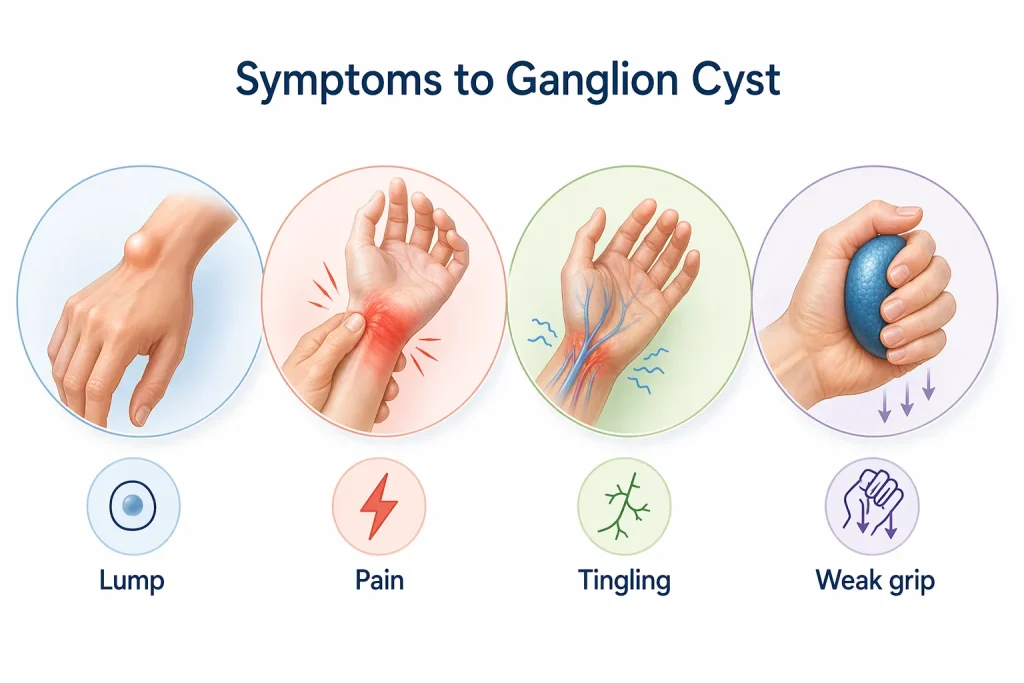
Not every ganglion cyst causes obvious symptoms. In fact, many people discover them by accident. Here is what the full range of symptoms can look like:
Visible signs:
- A round, smooth lump on the wrist, hand, or finger – often on the back of the wrist
- The lump may be firm or slightly soft, depending on how much fluid is present
- The size may change day to day – larger after physical activity, smaller after rest
Physical symptoms:
- Dull aching pain or tenderness over the cyst, especially with movement
- Sharp pain when gripping objects (particularly for cysts at the finger base)
- Wrist pain that worsens with activity
- Muscle weakness in the hand if a nerve is compressed
Neurological symptoms (if the cyst presses on a nerve):
- Tingling or numbness in the fingers
- A burning sensation in the hand
- Reduced grip strength
Occult ganglion cysts: Some ganglion cysts remain hidden under the skin – these are called occult ganglions. They do not form a visible lump but may cause persistent wrist pain. An MRI or ultrasound is needed to detect them.
Cosmetic concern: Even without pain, a visible lump on the hand or wrist can cause anxiety or embarrassment. This is a completely valid reason to seek treatment.
How Is a Ganglion Cyst Diagnosed?
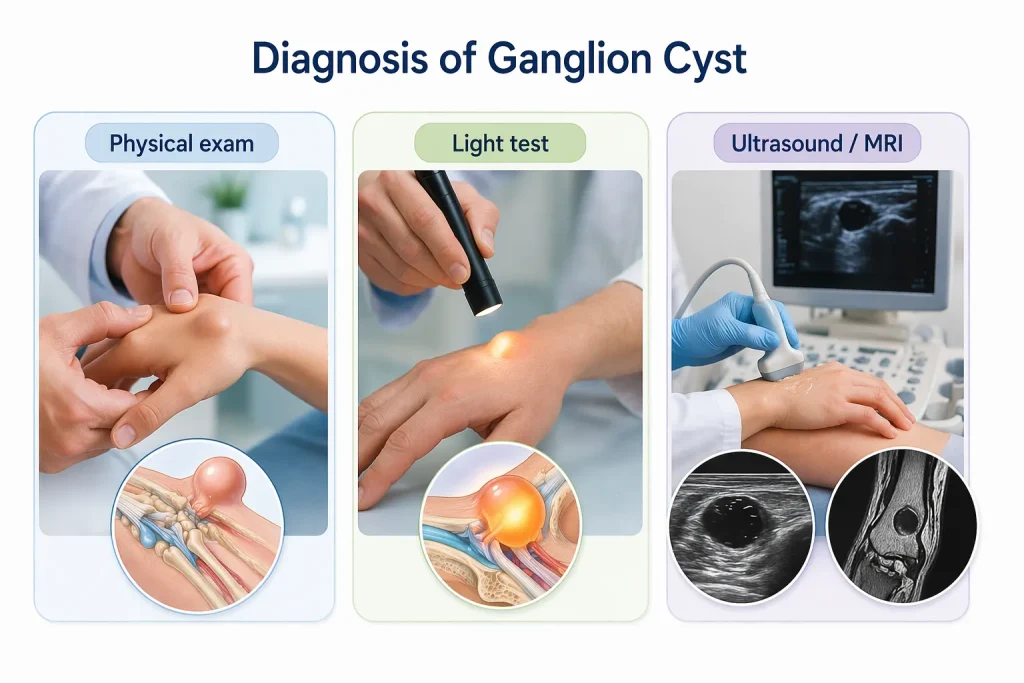
A ganglion cyst is usually diagnosed through a combination of physical examination and, where needed, imaging.
Physical Examination: Your doctor will:
- Review your medical history and ask how long the lump has been present, whether its size changes, and whether it causes pain
- Press gently on the cyst to check for tenderness
- Perform a transillumination test – shining a small light (penlight) through the cyst to confirm it is fluid-filled rather than solid; solid tumours do not transmit light
Imaging Tests:
- X-ray: Does not show the cyst directly, but helps rule out other conditions such as arthritis of the wrist, arthritis of the hand, or a bone tumour. Useful if the diagnosis is uncertain.
- Ultrasound (USG): A ganglion cyst ultrasound is often the first-choice imaging tool. It confirms the fluid-filled nature of the cyst in real time without radiation. Also useful for guiding aspiration.
- MRI: The most detailed imaging option. An MRI can identify occult ganglion cysts not visible on the surface, distinguish cysts from other soft tissue tumours, and map the cyst’s connection to the underlying joint or tendon sheath.
In most straightforward cases, imaging beyond physical examination is not required before starting treatment.
Ganglion Cyst Treatment Options
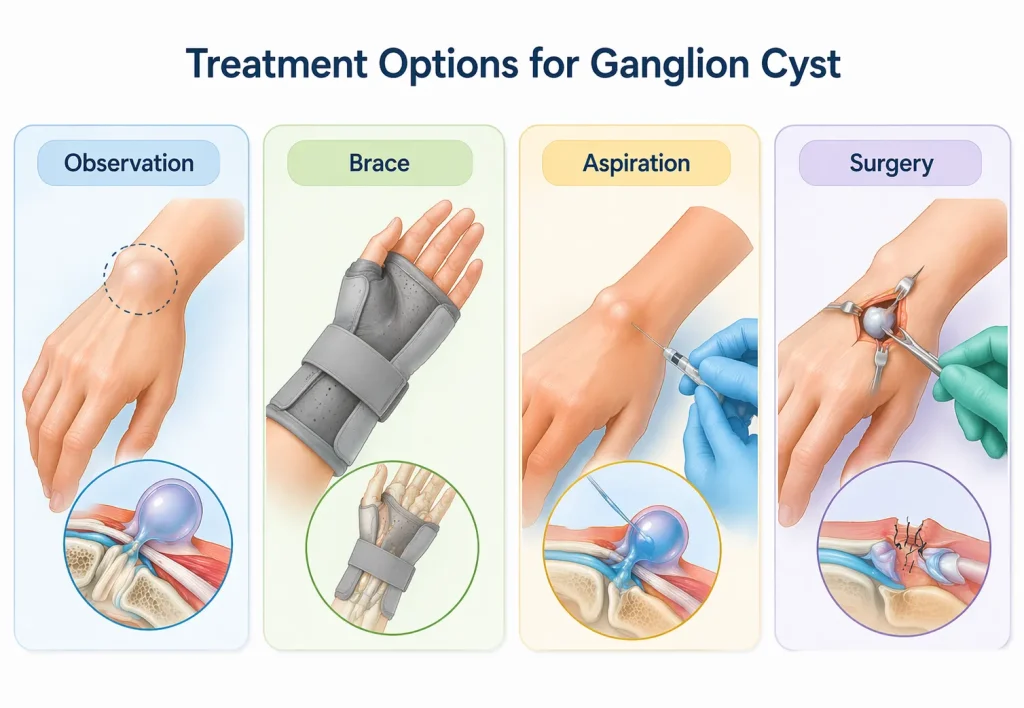
Treatment depends on several factors: the size of the cyst, its location, the level of pain or functional limitation, and your personal preference. Here are the main options:
Observation – Watchful Waiting
If the cyst causes no pain and does not limit your activities, your doctor may recommend simply monitoring it. This is appropriate because:
- Ganglion cysts often disappear on their own over time
- They are not dangerous and do not need to be removed unless they cause problems
- Unnecessary procedures carry their own small risks
Regular monitoring ensures any changes in size, shape, or symptoms are caught early.
Immobilisation with a Wrist Brace or Splint
Activity tends to increase the size of a ganglion cyst, which can increase pressure and pain. A splint for a ganglion cyst or a wrist brace for a ganglion cyst limits movement, which may:
- Reduce the cyst’s size over time
- Relieve associated wrist pain
- Give the underlying joint tissue time to settle
A wristband for a ganglion cyst can also provide mild compression support for daily activity. Once pain decreases, gentle strengthening exercises are introduced to restore the range of motion.
Aspiration – Draining the Cyst
Ganglion cyst aspiration is a non-surgical procedure in which a needle is inserted into the cyst to drain the fluid. It involves:
- Numbing the area with a local anaesthetic
- Inserting a fine needle into the cyst under sterile conditions
- Withdrawing the fluid, which may be accompanied by the injection of a steroid to reduce inflammation
Aspiration provides immediate cosmetic relief and often reduces pain. However, the recurrence rate is significant – many cysts return because the root connection to the joint or tendon sheath is not removed. Think of it like cutting a weed at the stem but leaving the root intact.
Aspiration works best for dorsal wrist ganglions. Volar ganglion cysts are typically not aspirated due to the proximity of major blood vessels and nerves.
Ganglion Cyst Surgery (Excision)
Ganglion cyst surgery – technically called ganglion cyst excision – is the most definitive treatment. It is recommended when:
- Non-surgical options have failed or the cyst has returned after aspiration
- The cyst causes significant pain or nerve compression
- Hand function is affected
- The patient is unhappy with the cosmetic appearance despite trying conservative measures
The procedure involves removing not only the cyst but also the stalk and root – including a portion of the joint capsule or tendon sheath from which it arises. This thorough approach is what makes surgery more effective than aspiration at preventing recurrence.
Ganglion excision is typically performed as a day procedure under local or regional anaesthesia. You go home the same day.
Ganglion Cyst Surgery – What to Expect
Understanding what happens before, during, and after ganglion wrist removal helps reduce anxiety and prepare you for a smoother recovery.
Before Surgery:
- Your surgeon will review imaging (X-ray, MRI, or ultrasound) to map the cyst precisely
- Blood thinners or certain medications may need to be paused
- You will receive instructions on fasting if general anaesthesia is used
During Surgery:
- The procedure takes 30 to 60 minutes in most cases
- A small incision is made over the cyst
- The cyst, its stalk, and the root tissue are carefully removed
- The incision is closed with sutures
- A sterile dressing and sometimes a short splint are applied
Arthroscopic Ganglion Excision: For dorsal wrist ganglions, some surgeons offer arthroscopic excision – a minimally invasive approach using a small camera inserted through tiny incisions. This technique results in a smaller ganglion cyst surgery scar, faster recovery, and less post-operative stiffness. Discuss with your surgeon whether this is appropriate for your case.
Recovery After Ganglion Cyst Removal
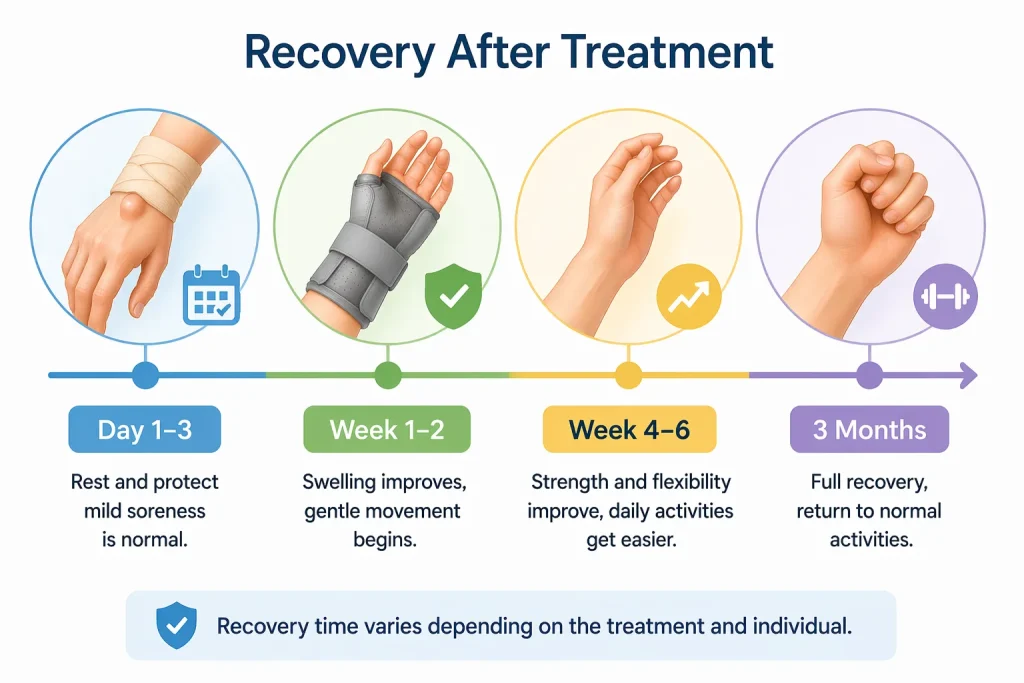
Recovery timelines vary depending on the location of the cyst and the technique used. Here is a general guide:
- Days 1–3: Some tenderness, swelling, and discomfort around the incision site. Keep the hand elevated and rest.
- Week 1–2: Sutures are reviewed or removed. Light daily activities can resume with care.
- Week 2–4: Gradual return to normal activities. Avoid heavy lifting or repetitive wrist stress.
- Week 4–6: Most patients return to full activity, including sports and manual work.
- 3 months: Full recovery, and any residual stiffness typically resolves.
Physiotherapy or hand exercises may be recommended after surgery to restore grip strength and wrist range of motion.
The ganglion cyst surgery scar is usually small and fades significantly over time, particularly with scar massage and silicone-based scar therapy if recommended.
Home Remedies for Ganglion Cyst – What Works and What Doesn’t
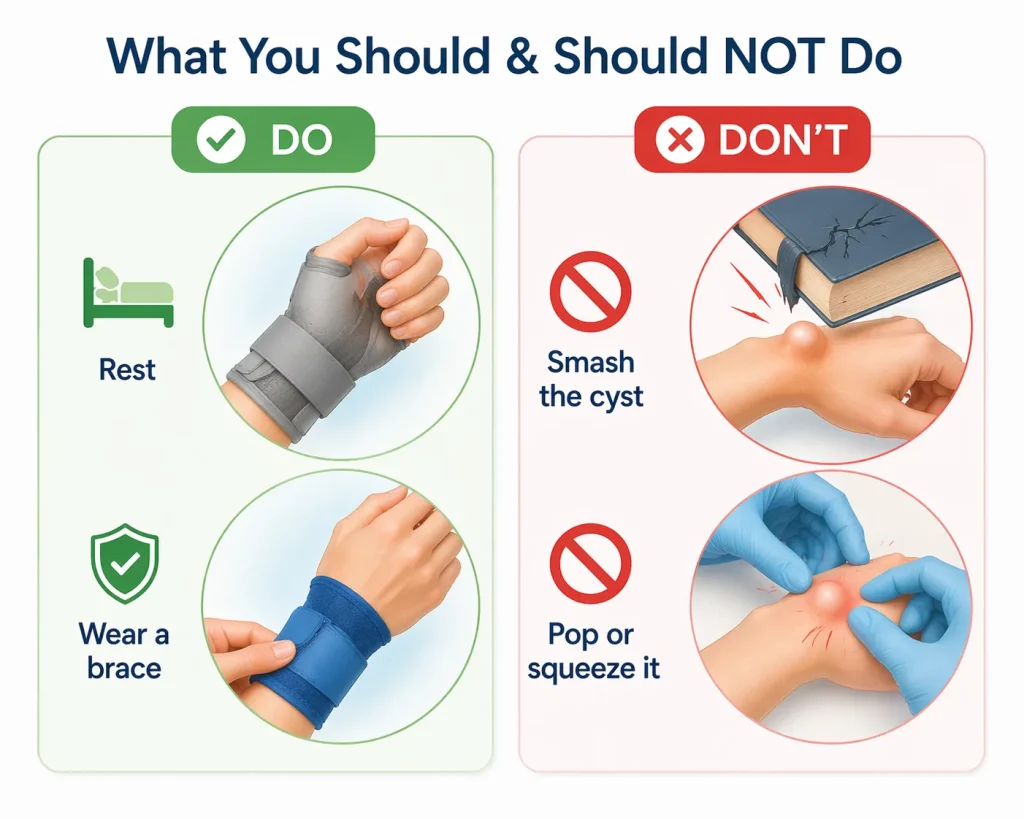
It is natural to search for home remedies for a ganglion cyst on the wrist before committing to a medical procedure. Here is an honest assessment:
What does NOT work:
- Smashing the cyst with a heavy book (the “bible bump” method): This is dangerous. It can rupture the cyst internally, damage surrounding tendons and nerves, and cause significant injury.
- Popping the ganglion cyst yourself: Attempting to pop a ganglion cyst at home risks infection, incomplete drainage, and rapid recurrence.
- Herbal poultices or topical remedies: There is no clinical evidence that any topical application reduces or eliminates a ganglion cyst.
What may help manage symptoms at home:
- Resting the wrist: Reduced activity often causes the cyst to decrease in size naturally.
- Wearing a wrist brace: A wrist brace for a ganglion cyst or wristband limits movement and may reduce discomfort.
- Anti-inflammatory pain relief: Over-the-counter medications like ibuprofen can reduce associated pain. Always take as directed and consult your doctor.
- Monitoring changes: Keep track of whether the cyst grows, shrinks, changes shape, or becomes more painful.
The bottom line: home management can help with symptom control, but it will not remove the cyst. If the cyst persists, grows, or causes significant discomfort, professional evaluation is the appropriate next step.
Can a Ganglion Cyst Come Back?
Yes – recurrence is possible, and patients should be aware of this before choosing a treatment path.
- After aspiration: Recurrence rates are relatively high because the root of the cyst remains. Many patients require repeat aspiration or eventually opt for surgery.
- After surgery (excision): Recurrence rates are lower but not zero. Even after thorough removal of the cyst and its root, a small percentage of patients develop the cyst again – typically at the same site.
- If recurrence occurs: A revision excision can be performed. Outcomes remain good in the majority of cases.
Choosing an experienced hand and wrist surgeon significantly reduces the risk of recurrence. The technique used, particularly how thoroughly the stalk and root are excised, directly influences long-term outcomes.
Which Doctor to Consult for a Ganglion Cyst?
If you have a lump on your wrist, hand, or finger that you suspect is a ganglion cyst, the appropriate specialist is an orthopaedic surgeon with expertise in hand and wrist conditions.
In India, you may also consult:
- A hand surgeon (a subspecialty within orthopaedics and plastic surgery)
- An orthopaedic specialist who manages musculoskeletal conditions
- Your general physician or family doctor as a first point of contact, who can then refer you appropriately
When you see your doctor, bring the following information:
- How long have you noticed the lump
- Whether it has changed in size
- Any pain, tingling, or weakness in the hand or fingers
- Any previous wrist injuries or history of arthritis
Early consultation ensures you get an accurate diagnosis and the right treatment plan from the start – rather than waiting until the cyst becomes larger or more symptomatic.
Conclusion
A ganglion cyst on your wrist or hand is almost always a benign condition – one that many people live with comfortably for years, or that resolves entirely on its own.
But when a cyst causes pain, limits your ability to use your hand, presses on a nerve, or simply concerns you, you deserve precise, professional care. The right treatment – whether watchful waiting, aspiration, or surgical excision – depends on your specific situation, the location of the cyst, and your personal goals.
Do not attempt to drain or rupture the cyst at home. Do not delay seeking evaluation if symptoms are worsening. And remember – a lump on the wrist is rarely something to fear, but it is always something worth understanding. If you have questions about a ganglion cyst or any other hand or wrist condition, our specialists at deformity.co.in are here to provide accurate diagnosis and compassionate, evidence-based care.
Read: Carpal Tunnel Syndrome: Causes, Symptoms, Diagnosis, Treatment and Cure
FAQs
What is a ganglion cyst?
A ganglion cyst is a non-cancerous, fluid-filled sac that forms near a joint or tendon – most commonly on the back of the wrist. It is the most common benign lump in the hand and wrist.
Is a ganglion cyst dangerous?
No. A ganglion cyst is benign and not dangerous. However, it can cause pain, nerve compression, or functional limitation – all of which are valid reasons to seek treatment from a specialist.
What causes a ganglion cyst on the wrist?
The exact cause is unknown. It is associated with joint stress, repetitive wrist movements, prior injury, and in finger cysts, with underlying arthritis. Women between 15 and 40 are most commonly affected.
Can a ganglion cyst go away on its own?
Yes – many ganglion cysts resolve without treatment. Resting the wrist and avoiding repetitive activity can help. However, cysts that persist, grow, or cause pain should be evaluated by a doctor.
What does a ganglion cyst look like?
It appears as a smooth, round, firm or slightly soft lump – typically on the back of the wrist. It may vary in size with activity and can sometimes be translucent when light is shone through it.
What is the difference between a dorsal and volar ganglion cyst?
A dorsal ganglion cyst appears on the back (top) of the wrist – the most common type. A volar ganglion cyst appears on the underside near the pulse point and is more complex to treat due to proximity to blood vessels and nerves.
What is ganglion cyst aspiration?
Aspiration is a non-surgical procedure that drains the fluid from the cyst using a needle. It provides quick relief but has a higher recurrence rate than surgery, as the root of the cyst is not removed.
How long does recovery take after ganglion cyst surgery?
Most patients return to normal activities within 2 to 6 weeks after excision. Full recovery, including resolution of stiffness, typically occurs within 3 months. Physiotherapy may be recommended.
Can a ganglion cyst come back after surgery?
Yes, though recurrence after proper surgical excision is less common than after aspiration. If the cyst returns, a revision surgery can be performed with good outcomes in most cases.
Which doctor should I see for a ganglion cyst in India?
Consult an orthopaedic surgeon specialising in hand and wrist conditions. Your general physician can also provide an initial assessment and refer you to the appropriate specialist.