

You wake up in the middle of the night with a burning, numb feeling in your fingers. Or your hands tingle during a long drive. Or you drop things more than you used to – and your grip feels weaker than it should be. These are not random complaints. These are some of the most recognisable signs of carpal tunnel syndrome, one of the most common nerve problems affecting the hand and wrist.
Millions of people in India and around the world live with carpal tunnel syndrome – many of them without realising that what they are experiencing has a name, a clear cause, and effective treatment options. Whether you are a software professional who types all day, a homemaker doing repetitive household work, or someone who has been experiencing wrist and forearm pain for months, this guide is for you.
We will cover everything – from carpal tunnel syndrome meaning and anatomy, to causes, symptoms, diagnosis, and how to treat and even cure carpal tunnel syndrome. We will also answer the most common questions Indian patients ask, including what the jhanjhanahat (tingling sensation) in the hand really means and why hands feel numb in the morning.
Table of Contents
What is Carpal Tunnel Syndrome? Definition and Meaning
Carpal tunnel syndrome – abbreviated as CTS – is a condition where the median nerve in the wrist becomes compressed or squeezed inside a narrow passageway called the carpal tunnel. This compression leads to pain, numbness, tingling, and weakness in the hand and fingers.
The CTS full form in medical terminology is Carpal Tunnel Syndrome. It is also sometimes written as “tunnel syndrome” or “carpal syndrome.” The condition is classified as a type of median nerve entrapment – meaning the nerve is trapped or pinched within a tight anatomical space.
In Hindi, carpal tunnel syndrome in Hindi is often described as “haath ki nass dabna” – the compression of a nerve in the hand. The tingling and numbness patients describe – jhunjhuni in hand or jhanjhanahat – is the direct result of this nerve compression.
If left untreated, CTS does not stay stable. It progressively worsens and can eventually lead to permanent nerve damage in the hand and significant loss of hand function.
Carpal Tunnel Anatomy: Understanding the Affected Area
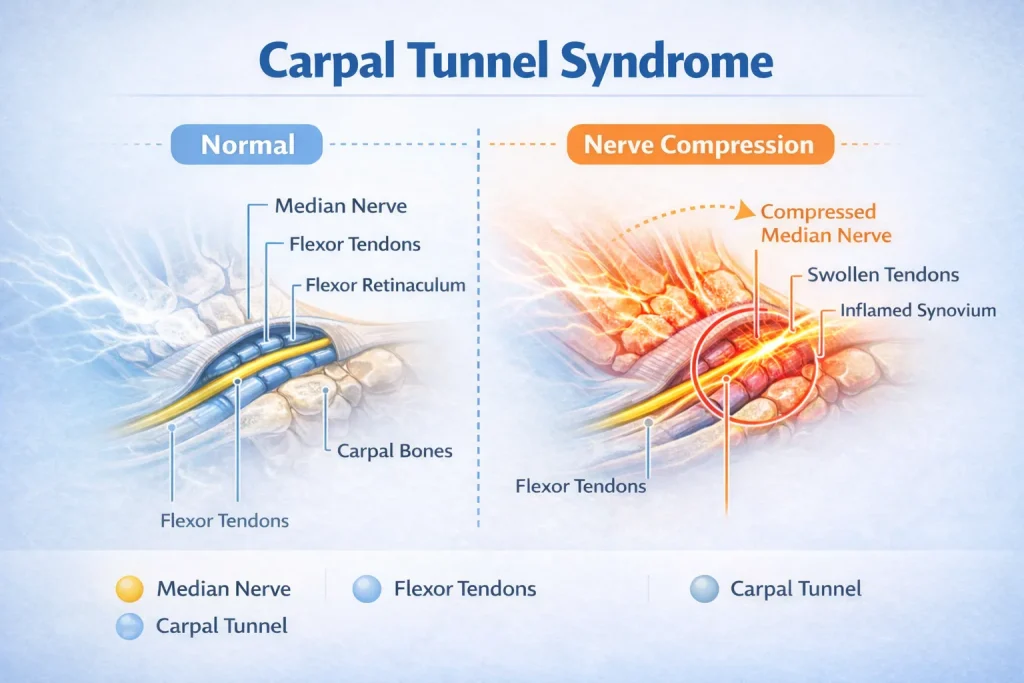
To understand carpal tunnel syndrome, you first need to understand what the carpal tunnel actually is and what passes through it.
What is the Carpal Tunnel?
The carpal tunnel is a narrow, rigid channel located at the base of the wrist, on the palm side. It is approximately one inch wide. The carpal tunnel boundaries are formed by:
- The floor and sides – made up of eight small wrist bones called carpals (also called carpal bones or wrist carpals)
- The roof – a tough band of connective tissue called the flexor retinaculum, also known as the transverse carpal ligament
Because the flexor retinaculum and carpal tunnel walls are rigid and non-elastic, there is very little room inside. Even small amounts of swelling inside this space can compress the structures within it.
Structures Passing Through the Carpal Tunnel
The structures passing through the carpal tunnel include:
- The median nerve – the most important structure affected in CTS
- Nine flexor tendons – these are the tendons that bend the fingers and thumb (called flexor tendons)
- Synovium – the tissue surrounding the tendons that can swell and compress the nerve
The Median Nerve – The Key Nerve in Carpal Tunnel Syndrome
The median nerve is one of three major nerves supplying the hand. It is the nerve most directly affected in carpal tunnel syndrome.
Here is the path of the median nerve:
- Originates from nerve roots in the neck (cervical spine)
- Travels down the upper arm
- Crosses the elbow
- Runs through the forearm (median nerve forearm)
- Passes through the carpal tunnel at the wrist
- Divides into branches in the palm (nerve supply of the palm)
- Supplies feeling to the thumb, index finger, middle finger, and the thumb-side half of the ring finger
- Controls the small muscles at the base of the thumb (thenar muscles)
The median nerve is essentially the “eye of the hand nerve” – a poetic term patients use for how central this nerve is to hand sensation and fine motor function. Without a healthy median nerve, hand function deteriorates significantly.
What Causes Carpal Tunnel Syndrome?
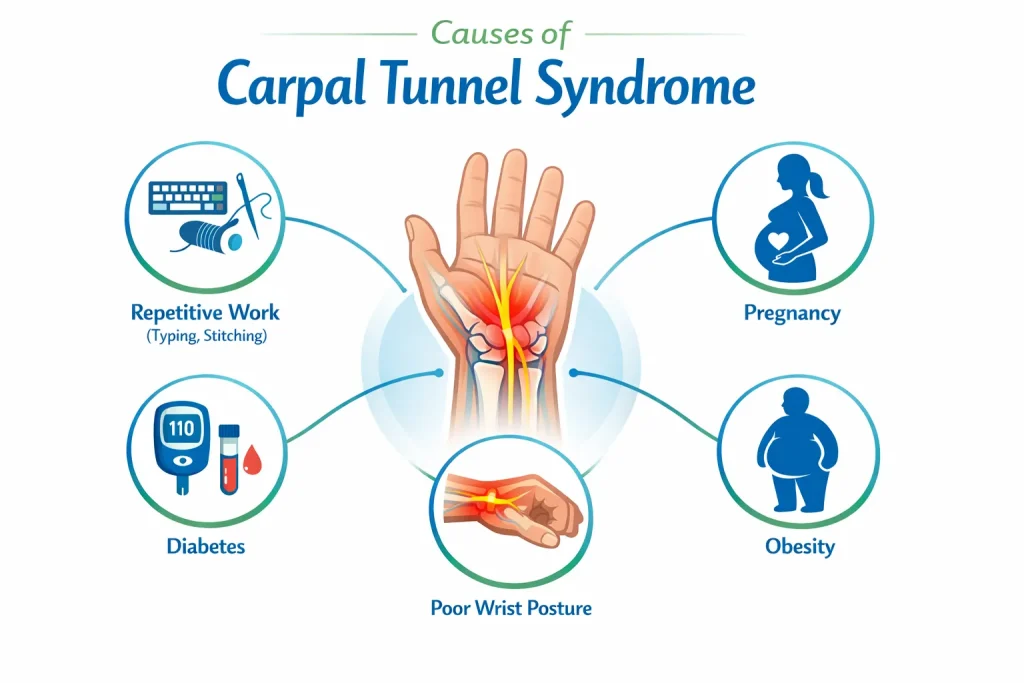
Carpal tunnel syndrome causes are varied. In most patients, it is not a single cause but a combination of factors that together lead to median nerve compression.
Hereditary Factors
Some people are simply born with a smaller carpal tunnel. This anatomical trait runs in families. If your parent or sibling has CTS, your own risk is higher. This is one of the reasons CTS seems to occur “without reason” in some patients – the tunnel was never large enough to absorb even mild swelling.
Repetitive Hand and Wrist Use
This is one of the most common carpal tunnel causes in India, particularly among:
- Software professionals and typists who use a keyboard for hours daily
- Garment workers doing repetitive stitching
- Assembly line workers doing the same hand motion repeatedly
- Musicians, especially pianists and violinists
- Homemakers doing repetitive chopping, grinding, or washing
Repeating the same hand and wrist motion for prolonged periods aggravates the flexor tendons, causing the synovium around them to swell – which then compresses the median nerve inside the already-tight carpal tunnel.
Prolonged Awkward Wrist Position
Holding the wrist in extreme flexion (bent downward) or extension (bent upward) for long periods increases pressure inside the carpal tunnel. This is why symptoms often occur while driving, reading a book, or using a smartphone – all activities where the wrist stays in a fixed, often bent position for extended periods.
Pregnancy
Left-hand pain during pregnancy and right-hand tingling are common complaints among pregnant women. This is because hormonal changes during pregnancy cause generalised fluid retention and swelling throughout the body – including inside the carpal tunnel. CTS during pregnancy is usually temporary and often resolves after delivery, but it can cause significant discomfort in the third trimester.
Underlying Health Conditions
Several medical conditions are associated with an increased risk of carpal tunnel syndrome:
- Diabetes – affects nerve health directly and increases susceptibility to nerve compression
- Rheumatoid arthritis – causes joint and tendon inflammation that can narrow the tunnel
- Thyroid gland imbalance (hypothyroidism) – leads to fluid retention and nerve vulnerability
- Obesity – increases pressure on the wrist structures
- Wrist fractures or previous wrist injuries can alter the carpal tunnel anatomy
Carpal Tunnel Syndrome Symptoms: What to Watch For
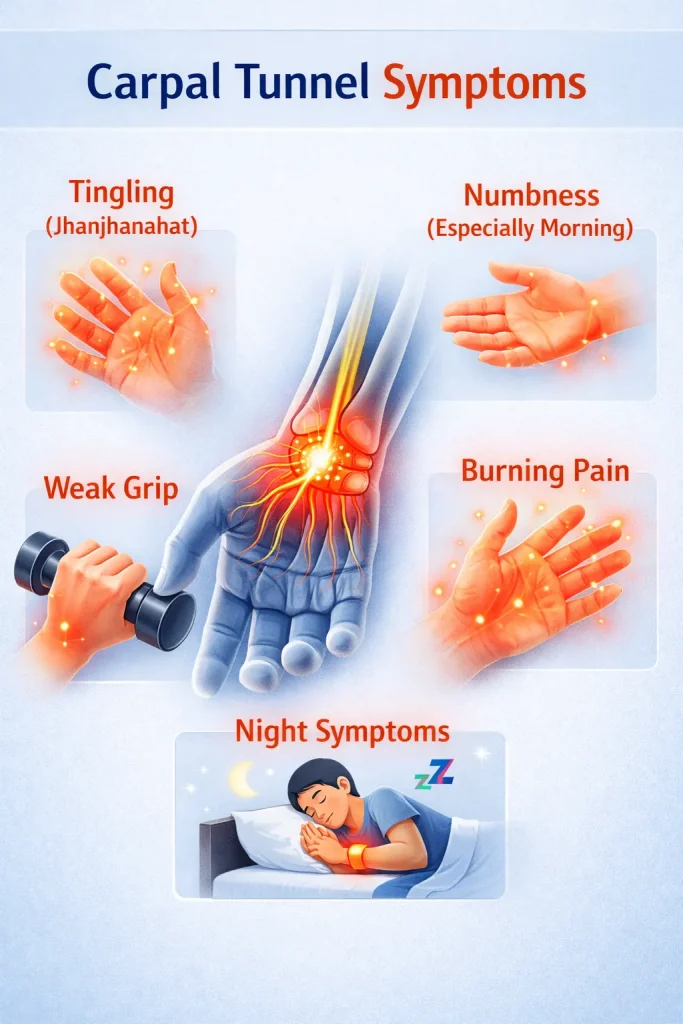
Carpal tunnel syndrome symptoms develop gradually in most patients. They rarely begin overnight. Understanding the early signs can help you seek treatment before permanent nerve damage occurs.
Primary Symptoms
- Numbness and tingling in the thumb, index finger, middle finger, and part of the ring finger – the classic distribution of the median nerve
- Burning sensation in the fingers of the hand – often one of the earliest complaints
- Pain in the palm, particularly on the thumb side
- Wrist nerve pain and wrist and forearm pain that can travel up toward the shoulder
- Electric shock feeling in the hands – sudden, sharp sensations radiating into the fingers
- Pain in right hand fingers or left-hand pain and numbness, depending on which side is affected
- Hand weakness – patients drop objects or find it difficult to perform fine tasks like buttoning clothes
- Numbness in right hand fingers or numbness in the left palm on waking
- Tingling sensation in the right hand or tingling in the left hand during daily activities
- Palm numbness that worsens with prolonged gripping or holding
Nighttime Symptoms – A Key Diagnostic Clue
One of the most characteristic features of carpal tunnel syndrome is that symptoms are worse at night. Patients often describe:
- Waking up with numb hands in the morning
- Hand pain while sleeping that disturbs rest
- Hand cramps while sleeping
- Left thumb numb or right thumb tingling on waking
This happens because people naturally sleep with their wrists bent, which increases pressure inside the carpal tunnel and cuts off blood supply to the median nerve.
Many patients find temporary relief by shaking or moving their hands – this is called the “flick sign” and is considered a classic indicator of carpal tunnel syndrome.
Progressive Symptoms – When CTS Gets Worse
As carpal tunnel syndrome advances without treatment:
- Weakness in the left hand or the right hand becomes persistent, not just occasional
- Hand muscle pain develops as the muscles supplied by the median nerve begin to waste away
- Median nerve palsy can occur in severe, long-standing cases – causing significant loss of thumb function and coordination
- Swelling in the palm near the thumb may develop as the muscles at the base of the thumb (thenar muscles) begin to atrophy
One important clinical feature: median nerve injury deformity – in severe, untreated CTS, the thumb can lose the ability to oppose (touch the other fingers), causing significant functional disability. This is the “ape hand deformity” seen in advanced median nerve damage.
Carpal Tunnel Syndrome Diagnosis: How Doctors Confirm It
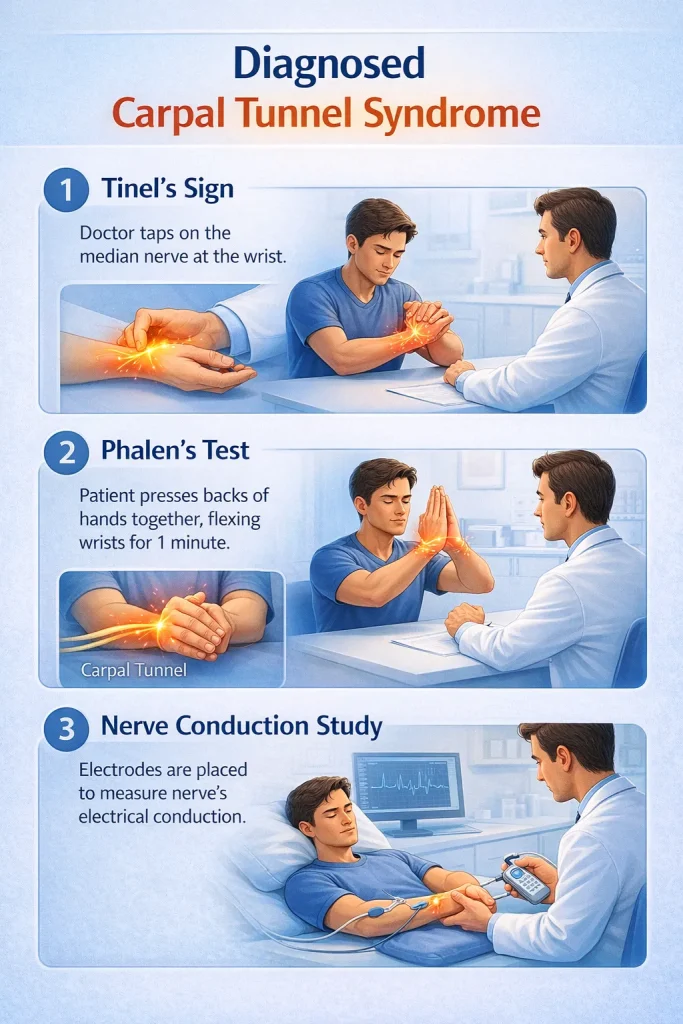
Clinical Examination and Tests
A doctor can often diagnose carpal tunnel syndrome from the history and physical examination alone. Key tests include:
- Tinel’s sign – The doctor taps the inside of the wrist over the median nerve. A tingling or electric shock feeling in the fingers confirms nerve irritation at that point.
- Phalen’s test (carpal tunnel test) – The patient holds their wrists bent for 60 seconds. Numbness and tingling that appear during this position are a positive test for CTS.
- Sensitivity testing – The doctor touches specific fingertips to check whether sensation is reduced or absent.
- Thumb muscle strength testing – Weakness or visible wasting of the muscles at the base of the thumb (thenar atrophy) indicates more advanced nerve damage.
Carpal Tunnel Syndrome Test: Diagnostic Investigations
When clinical examination is not sufficient, or to confirm severity, the following investigations are used:
- Nerve Conduction Study (NCS) – Measures the speed at which electrical signals travel through the median nerve. A slowed signal confirms median nerve compression and helps determine severity. This is the gold standard test for CTS diagnosis.
- Electromyogram (EMG) – Measures electrical activity in the muscles. Abnormal results indicate nerve or muscle damage from prolonged compression.
- Carpal Tunnel Syndrome MRI – Not routinely used but helpful when other causes of nerve compression need to be ruled out, or when an abnormal mass inside the tunnel is suspected.
- Ultrasound – Used to directly visualise the median nerve and check for swelling (swollen nerve in the hand) or compression at the wrist.
- X-rays – Ordered when wrist pain is present alongside CTS symptoms to exclude fractures, arthritis, or bony abnormalities affecting the tunnel.
Carpal Tunnel Syndrome Treatment: All Options Explained
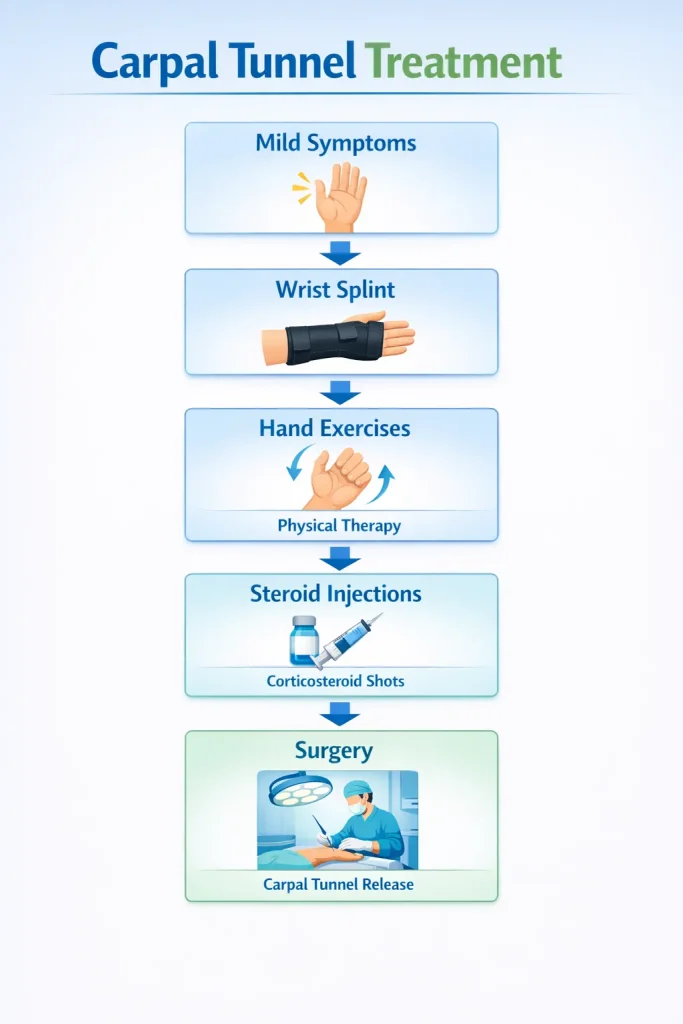
The good news is that carpal tunnel syndrome can be effectively treated – and in many cases, it can be cured entirely, especially when caught early. Treatment falls into two categories: nonsurgical and surgical.
Nonsurgical Carpal Tunnel Syndrome Treatment
Non-surgical management is the first approach for most patients with mild to moderate symptoms.
Wrist Splinting and Bracing
- A median nerve splint or carpal tunnel syndrome gloves keeps the wrist in a neutral (straight) position, reducing pressure on the median nerve
- Wearing a wrist brace at night is the single most effective home-based intervention for carpal tunnel syndrome
- Carpal tunnel syndrome gloves with wrist support are widely available and helpful during daytime activities that aggravate symptoms
- The goal of splinting is simple: to prevent the wrist from bending during activities or sleep, which directly reduces nerve pressure
Activity Modification
- Changing how you perform repetitive tasks – adjusting keyboard height, mouse position, grip angle – can significantly reduce symptoms
- Taking regular breaks from prolonged wrist use reduces cumulative pressure on the nerve
- How to avoid carpal tunnel syndrome: ergonomic adjustments at the workplace are one of the most effective preventive strategies
Medications for Carpal Tunnel Syndrome
- NSAIDs (non-steroidal anti-inflammatory drugs) such as ibuprofen help reduce pain and inflammation around the tendons
- Medicine for carpal tunnel syndrome also includes short-term oral corticosteroids in some cases to reduce synovial swelling
- Vitamin B6 and B12 supplementation is sometimes recommended as supportive therapy for nerve health, though it is not a definitive treatment
Nerve Gliding Exercises – Therapy for Carpal Tunnel Syndrome
Specific exercises help the median nerve move more freely inside the carpal tunnel, reducing mechanical compression. These are called nerve gliding or nerve mobilisation exercises and are part of formal physiotherapy for CTS.
Carpal tunnel syndrome exercises include:
- Tendon gliding exercises – moving the fingers through specific patterns to mobilise the tendons inside the tunnel
- Median nerve gliding – gentle wrist and finger movements that help the nerve slide freely
- Wrist stretching – gentle extension and flexion stretches to maintain joint mobility
A physiotherapist or hand therapist will guide you through the correct technique. These exercises can significantly slow progression and reduce symptoms in early-to-moderate CTS.
Steroid Injections
- A corticosteroid (cortisone) injection directly into the carpal tunnel is one of the most effective short-term treatments
- It reduces inflammation of the synovium around the flexor tendons, creating more space for the median nerve
- Relief is often significant but temporary – most patients experience benefit for weeks to a few months
- Injections are also used as a diagnostic tool: if the injection relieves symptoms, it confirms CTS as the diagnosis
- PRP (Platelet Rich Plasma) injections have shown some benefit in studies, but are not proven for long-term CTS management
Carpal Tunnel Syndrome Treatment at Home
For mild symptoms, several home strategies can help:
- Sleeping with a wrist splint in a neutral position to prevent nighttime wrist bending
- Icing the wrist for 10 to 15 minutes to reduce inflammation during flares
- Avoiding prolonged activities that require sustained gripping or wrist bending
- How to relieve nerve pain in the hand: gently shaking the hand and elevating it above heart level during painful episodes
- How to reduce carpal tunnel syndrome: breaking up computer or phone use into shorter sessions with regular hand stretches
- Carpal tunnel prevention: ergonomic mouse, keyboard pad, and proper desk height – these small changes make a significant difference over time
Surgical Treatment – Carpal Tunnel Release
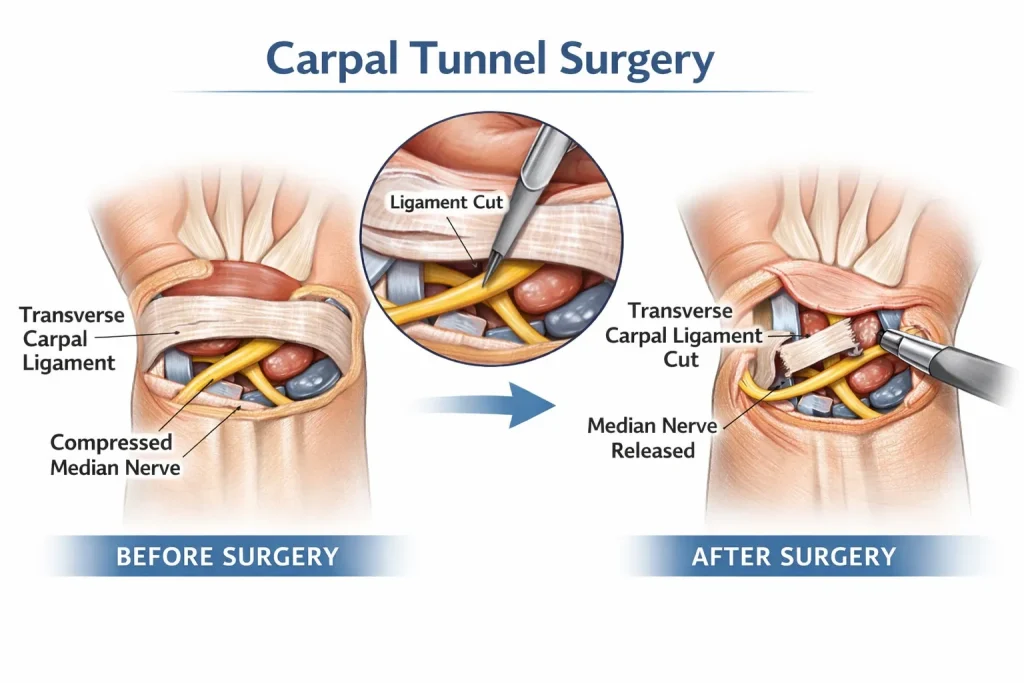
When nonsurgical treatment does not provide adequate relief or when nerve damage is progressing, carpal tunnel release surgery is recommended.
What is Carpal Tunnel Release?
Carpal tunnel decompression or carpal tunnel release is a surgical procedure that cuts the transverse carpal ligament (flexor retinaculum and carpal tunnel roof) to increase the size of the tunnel and permanently relieve pressure on the median nerve.
The CTS release procedure is one of the most commonly performed hand surgeries in the world – and when performed at the right time, it has an excellent success rate.
Two Surgical Techniques
Open Carpal Tunnel Release:
- A small incision is made in the palm
- The transverse carpal ligament is divided under direct vision
- The incision is closed, and the tunnel now has more space
- Simple, reliable, and widely available in India
Endoscopic Carpal Tunnel Release:
- One or two tiny skin incisions (portals) are made
- A small camera (endoscope) is inserted to view inside the wrist
- The ligament is cut using a specialised instrument passed through the portal
- Slightly faster recovery of hand strength in the early weeks
- Both techniques produce equivalent long-term outcomes
What to Expect After Carpal Tunnel Surgery
- Nighttime symptoms (numbness, tingling, hand pain while sleeping) typically improve within the first week after surgery
- Grip strength returns to normal in most patients within 2 to 3 months
- Numbness and tingling in the fingers gradually resolve over the first few months
- Complete recovery, including return of full sensation in severe cases, may take up to one year
- Patients wear a wrist splint for several weeks post-operatively
- Light activities – driving, self-care, light lifting – can usually resume within days to weeks
Can Carpal Tunnel Syndrome Be Cured?
Yes – carpal tunnel syndrome can absolutely be cured, particularly when caught early and treated appropriately. Here is a clear framework:
- Mild CTS – Often cured with splinting, nerve exercises, and activity modification alone
- Moderate CTS – Responds well to steroid injections combined with physiotherapy; surgery may be needed if symptoms recur
- Severe CTS with nerve damage – Surgery is the most reliable cure; however, very severe and long-standing cases may not recover full sensation even after surgery, though surgery is still essential to prevent further deterioration
How I cured my carpal tunnel – a question many patients search for – almost always involves one of three paths: dedicated splinting and exercise for mild cases, steroid injection for moderate cases, or timely carpal tunnel release surgery for advanced cases. The key message is: do not delay. The longer the median nerve compression continues, the harder it is to fully reverse the damage.
Bilateral CTS – where both hands are affected – is common and may require staged treatment of each hand separately.
Carpal Tunnel Syndrome in India: Who Is Most at Risk?
While CTS is a global condition, several factors make it particularly relevant in the Indian context:
- IT and software professionals spending 8 to 12 hours daily on a keyboard and mouse face a very high cumulative risk
- Homemakers performing repetitive kitchen tasks, grinding, and hand washing are frequently affected
- Women are significantly more likely to develop CTS than men – a relevant fact given that many Indian women combine manual household work with professional roles
- Pregnant women commonly report left-hand pain during pregnancy, left-hand thumb numbness, and sensation changes in the left hand – all consistent with gestational CTS
- Diabetic patients in India – a very large population – face a higher risk due to concurrent neuropathy
- Reason for numbness in left hand or right hand is one of the most searched health queries in India – and CTS is among the most common diagnoses behind this symptom
How to Prevent Carpal Tunnel Syndrome
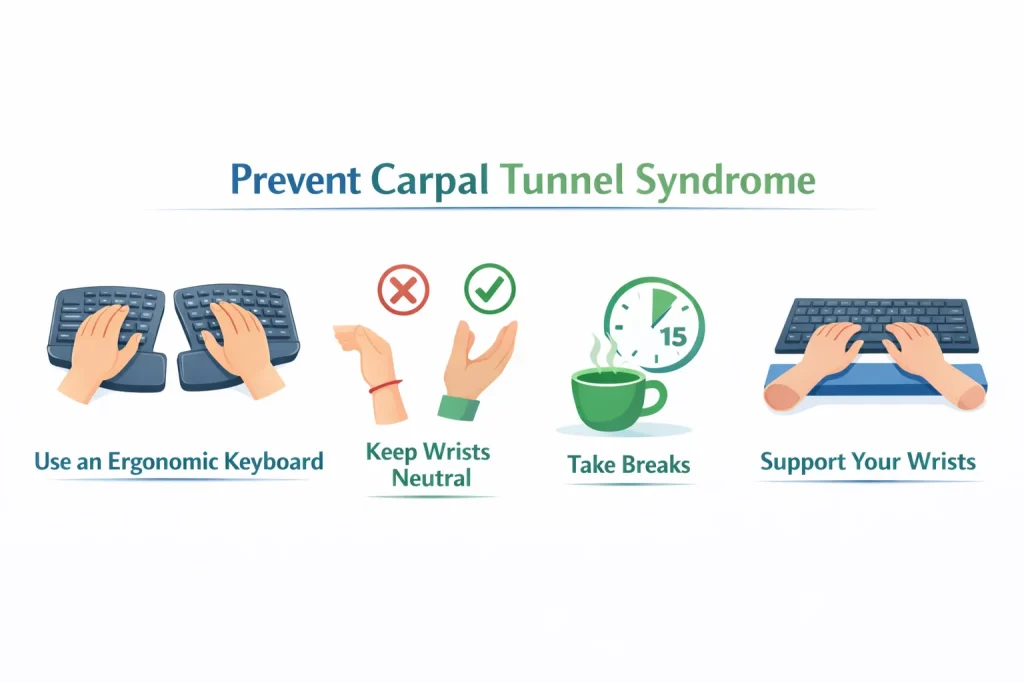
Prevention is far better than treatment. Here is what the evidence supports:
- Use ergonomic keyboards and mouse devices – these reduce wrist extension and cumulative nerve stress
- Keep wrists in a neutral position during all computer and phone use
- Take a 5-minute hand and wrist break every hour of sustained typing or gripping
- Avoid resting the wrist directly on hard surfaces during computer use
- Sleep with a neutral wrist – a simple wrist brace at night costs very little and prevents the nighttime bending that worsens CTS
- Manage underlying conditions – control diabetes, thyroid function, and rheumatoid arthritis proactively
- Carpal tunnel syndrome medical devices, including ergonomic wrist rests and specialised gloves, are widely available online in India
Conclusion: Key Takeaways on Carpal Tunnel Syndrome
Carpal tunnel syndrome is not something to dismiss as “just hand numbness.” It is a progressive nerve compression condition that can permanently damage your hand function if left untreated. Here is what you need to remember:
- CTS is caused by compression of the median nerve inside the carpal tunnel at the wrist
- The primary symptoms are numbness, tingling, burning sensation in the hand fingers, wrist nerve pain, hand weakness, and nighttime waking with numb hands
- The most common causes are repetitive hand use, prolonged awkward wrist position, pregnancy, and underlying health conditions like diabetes and thyroid imbalance
- Diagnosis is confirmed with clinical tests (Tinel’s sign, Phalen’s test) and nerve conduction studies
- Treatment ranges from wrist splinting, nerve gliding exercises, and steroid injections for mild-moderate cases to carpal tunnel release surgery for severe or non-responsive cases
- Can carpal tunnel be cured? Yes – especially with early diagnosis and the right treatment approach
- Prevention through ergonomic adjustments and wrist care is the most sustainable strategy
If you are experiencing persistent numbness and tingling in your hands, wrist pain, or weakness in your hand that is not improving, do not wait. An early orthopaedic evaluation for carpal tunnel syndrome can protect your nerve function and restore your quality of life.
FAQs
What is carpal tunnel syndrome?
Carpal tunnel syndrome is a condition where the median nerve gets compressed in the wrist, causing numbness, tingling, pain, and weakness in the hand and fingers.
What are the first signs of carpal tunnel syndrome?
Early signs include tingling, numbness in fingers, burning sensation, and weakness in grip, especially during activities like typing or at night.
Why are symptoms worse at night?
Symptoms are worse at night because the wrist bends during sleep, increasing pressure inside the carpal tunnel and reducing blood flow to the median nerve.
Can carpal tunnel syndrome go away on its own?
Mild cases may improve with rest and lifestyle changes, but untreated CTS can worsen over time and may lead to permanent nerve damage.
What causes carpal tunnel syndrome?
Common causes include repetitive hand movements, poor wrist posture, pregnancy, diabetes, and inflammation of tendons inside the wrist.
How is carpal tunnel syndrome diagnosed?
Doctors diagnose CTS using physical tests like Tinel’s and Phalen’s tests, along with nerve conduction studies to confirm severity.
What is the best treatment for carpal tunnel syndrome?
Treatment depends on severity and includes wrist splints, exercises, medications, steroid injections, and surgery for severe cases.
Can carpal tunnel syndrome be cured permanently?
Yes, especially when treated early. Surgery provides a permanent solution in severe cases by relieving nerve pressure.
What exercises help carpal tunnel syndrome?
Nerve gliding exercises, tendon gliding, and wrist stretches help reduce pressure and improve nerve movement inside the carpal tunnel.
How can I prevent carpal tunnel syndrome?
Maintain proper wrist posture, use ergonomic tools, take frequent breaks, and avoid prolonged repetitive hand movements.