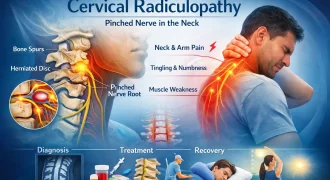
Most people have heard the word orthopedic. You may have seen it on a hospital signboard, a clinic near your home, or your doctor’s prescription pad. But when you actually need help – when your knee hurts, your child has a limb deformity, or you have broken a bone – the questions become very real: What is an orthopaedic doctor? What does a bone doctor do? And is this the right specialist for my problem?
This guide answers all of those questions clearly and completely. Whether you are searching for a bone doctor near you, trying to understand what orthopedic care means, or simply wanting to know what a bone specialist is called, you are in the right place. We have written this for patients across India who deserve clear, honest, and clinically sound information before stepping into a specialist’s clinic.
By the end of this article, you will know exactly what orthopaedics is, what an orthopedic surgeon does, what their training looks like, when you should see one, and what to expect from orthopaedic care.
Table of Contents
What is Orthopaedics? The Meaning Explained Simply
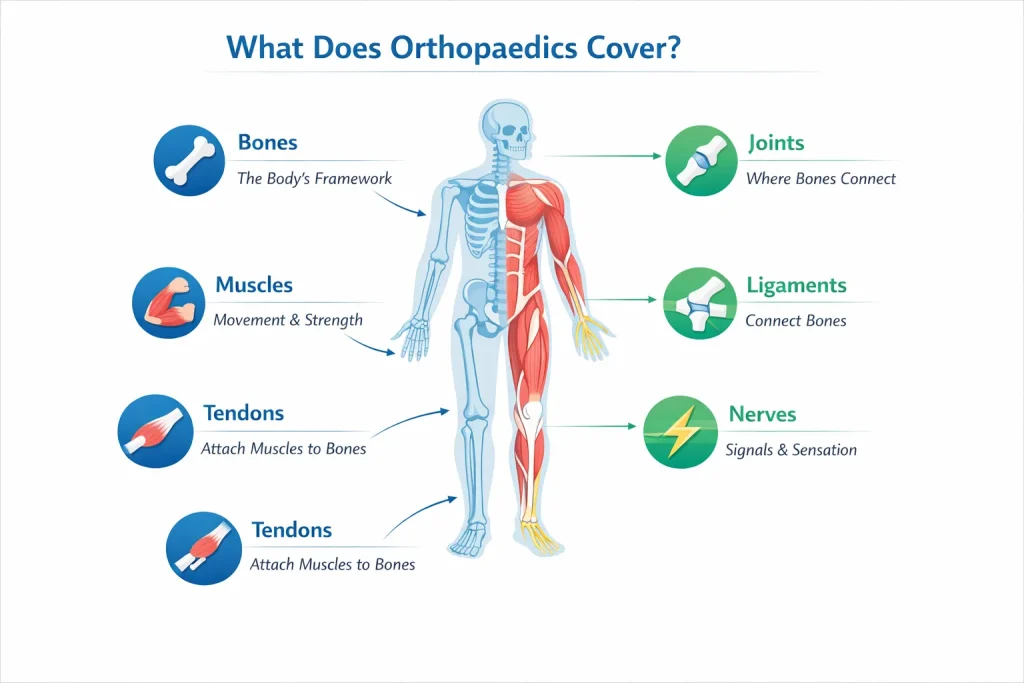
Orthopaedics – also spelled orthopedics – is the branch of medicine that focuses on the diagnosis, treatment, prevention, and rehabilitation of injuries and diseases affecting the musculoskeletal system.
The musculoskeletal system includes:
- Bones – the structural framework of your entire body
- Joints – where two bones meet and allow movement
- Ligaments – tough bands that connect bones
- Tendons – tissue that connects muscles to bones
- Muscles – the engines that power all your movement
- Nerves – the communication pathways that control sensation and movement
In simple terms, if the problem involves your bones, joints, muscles, or the tissues around them, orthopaedics is the right specialty.
Orthopaedic Meaning in Hindi and Other Indian Languages
For patients more comfortable in Hindi, the orthopaedic doctor’s meaning in Hindi is “haddi aur jodon ka visheshagya” – literally, a specialist in bones and joints. The term “haddi ka doctor in English” translates to orthopaedist or orthopaedic surgeon. Asthi rog visheshagya in English also means bone disease specialist, which is another way of describing an orthopaedic doctor. In Telugu, orthopaedics is referred to as orthopedic, meaning in Telugu – a bone and joint specialist. The word “ortho” comes from the Greek word “orthos,” meaning straight or correct. “Paedics” comes from the Greek “paideia,” meaning the rearing of children – reflecting the specialty’s origins in treating childhood deformities. So the full ortho meaning in medical terms is: the art of correcting deformities of bones and joints.
Orthopaedic vs Orthopedic – Is There a Difference?
One of the most searched questions is orthopaedic vs orthopedic – which spelling is correct? The honest answer is both are correct. “Orthopaedic” is the traditional British and international spelling used in medical education worldwide, including in India. “Orthopedic” is the simplified American spelling. Both words refer to the same medical specialty. In India, you will find both spellings used on hospital signboards, medical degrees, and doctor credentials – they are interchangeable.
What is a Bone Doctor Called? All the Terms Explained
Patients often search for different names for the same specialist. Here is a clear breakdown:
- Orthopaedic surgeon – the most formal and widely used title for a doctor who specializes in bones, joints, and the musculoskeletal system
- Orthopaedist or orthopedist – a doctor who specializes in orthopaedics, whether or not they perform surgery
- Orthopedician – a term sometimes used in India to describe a bone and joint specialist
- Bone doctor – a common informal term for an orthopaedic surgeon
- Bone specialist – another informal term referring to the same doctor
- Joint doctor – used when the focus is on joint problems like arthritis or joint replacement
- Skeleton doctor – an informal term sometimes used by patients
- Haddi ka doctor – the Hindi way of saying bone doctor, equivalent to orthopaedist in English
- Haddiyo ka doctor in English – orthopaedic surgeon
- Haddi ke doctor in English – bone specialist or orthopaedic doctor
- A muscle doctor is called a myologist in strict terms, but in clinical practice, orthopaedic surgeons also treat muscle injuries alongside physiotherapists
- A doctor of bones and muscles is called an orthopaedic surgeon in most clinical contexts
- Knee doctor called – an orthopaedic surgeon, often with subspecialty training in sports medicine or joint replacement
- Leg doctor specialist name – orthopaedic surgeon, sometimes a trauma specialist
- Backbone specialist – a spine surgeon, who is a subspecialty within orthopaedics
So, to answer the most searched question directly: a bone doctor is called an orthopaedic surgeon or orthopaedist.
What Does an Orthopaedic Surgeon Do?
Many patients ask: What does an orthopedic doctor do, exactly? The role covers four key areas of care.
1. Diagnosis
An orthopaedic doctor assesses your symptoms through clinical examination and imaging investigations. They will review your X-rays, MRI scans, or CT scans and make a precise diagnosis of your bone, joint, or soft tissue problem. Orthopedic diagnosis is the foundation of all treatment decisions.
2. Treatment
Treatment by an orthopaedic surgeon is not always surgical. Treatment options include:
- Medications such as pain relievers and anti-inflammatories
- Injections – including steroid or PRP (platelet-rich plasma) injections for joints
- Casting and splinting for fractures
- Bracing and orthopaedic devices (splints, braces, orthopaedic supports)
- Surgery – when non-surgical options are insufficient
- Referral to physiotherapy and rehabilitation
3. Rehabilitation
After treating your injury or condition, an orthopaedic surgeon coordinates your recovery. This includes prescribing physiotherapy, mobility aids, and exercise programs to restore function, strength, and range of motion.
4. Prevention
Orthopaedic doctors also work on preventing injury progression. They advise patients on lifestyle changes, posture, activity modifications, and surgical interventions that can stop a condition from worsening.
Orthopaedic Procedures: What Surgeries Do They Perform?
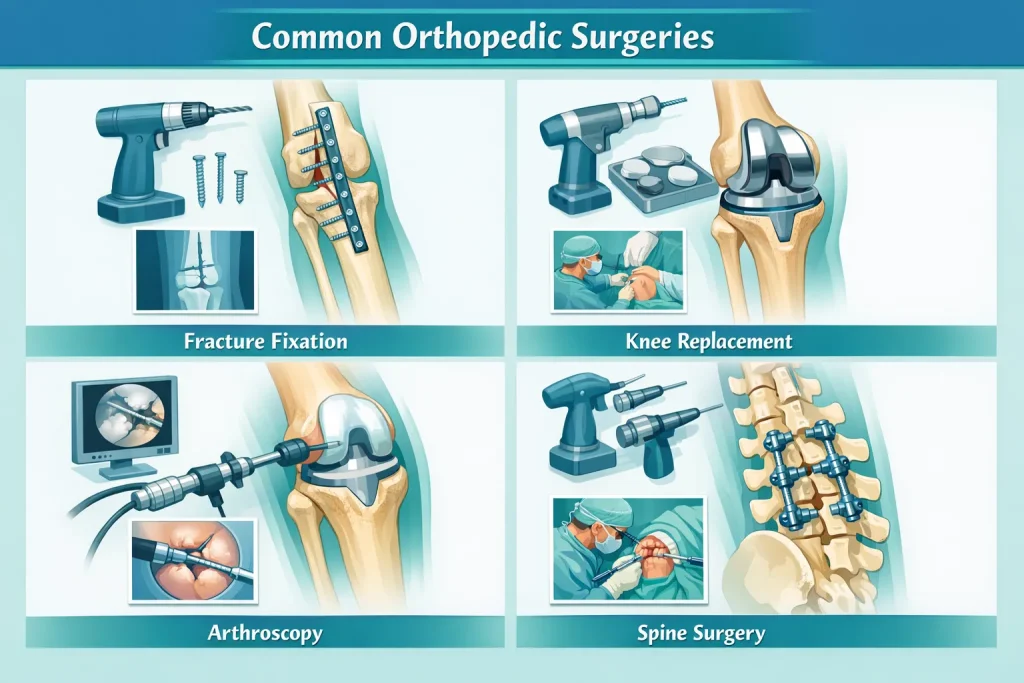
Orthopaedic operation types vary widely depending on the problem. Common ortho surgery names and procedures include:
- Fracture fixation – using rods, plates, screws, and nails to stabilize broken bones
- Joint replacement surgery – total knee replacement, total hip replacement
- Arthroscopy – minimally invasive camera-assisted surgery inside joints
- Spine surgery – for disc problems, deformities, and spinal fractures
- Ligament reconstruction – such as ACL repair after sports injuries
- Deformity correction surgery – correcting congenital or acquired limb deformities
- Bone tumor surgery – removal of benign and malignant bone tumors
- Ortho plating surgery – fixing fractures with metal plates and screws
The Orthopaedic Care Team
An orthopaedic surgeon does not work alone. Orthopaedic care involves a team of trained professionals working together around you as a patient:
- The orthopaedic surgeon – leads the diagnosis and surgical treatment
- Physiotherapists – guide rehabilitation and exercise-based recovery
- Nurse practitioners and registered nurses – manage wound care, post-operative monitoring, and patient education
- Physician assistants – support the surgeon in clinics and operating theatres
- Radiologists – interpret your X-rays, MRI, and CT scans
- Anesthesiologists – manage your safety during surgery
- Pain management specialists – help control post-surgical or chronic pain
- Orthopaedic technicians – assist in the application of casts, splints, and traction
When you attend an ortho care clinic or orthopaedic department at a hospital, you are interacting with this entire team – not just the surgeon. Each member plays an important role in your recovery.
Orthopaedic Subspecialties: Not All Bone Doctors Are the Same
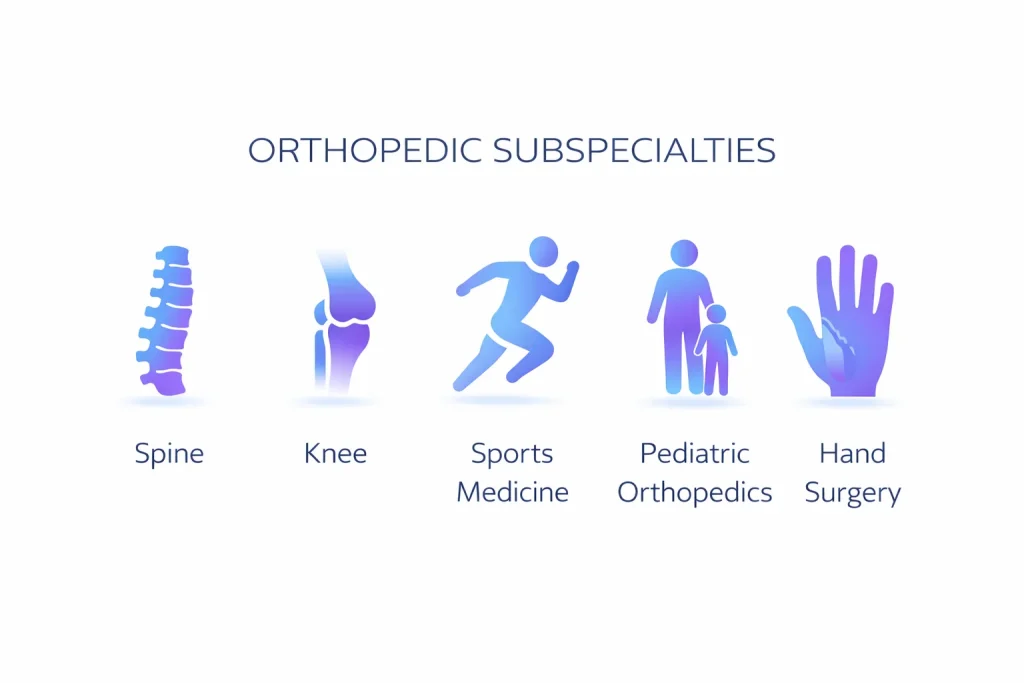
Orthopaedics is a broad field. Many orthopaedic surgeons develop deep expertise in a specific area. The main orthopaedic subspecialties are:
- Spine surgery – for back pain, disc herniation, scoliosis, spinal deformities, and spinal fractures. The backbone specialist in orthopaedics is a spine surgeon.
- Knee and joint replacement – specializing in total knee and hip replacement surgeries for arthritis and joint damage
- Sports medicine – treating sports injuries such as ligament tears, cartilage damage, and muscle injuries, usually with arthroscopic (minimally invasive) techniques
- Foot and ankle surgery – managing conditions from flat feet and bunions to complex ankle fractures
- Hand and wrist surgery – covering carpal tunnel, tendon repairs, and fractures of the hand
- Shoulder and elbow surgery – for rotator cuff tears, shoulder dislocations, and elbow conditions
- Paediatric orthopaedic surgery – treating children with congenital deformities, growth plate injuries, and developmental conditions like clubfoot
- Orthopaedic trauma – managing complex fractures and polytrauma patients, typically in emergency settings
- Orthopaedic oncology – diagnosing and treating bone and soft tissue tumors
It is important to note that some orthopaedic surgeons specialize in multiple areas. For example, a sports medicine surgeon, a shoulder surgeon, and a hand and wrist surgeon may all treat elbow injuries. When you are looking for the right ortho specialist, ask specifically about their subspecialty experience in your type of problem.
How to Become an Orthopaedic Surgeon in India
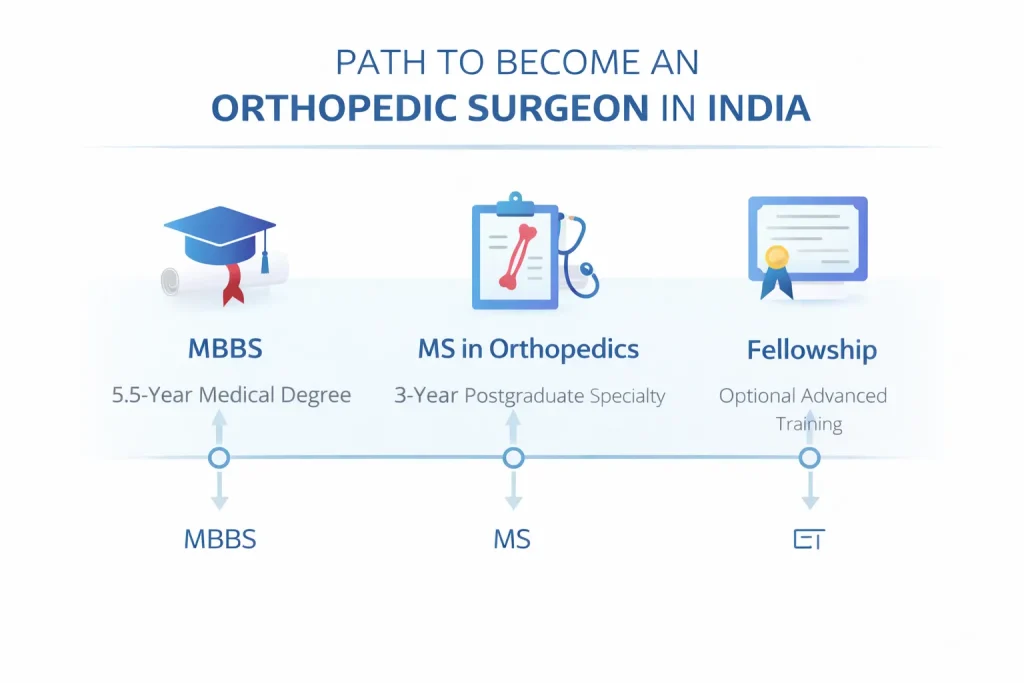
One of the commonly searched topics – especially among medical students – is how to become an orthopaedic surgeon. Here is the training pathway in India:
- MBBS degree – 5.5 years of undergraduate medical training, the foundation of all medical careers
- MS (Master of Surgery) in Orthopaedics – 3 years of postgraduate surgical training, the main orthopaedic degree in India
- DNB (Diplomate of National Board) in Orthopaedics – an alternative postgraduate certification equivalent to MS
- MCh or Fellowship – additional superspecialty training for subspecialties like spine surgery, paediatric orthopaedics, or joint replacement
- Senior residency and clinical practice – further exposure before independent practice
Total training from MBBS to independent orthopaedic practice typically takes 10 to 13 years. In international settings, an orthopaedic surgeon may train for up to 14 years, including fellowship programs.
Father of Orthopaedics
A question that appears in many searches: Who is the father of orthopaedics? Nicolas Andry, a French physician, is widely credited as the father of orthopaedics. In 1741, he coined the word “orthopaedics” from the Greek roots orthos (straight) and paideia (child rearing), and used the now-famous image of a bent tree being corrected with a stake – still the symbol of the specialty today.
When Should You See an Orthopaedic Doctor?
This is the most practically important section for patients. Knowing when to see an ortho doctor can be the difference between a good outcome and a long delay in treatment.
Go to Emergency Care Immediately If You Have:
- A visible bone deformity or bone protruding through the skin (open fracture)
- Severe pain after an accident or fall, with inability to move a limb
- Multiple injuries after a road accident
- Severe swelling, intense pain, and numbness in a limb
- Loss of sensation or movement in an arm or leg
See an Orthopaedic Surgeon (Non-Emergency) If You Have:
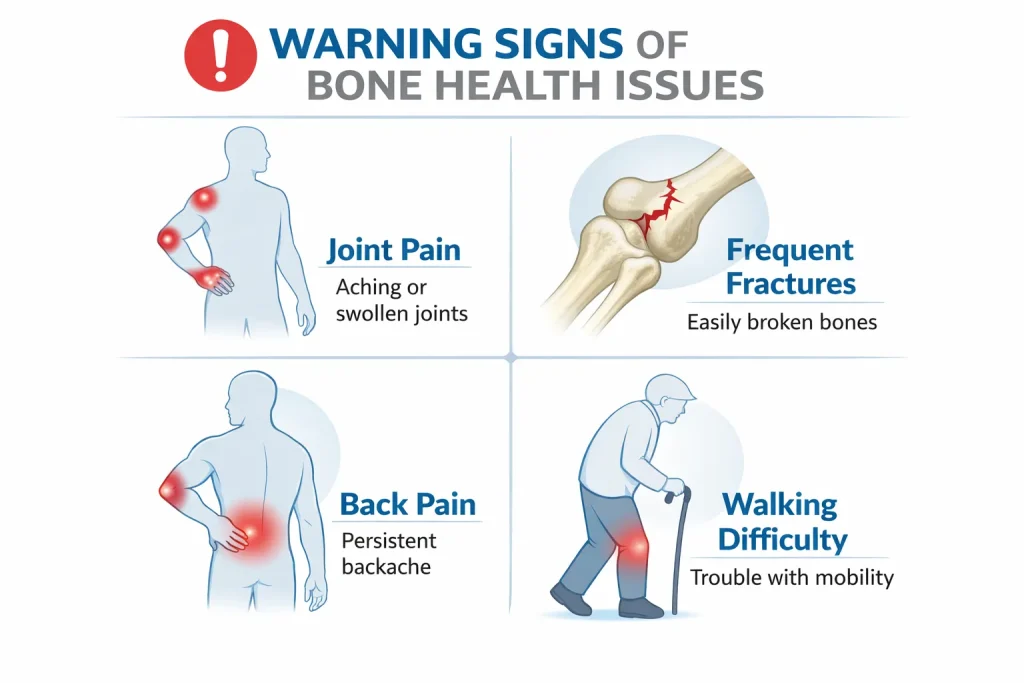
- Joint pain that has lasted more than 3 months
- Swelling, stiffness, or limited movement in any joint
- Back pain or neck pain that is not improving with rest
- A limb deformity – congenital or acquired
- Difficulty walking, climbing stairs, or standing for prolonged periods
- Recurring sports injuries that are not healing properly
- A bone fracture that needs evaluation or follow-up
- Been told by another doctor that you need bone or joint surgery
- Muscle pain, tendon problems, or ligament injuries that are not resolving
Seeing an orthopaedic surgeon does not automatically mean you will need surgery. Orthopaedic doctors are trained to evaluate all treatment options – medication, physiotherapy, bracing, injections, and surgery – and recommend the approach that is best for your specific condition and life situation.
Orthopedic vs General Surgery: What Is the Difference?
Patients sometimes ask whether they should see a general surgeon or an orthopaedic surgeon for a bone or joint problem. The answer is clear: for any musculoskeletal condition – bones, joints, muscles, tendons, ligaments – an orthopaedic surgeon is the right specialist. General surgeons handle abdominal, digestive, and soft tissue procedures but do not specialize in musculoskeletal care. Define surgeon broadly: any doctor who performs operative procedures. But define orthopaedic surgeon more specifically: a surgeon trained exclusively in the musculoskeletal system, with great technical skill in fracture fixation, joint reconstruction, and deformity correction.
What to Expect at Your First Orthopedic Appointment
Many patients feel anxious before their first ortho appointment. Here is what typically happens:
- Medical history – The doctor will ask about your symptoms, when they started, what makes them worse or better, your past medical history, medications, and allergies
- Physical examination – They will examine the affected limb or joint, check your range of motion, strength, and stability
- Imaging review – X-rays are most commonly ordered first. MRI or CT scans may follow if more detail is needed
- Diagnosis and discussion – Your doctor will explain what they have found and discuss your treatment options clearly
- Treatment plan – This may include a prescription, physiotherapy referral, a brace, an injection, or further investigation before any surgical decision is made
An orthopaedic consultation is not just a step toward surgery. It is a thorough evaluation to find the safest, most effective solution for your problem.
Orthopaedic Care in India: What Patients Should Know
Orthopaedic care in India has advanced significantly over the past two decades. Major cities – including Delhi, Mumbai, Chennai, Bengaluru, Hyderabad, Kolkata, and Coimbatore – have world-class orthopaedic hospitals and surgeons. But quality orthopaedic care is also available in smaller cities and tier-2 towns across the country.
When looking for an orthopaedic doctor in your city – whether you are searching for the best orthopaedic doctor in Dehradun, Nashik, Jalandhar, Ranchi, Patna, Indore, Nellore, or Visakhapatnam – here are some key things to look for:
- The surgeon’s postgraduate degree: MS (Orthopaedics) or DNB (Orthopaedics) is the primary credential
- Fellowship or superspecialty training in the relevant area (spine, joint replacement, trauma, etc.)
- Hospital affiliation and the facilities available for surgery and post-operative care
- The surgeon’s experience specifically with your type of condition or procedure
- Clear communication – a good orthopaedic doctor explains your diagnosis and options in language you can understand
Orthopaedic services in India range from basic fracture management and casting at district hospitals to highly complex deformity correction, robotic joint replacement, and revision surgeries at specialty centres.
Consult Dr. Divya Ahuja – Best Orthopaedic & Deformity Correction Specialist in Mumbai
If you are searching for the best orthopaedic doctor for bone, joint, or deformity-related problems, Dr. Divya Ahuja is a leading name you can trust. Known for his expertise in deformity correction, fracture treatment, joint conditions, and advanced orthopaedic procedures, Dr. Ahuja offers personalized care focused on fast recovery and long-term results. He uses modern surgical techniques along with effective non-surgical treatments to ensure the best outcomes for every patient.
With years of experience and practice across top hospitals in Mumbai, Navi Mumbai, and Thane, Dr. Ahuja has successfully treated patients with complex orthopaedic conditions, helping them regain mobility and live pain-free lives. If you are dealing with persistent joint pain, bone deformity, injury, or have been advised surgery, booking a consultation with Dr. Divya Ahuja can be your first step toward expert diagnosis and the right treatment plan.
Orthopaedic Meaning in Other Languages
For readers searching across different languages:
- Orthopaedic meaning in Hindi: हड्डी और जोड़ों का इलाज करने वाला डॉक्टर
- Orthopaedic meaning in Telugu: ఎముకలు మరియు కీళ్ల వైద్యుడు
- Orthopaedic in Hindi: अस्थि रोग विशेषज्ञ
- Orthopaedician or orthopedist: Same meaning – a bone and joint specialist
- Haddi wala doctor in English: Orthopaedic surgeon
- Haddi doctor meaning in English: Bone specialist or orthopaedic doctor
- Ortho full form: Orthopaedics – from Greek “orthos” (straight) and “paedeia” (child)
- Ortho meaning in medical: Straight, correct, or relating to the musculoskeletal system
Conclusion: Key Takeaways
Understanding what an orthopaedic surgeon is – and what they actually do – helps you make better decisions about your health. Here is a summary of the most important points from this guide:
- Orthopaedics is the medical specialty focused on bones, joints, muscles, tendons, ligaments, and nerves – the entire musculoskeletal system
- An orthopaedic surgeon is also called a bone doctor, bone specialist, orthopaedist, or haddi ka doctor in Hindi
- Orthopaedic and orthopaedic refer to the same specialty – the only difference is British vs American spelling
- Orthopaedic doctors diagnose, treat, rehabilitate, and help prevent musculoskeletal conditions – not all patients need surgery
- There are many orthopaedic subspecialties – spine, joints, sports medicine, paediatric orthopaedics, trauma, and more
- Training to become an orthopaedic surgeon in India takes a minimum of 10 to 13 years
- You should see an orthopaedic doctor if you have persistent joint pain, a fracture, a deformity, a sports injury, or any musculoskeletal problem affecting your daily life
- Quality orthopaedic care is available across India – from major metropolitan hospitals to specialist clinics in smaller cities
If you have a bone or joint problem that is affecting your movement, daily activity, or quality of life, do not delay. An early orthopaedic evaluation gives you the best chance of a full and faster recovery.
FAQs
What is an orthopaedic doctor?
An orthopaedic doctor is a medical specialist who diagnoses and treats conditions related to bones, joints, muscles, ligaments, and tendons, helping patients restore movement, reduce pain, and improve overall physical function.
What is another name for a bone doctor?
A bone doctor is commonly called an orthopaedic surgeon or orthopaedist. These terms refer to specialists trained to manage musculoskeletal problems, including fractures, joint issues, sports injuries, and deformities affecting movement and mobility.
When should I visit an orthopaedic doctor?
You should visit an orthopaedic doctor if you experience persistent joint pain, swelling, fractures, back pain, stiffness, or difficulty in movement that affects your daily activities or does not improve with rest or basic treatment.
Do orthopaedic doctors always recommend surgery?
No, orthopaedic doctors do not always recommend surgery. Many conditions are treated with medications, physiotherapy, lifestyle changes, braces, or injections, and surgery is only advised when non-surgical treatments are ineffective or insufficient.
What conditions are treated by orthopaedic doctors?
Orthopaedic doctors treat a wide range of conditions, including arthritis, fractures, ligament injuries, back pain, sports injuries, joint problems, bone deformities, and muscle or tendon issues affecting movement and physical function.
What happens during the first orthopaedic consultation?
During your first orthopaedic visit, the doctor reviews your medical history, examines the affected area, may recommend imaging tests like X-rays or MRI, and then explains your condition along with suitable treatment options.
What is the difference between orthopaedic and Orthopedic?
There is no difference between orthopaedic and orthopedic. Both terms refer to the same medical specialty, with “orthopaedic” being the British spelling and “orthopedic” the American spelling, commonly used interchangeably worldwide.
How long does it take to become an orthopaedic surgeon in India?
Becoming an orthopaedic surgeon in India typically takes around 10 to 13 years, including MBBS, postgraduate MS or DNB in orthopaedics, and optional fellowship training for specialization in areas like spine or joint replacement.
What are common orthopaedic surgeries?
Common orthopaedic surgeries include fracture fixation, joint replacement like knee or hip surgery, arthroscopy for minimally invasive treatment, ligament reconstruction, and spine surgeries to correct disc issues or structural deformities.
Can physiotherapy help avoid orthopaedic surgery?
Yes, physiotherapy can often help avoid surgery by strengthening muscles, improving joint mobility, reducing pain, and restoring function, especially in early or moderate conditions when combined with proper medical guidance and lifestyle changes.