
Table of Contents
Understanding Joints in the Human Body
Key Takeaways:
- The human body contains approximately 360 joints in total, with the majority located in the hands and feet.
- Joints are classified into three structural types: fibrous, cartilaginous, and synovial, each serving a different movement purpose.
- Synovial joints are the most common joint type and allow the widest range of free movement in the body.
- The three core functions of joints are enabling movement, connecting bones, and providing stability throughout the skeletal system.
- Ball and socket joints like the shoulder and hip offer the greatest range of motion of any joint type.
- Cartilage reduces bone friction while synovial fluid lubricates joints, together allowing smooth and pain-free daily movement.
- Immovable joints called sutures protect the brain by fusing skull bones together with rigid fibrous tissue connections.
- Ligaments are not the same as joints; they are fibrous bands that hold bones together at a joint.
- Production of blood cells is NOT a function of joints; that process occurs inside the bone marrow instead.
- Damaged joints from arthritis, injury, or deformity affect far more than pain, directly reducing mobility, confidence, and independence.
Every movement you make, whether it is walking, bending, sitting, or even holding a mobile phone, depends on one crucial part of your body: joints. Joints are the silent workers of the skeletal system. You rarely notice them until pain, stiffness, or injury interrupts daily life. Yet, joints are what allow bones to meet, stay connected, and move smoothly together.
In simple terms, joints are places in the body where two or more bones meet. Without joints, your body would be stiff like a statue. With joints, your body becomes flexible, balanced, and capable of controlled motion. Some joints move freely, like the shoulder. Others move a little, like the spine. Some do not move at all, like the joints in the skull.
This blog explains what joints are, how many joints are in the human body, the types of joints in the body, their structure, and their functions, using simple language and real-life examples. It also answers common questions such as what the joints do, which of the following is not a function of joints, and what connects the bones in cartilaginous joints.
Written from an orthopedic perspective and aligned with patient education at deformity.co.in, this guide is useful for students, patients, parents, and anyone curious about human joint anatomy and how the skeletal system works.
What is a Joint in the Human Body?

A joint in the human body is a location where two or more bones connect. Another name for a joint is articulation. This term is often used in medical science and anatomy books.
In joint science, a joint is defined as a structural connection that provides:
- Support
- Stability
- Movement
So, when someone asks what a body joint is, the simplest answer is:
A joint is the meeting point of bones that allows movement or support.
What are the Joints in the Body Made Of? (Joint Structure)
To understand joints fully, you must know their structure. Joint structure includes several parts working together like parts of a well-oiled machine.
Main Parts of a Joint
- Bones: The hard structures that form the skeleton
- Cartilage: Smooth tissue that reduces friction
- Ligaments: Strong bands connecting bone to bone
- Tendons: Tissues connecting muscle to bone
- Synovial fluid: A lubricating fluid in movable joints
- Nerves and blood vessels: Provide sensation and nourishment
Think of a joint like a door hinge. The door and wall are bones. The hinge is the joint. Oil in the hinge is like synovial fluid.
How Many Joints Are in the Human Body?
This is one of the most searched questions.
Total number of joints in the human body: approximately 360
This count includes:
- Movable joints
- Slightly movable joints
- Immovable joints
So if you are asked how many joints are in the body or the total no of joints in the human body, the correct answer is about 360 joints.
360 Joints in Human Body: Region-Wise Breakdown
Many people search for 360 joints in the human body list. While listing all 360 individually is not practical, here is a clear region-wise breakdown to help you understand where they are distributed.
| Body Region | Approximate Number of Joints |
| Skull (cranium) | 22 suture joints |
| Spine (vertebral column) | 25+ joints |
| Rib cage and sternum | 24+ joints |
| Shoulder and arm | 6 joints (both sides) |
| Elbow and forearm | 6 joints (both sides) |
| Wrist and hand | 54+ joints (both hands) |
| Hip joints | 2 joints |
| Knee and leg | 6 joints (both sides) |
| Ankle and foot | 52+ joints (both feet) |
| Pelvis | 3 joints |
Key takeaway: Most of the 360 joints are found in the hands and feet. These small joints allow fine movement and precise grip.
This is why hand and foot conditions – like arthritis or deformity – affect daily life so significantly. Early orthopedic care can make a real difference.
Functions of Joints in the Human Body
What do the Joints Do?
The functions of joints are simple but essential:
- Allow movement
- Hold bones together
- Provide stability
- Support body weight
- Enable posture and balance
What is the Purpose of Joints?
The main purpose of joints is to allow controlled movement while keeping bones connected.
Which of the Following is NOT a Function of Joints?
This question is common in exams.
Functions of joints include:
- Movement
- Support
- Stability
NOT a function of joints:
- Production of blood cells
(This happens in bone marrow, not joints.)
10 Functions of Joints in the Human Body
Many students and medical aspirants search for 10 functions of joints. Here is a complete and exam-ready list:
- Enable voluntary movement – Joints allow your arms, legs, and fingers to move on command
- Connect bones – They link skeletal bones together to form a complete skeleton
- Provide mechanical support – Joints bear the load of body weight during standing and walking
- Allow flexible posture – The spine joints allow you to bend forward, backward, and sideways
- Absorb shock – Cartilage in joints absorbs impact during running or jumping
- Protect internal organs – Rib joints help the chest expand and contract to protect the lungs and heart
- Enable fine motor skills – Small joints in the fingers allow writing, typing, and gripping
- Facilitate speech and chewing – The jaw joint (TMJ) enables eating and talking
- Support breathing – Costovertebral joints connect the ribs to the spine and assist in breathing
- Maintain balance and coordination – Ankle and knee joints play a key role in body balance
These 10 functions explain why joints are irreplaceable in everyday life.
3 Main Functions of Joints (Simple Answer for Students)
If an exam asks: What are the 3 main functions of joints? or What are the three main functions of joints? – here is the precise answer:
- Movement – Joints allow bones to move relative to each other
- Support – Joints hold the skeleton together as a working unit
- Stability – Joints keep bones aligned and prevent dislocation during movement
These three functions form the foundation of everything joints do. All other functions are extensions of these three.
Why Are Joints Important in Our Body?
Many people ask: Why are joints important? or Why do we need joints in our body?
Here is a simple, honest answer:
Without joints, you cannot move. Without movement, every daily activity stops.
Consider these real examples:
- Walking to the kitchen requires 6 major joints to work – hip, knee, and ankle on each side
- Picking up a glass of water requires wrist, elbow, and shoulder joints to coordinate
- Breathing depends on the small joints that connect your ribs to your spine
Beyond movement, joints are important because:
- They protect bones from grinding against each other
- They allow the body to grow and change shape over time
- They act as shock absorbers during physical activity
- They enable work, exercise, and independence
When joints become damaged through injury, arthritis, or deformity, the impact goes far beyond pain. It affects confidence, mobility, and quality of life. This is why early joint care and orthopedic evaluation matter deeply.
Function Classification of Joints
Joints are classified based on movement. This is called functional classification of joints.

1. Synarthrosis (Immovable Joints)
- No movement
- Provide strength and protection
Example: Skull joints
Immovable joint meaning in Hindi: अचल जोड़
2. Amphiarthrosis (Slightly Movable Joints)
If you are searching for what amphiarthrosis joints are, here is a simple explanation.
- Limited movement
- Provide stability with slight flexibility
Examples: Joints between vertebrae, Pubic symphysis
3. Diarthrosis (Freely Movable Joints)
- Wide range of movement
- Most joints in the body are diarthrosis joints
Examples: Knee, shoulder, elbow
Question – Most Joints in the Body Are of Which Type?
Answer – Most joints in the body are synovial joints, which fall under diarthrosis.
Movable, Slightly Movable, and Immovable Joints: A Complete Comparison
This is one of the most commonly tested topics in school and competitive exams. Here is a clear comparison.
| Feature | Movable Joints | Slightly Movable Joints | Immovable Joints |
| Medical name | Diarthrosis | Amphiarthrosis | Synarthrosis |
| Range of motion | Full and free | Limited | None |
| Examples | Knee, shoulder, elbow, hip | Vertebrae, pubic symphysis | Skull sutures |
| Contains synovial fluid? | Yes | No | No |
| Main purpose | Movement | Stability with slight flexibility | Protection and strength |
Immovable Joints in the Human Body
The immovable joints are found mainly in the skull. The bones of the skull are fused together by fibrous tissue called sutures. These joints provide rigid protection for the brain.
Examples of immovable joints:
- Coronal suture (frontal and parietal bones)
- Sagittal suture (between parietal bones)
- Lambdoid suture (parietal and occipital bones)
Which joints are immovable? → All skull sutures and the joint between the teeth socket and jawbone (gomphosis) are immovable.
Slightly Movable Joints Examples in Humans
Slightly movable joints (amphiarthrosis) include:
- Intervertebral joints – between the vertebrae of the spine; allow small bending and twisting movements
- Pubic symphysis – connects the two pubic bones; stretches slightly during childbirth
- Sacroiliac joint – connects the sacrum to the pelvis
These joints strike a balance: they offer enough movement for function, but enough rigidity for structural support.
Most Joints in the Body Are Which Type?
Most joints in the body are synovial joints, which fall under diarthrosis.
Structural Classification: Types of Joints in the Human Body
This is also called the types of joints in the skeletal system.

1. Fibrous Joints
- Bones connected by fibrous tissue
- Little or no movement
Examples: Skull sutures, Tooth sockets
2. Cartilaginous Joints
- Bones connected by cartilage
- Slight movement
What connects the bones in cartilaginous joints?
👉 Cartilage
Examples: Rib to sternum, Pubic symphysis
3. Synovial Joints
- Freely movable joints
- Most common joint type
Three Main Types of Joints in the Human Body
When someone asks what the 3 kinds of joints are, the answer is:
- Fibrous joints
- Cartilaginous joints
- Synovial joints
Types of Synovial Joints With Examples

This section answers the types of joints in the human body with examples.
Major Synovial Joint Types
- Hinge joint: Knee, elbow
- Ball and socket joint: Shoulder, hip
- Pivot joint: Neck
- Gliding joint: Wrist
- Saddle joint: Thumb
- Condyloid joint: Fingers
All 6 Types of Synovial Joints: Explained Simply
Synovial joints are the most common and most important joints in your body. There are 6 types of synovial joints, each designed for a specific kind of movement.
1. Hinge Joint
Moves in one direction – like opening and closing a door.
- Examples: Knee joint, elbow joint, ankle joint
- Movement: Flexion and extension only
2. Ball and Socket Joint
The most mobile joint type. A rounded bone head fits into a cup-shaped socket.
- Examples: Shoulder joint (most mobile), hip joint (most stable)
- Movement: In all directions – forward, backward, sideways, and rotation
3. Pivot Joint
Allows rotation around a single axis.
- Example: The joint between the atlas (C1) and axis (C2) vertebrae in the neck
- Movement: Rotation – allows you to shake your head “no”
4. Gliding Joint (Plane Joint)
Flat surfaces slide across each other.
- Examples: Joints between wrist bones (carpals), joints between ankle bones (tarsals), joints between vertebrae facets
- Movement: Smooth gliding in multiple directions
5. Saddle Joint
Shaped like a horse saddle. Allows more movement than a hinge but less than a ball and socket.
- Example: The joint at the base of the thumb (carpometacarpal joint)
- Movement: Forward, backward, and sideways – but no full rotation
6. Condyloid Joint (Ellipsoidal Joint)
An oval-shaped condyle fits into an elliptical socket.
- Examples: Knuckle joints (metacarpophalangeal joints), wrist joint
- Movement: Flexion, extension, and side-to-side – but no rotation
Why does this matter clinically?
Different joint types get injured differently. A ball-and-socket shoulder can dislocate in multiple directions. A hinge knee can be torn in a specific plane. Understanding joint type helps doctors diagnose and treat conditions more precisely.
Major Joints in the Body

If you search for major joints in the body or name joints in the body, here they are:
Shoulder, Elbow, Wrist, Hip, Knee, Ankle, Spine, Jaw
List of Joints in the Human Body
This is a human body joint for easy understanding:
- Skull joints
- Jaw joint
- Shoulder joint
- Elbow joint
- Wrist joint
- Finger joints
- Hip joint
- Knee joint
- Ankle joint
- Toe joints
- Spine joints
Joints and Ligaments: What is the Difference?
Many people confuse joints and ligaments. They are related, but they are not the same thing.
| Feature | Joint | Ligament |
| What is it? | The place where two bones meet | A band of fibrous tissue |
| Main role | Allows movement or connection between bones | Holds bones together at the joint |
| Made of | Multiple structures (bone, cartilage, fluid, ligaments) | Dense connective tissue (collagen) |
| Can it move? | Yes (depending on type) | No – it is a passive stabilizer |
| Injury name | Joint dislocation or arthritis | Ligament sprain or tear |
| Example | Knee joint | ACL (anterior cruciate ligament) in the knee |
Simple way to remember:
- A joint is the location
- A ligament is the rope that keeps bones connected at that location
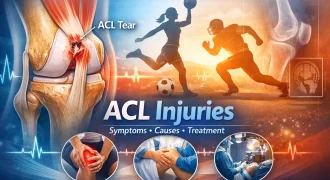
When a ligament tears (like an ACL tear in the knee), the joint becomes unstable. This is why ligament injuries often require orthopedic care and sometimes surgical reconstruction.
Where Are Joints in Your Body?
Joints are found:
- Between skull bones
- In the spine
- At the shoulders, hips, knees, and elbows
- In hands and feet
So, where are the joints in the body?
👉 Everywhere bones meet
Bones and Joints of the Human Body
The skeletal system joints work with bones to:
- Allow motion
- Protect organs
- Support posture
Without joints, bones alone cannot move.
What Are Joints and How Do They Work?
Joints work by:
- Reducing friction with cartilage
- Lubrication using synovial fluid
- Controlled movement through muscles and ligaments
Think of joints like wheels on a suitcase. Without wheels, dragging is painful. With wheels, movement is smooth.
Joint Terms in Hindi (जोड़ों के बारे में हिंदी में)
For students and patients who prefer Hindi, here are the key joint terms explained simply.
| English Term | Hindi Meaning |
| Joint | जोड़ (Jod) |
| Immovable joint (Synarthrosis) | अचल जोड़ |
| Slightly movable joint (Amphiarthrosis) | अर्ध-चल जोड़ |
| Freely movable joint (Diarthrosis) | चल जोड़ |
| Fibrous joint | तंतुमय जोड़ |
| Cartilaginous joint | उपास्थि जोड़ |
| Synovial joint | श्लेष जोड़ |
| Ligament | स्नायु (Snayu) |
| Cartilage | उपास्थि (Upasthi) |
| Synovial fluid | श्लेष द्रव |
Amphiarthrosis meaning in Hindi: अर्ध-चल जोड़ – a joint that allows only limited movement, like the joints between the vertebrae of the spine.
Fibrous joints in Hindi: तंतुमय जोड़ – जैसे खोपड़ी की सिवनियां (skull sutures)
Joints in the Human Body: For Class 11 Students
If you are studying joints in human body for Class 11, here is a quick revision summary based on the NCERT biology syllabus:
Definition: A joint is the point of contact between two or more bones, or between bones and cartilage.
Classification (Structural):
- Fibrous joints – no movement (skull sutures)
- Cartilaginous joints – slight movement (intervertebral discs)
- Synovial joints – free movement (knee, shoulder)
Classification (Functional):
- Synarthrosis – immovable
- Amphiarthrosis – slightly movable
- Diarthrosis – freely movable
Types of synovial joints for Class 11:
- Ball and socket → shoulder, hip
- Hinge → elbow, knee
- Pivot → atlas-axis (neck)
- Gliding → between carpals (wrist bones)
- Saddle → thumb base
- Condyloid → knuckles
Most joints in the body are: Synovial joints (diarthrosis)
Most mobile joint: Shoulder (ball and socket)
Most stable joint: Hip (ball and socket, deeply seated)
This summary covers the key exam questions for Class 11 biology and related competitive exams.
Why Joint Health Matters
Joint pain, stiffness, deformity, or injury can affect daily life deeply. Early diagnosis and proper orthopedic care are important.
Dr. Divya Ahuja focuses on:
- Joint disorders
- Deformity correction
- Bone and joint alignment
- Long-term mobility improvement
Conclusion
Joints are not just connectors. They are the reason the human body moves, balances, and functions smoothly. Understanding joints in the human body, their types, structure, and functions, helps you care for them better and recognize problems early.
Whether you are a student, a patient, or someone simply curious about human joint anatomy, knowing how joints work is the first step toward lifelong mobility and joint health.
Our Clinical Locations
Tap a location to view timings, contact, and map.
Broadway Healthcare, Dadar East
Broadway Healthcare, Dadar East
Clinic Info
- 📍 Broadway Healthcare, Dadar East, Mumbai
- 🕒 Wednesdays · 10:00 AM – 12:00 NOON
- 📞 Appointments: +91 93213 17227
Sweet Clinics, Vashi, Navi Mumbai
Sweet Clinics, Vashi, Navi Mumbai
Clinic Info
- 📍 Sweet Clinics, Vashi, Navi Mumbai
- 🕒 Fridays · 10:00 AM – 12:00 NOON
- 📞 Appointments: +91 93213 17227
Heal Well Speciality Clinic, Thane West
Heal Well Speciality Clinic, Thane West
Clinic & OPD Info
- 📍 Heal Well Speciality Clinic, Thane West
- 🕒 Every Wednesday 10:00 AM – 11:00 AM
- 📞 Appointments: +91 81691 04438
Mangal Anand Hospital, Chembur Mumbai
Mangal Anand Hospital, Chembur Mumbai
Clinic & OPD Info
- 📍 Mangal Anand Hospital, Chembur Mumbai
- 🕒 Monday, Wednesday, Friday 03-07 PM, Thursday 06-07 PM, Free OPD Saturday 02-04 PM
- 📞 Appointments: +91 70212 18182
SRV Hospitals, Tilaknagar, Chembur
SRV Hospitals, Tilaknagar, Chembur
Clinic Info
- 📍 SRV Hospitals, Tilaknagar, Chembur
- 🕒 Monday, Wednesday, Friday 11 AM-12 PM
- 📞 Appointments: +91 84518 00800
FAQs
What is a joint in the human body?
A joint is a place in the human body where two or more bones meet. Joints help hold the skeleton together and allow movement, flexibility, and support. Without joints, bones would be rigid, and the body would not be able to bend or move.
How many joints are there in the human body?
The human body has approximately 360 joints. This number includes movable, slightly movable, and immovable joints. These joints are spread across the skull, spine, arms, legs, hands, and feet, allowing stability and controlled movement throughout the body.
What are the main functions of joints?
The main functions of joints are to allow movement, provide stability, support body weight, and connect bones. Joints also help maintain posture and balance. They work together with muscles and ligaments to ensure smooth and controlled body movements.
Which of the following is NOT a function of joints?
Producing force is not a function of joints. Muscles generate force, while joints only allow movement and stability between bones. Joints act as connection points, but they do not create movement on their own.
What are the three main types of joints in the human body?
The three main types of joints are fibrous joints, cartilaginous joints, and synovial joints. Fibrous joints allow no movement, cartilaginous joints allow limited movement, and synovial joints allow free movement, such as in the knee and shoulder.
What are synovial joints, and why are they important?
Synovial joints are freely movable joints found in the knee, hip, shoulder, and elbow. They contain synovial fluid, which reduces friction and allows smooth movement. These joints are essential for daily activities like walking, lifting, and bending.
What are amphiarthrosis joints with examples?
Amphiarthrosis joints are slightly movable joints that provide both stability and limited motion. Examples include joints between the vertebrae of the spine and the pubic symphysis. These joints help absorb shock while still allowing small, controlled movements.
What connects the bones in cartilaginous joints?
In cartilaginous joints, bones are connected by cartilage. This cartilage provides cushioning and allows limited movement. Such joints are commonly found between ribs and the sternum and between vertebrae, helping absorb pressure and reduce friction.
What is an immovable joint? Explain in simple terms.
An immovable joint is a joint that does not allow movement. These joints mainly provide strength and protection. A common example is the skull, where bones are joined by sutures to protect the brain.
Hindi meaning: अचल जोड़
Where are the major joints located in the human body?
Major joints are located at the shoulders, elbows, wrists, hips, knees, ankles, jaw, and spine. These joints play a key role in body movement and weight-bearing. Problems in these joints can directly affect daily activities and mobility.
What are the 3 main functions of joints?
The three main functions are: allowing movement, providing support, and maintaining stability of the skeletal system.
Which is the most common joint in the human body?
Synovial joints are the most common joint type in the human body.
Which joint has the widest range of motion?
The shoulder joint (ball and socket) has the widest range of motion of any joint in the human body.
What is the difference between a joint and a ligament?
A joint is where two bones meet. A ligament is a strong fibrous band that holds the bones together at the joint. Joints are locations; ligaments are the connecting structures within those locations.
Which joints are immovable?
Skull sutures (like the coronal, sagittal, and lambdoid sutures) are the primary immovable joints in the human body.
Are joints and bones the same thing?
No. Bones are the hard skeletal structures. Joints are the places where bones meet. You cannot have a joint without bones, but bones and joints are distinct structures.
What is not a function of joints?
Production of blood cells is not a function of joints. Blood cells are produced in bone marrow, not in joints.