

You stepped off a curb wrong. Or your foot slid sideways during a run. Maybe you just rolled your ankle on an uneven road. Whatever the moment was, the result is the same – pain, swelling, and a lot of uncertainty about what to do next.
A sprained ankle is one of the most common injuries worldwide, including in India. But “common” doesn’t mean simple. Not every ankle twist is the same, and how you treat it in the first 72 hours can mean the difference between healing cleanly in two weeks or dealing with chronic ankle instability for years.
This guide explains everything – what a sprained ankle actually is, how doctors grade its severity, the proper way to treat it at home, and the signs that indicate it’s time to stop guessing and see a specialist.
What is a Sprained Ankle? (Sprain Meaning Explained Simply)
A sprained ankle is an injury to one or more of the ligaments around your ankle joint. A ligament is a tough, flexible band of tissue that connects bone to bone. Its job is to hold the joint in place and keep your movement stable and controlled.
When your ankle rolls, twists, or turns beyond its normal range of motion, those ligaments are forced to stretch – or even tear. That stretching and tearing is what a sprain is.
The medical definition of a sprain is: an injury to a ligament caused by excessive force or abnormal movement of a joint. This is different from a strain, which affects muscles or tendons, and different from a fracture, which involves a broken bone.
Ligament vs. Muscle vs. Bone – Why the Difference Matters

Many people confuse a sprain, a strain, and a fracture because all three cause pain and swelling in the ankle. Here is a simple breakdown:
- Sprain – injury to a ligament (connects bone to bone)
- Strain – injury to a muscle or tendon (connects muscle to bone)
- Fracture – a crack or break in the bone itself
Getting this right matters because the treatment, recovery time, and risk of long-term complications are completely different for each. An ankle ligament injury that is mistaken for a minor strain and left untreated can lead to serious joint damage later.
Your ankle has ligaments on both the inner side (medial) and outer side (lateral). The lateral ligaments – especially the ATFL (Anterior Talofibular Ligament) – are injured most often because the ankle naturally rolls inward more easily than outward. This inward rolling motion is called an inversion ankle sprain, and it accounts for roughly 85% of all ankle sprains.
What Causes a Sprained Ankle?
A sprained ankle happens when the foot is forced into an unnatural position, overwhelming the ligament’s ability to hold the joint stable. The most common cause is inversion, where the foot rolls inward while the leg stays upright.

Common Situations That Lead to an Ankle Twist Injury
- Landing awkwardly after a jump in sports like basketball, badminton, or volleyball
- Stepping on uneven ground, a pothole, or a rocky surface
- Running on a sloped or wet surface and losing footing
- Wearing high heels or unsupportive footwear on uneven terrain
- Tripping on stairs or a curb
- Stepping on another player’s foot during contact sports
- Sudden changes of direction during physical activity
Ankle injuries in sports are particularly common among runners, football players, and dancers. But this injury does not discriminate – office-goers, homemakers, and school-going children are equally at risk.
Who Is at Higher Risk?
Some people are more likely to sprain their ankles than others. Risk factors include:
- A history of previous ankle sprains – this is the single biggest risk factor; ligaments that were not properly rehabilitated remain structurally weaker
- Flat feet or high arches, which alter how the load is distributed across the ankle
- Poor balance and weak ankle muscles
- Tight calf muscles that limit ankle flexibility
- Wearing worn-out or poorly fitting footwear
- Participating in high-impact or multidirectional sports
Sprained Ankle Symptoms – What You Will Feel and See

The symptoms of a sprained ankle depend on how severely the ligament was injured. Most people experience some combination of the following:
- Pain along the outer or inner side of the ankle, especially when pressing on the area
- Swelling that appears quickly after the injury – sometimes within minutes
- Bruising or discolouration (ecchymosis) around the ankle and foot
- Tenderness when touching the affected ligament
- Stiffness and reduced range of motion
- Difficulty or inability to bear weight on the foot
- A feeling of instability – as if the ankle might give way
In some cases, people report hearing or feeling a “pop” at the moment of injury. This is often associated with a more significant ligament tear.
Swelling after an ankle twist injury is the body’s natural inflammatory response. However, extreme swelling that spreads quickly, or swelling with significant bruising extending to the foot and toes, warrants urgent evaluation.
Sprained Ankle vs. Fractured Ankle – How to Tell the Difference

This is one of the most important questions to answer correctly. The symptoms of a sprained ankle and a broken ankle can look almost identical from the outside. Both cause pain, swelling, and difficulty walking.
There are clinical guidelines called the Ottawa Ankle Rules that doctors use to decide whether an X-ray is needed. Based on these rules, a fracture is more likely if:
- There is bone tenderness at the tip of the inner or outer ankle bone (malleolus)
- The patient cannot take four steps immediately after the injury, and in the clinical setting
- There is bony tenderness at the navicular bone (top of the foot) or the base of the fifth metatarsal (outer edge of the foot)
If you are in doubt, always get an X-ray. A missed fracture causes far more long-term damage than a cautious visit to an orthopaedic specialist.
Grades of Ankle Sprain – How Serious Is Your Injury?

Doctors classify ankle sprains into three grades based on how much of the ligament is damaged. Understanding your grade determines your treatment plan and realistic recovery timeline.
Grade 1 Ankle Sprain (Mild)
A Grade 1 ankle sprain involves microscopic tears in the ligament fibres. The structure of the ligament is mostly intact.
What you will notice:
- Mild pain and tenderness over the ligament
- Slight swelling with little or no bruising
- You can still walk, though it may be uncomfortable
- The ankle joint feels stable – no “giving way”
Recovery time: 1 to 3 weeks with proper rest and care.
Grade 1 sprains are extremely common, and most people recover well with basic first aid and light rehabilitation exercises.
Grade 2 Ankle Sprain (Moderate)
A Grade 2 ankle sprain involves a partial tear of the ligament. A significant portion of the fibers are damaged, but the ligament is not completely ruptured.
What you will notice:
- Moderate to severe pain with tenderness
- Noticeable swelling and bruising, sometimes with discolouration extending below the ankle
- Difficulty bearing weight – walking is painful
- Mild to moderate joint instability; the ankle may feel slightly loose
- A Grade 2 ankle sprain with bruising appearing within 12–24 hours is a reliable indicator of significant tissue damage
Recovery time: 3 to 6 weeks, depending on the extent of the tear and quality of rehabilitation.
Many patients make a costly mistake at this stage – they feel better after a few days of rest, skip physiotherapy, and return to full activity too soon. This leads to chronic ankle instability.
Grade 3 Ankle Sprain (Severe / Complete Ligament Tear)
A Grade 3 ankle sprain is a complete rupture of the ankle ligament. In many cases, the ATFL (Anterior Talofibular Ligament) is fully torn. Some Grade 3 injuries also involve the surrounding structures, including the calcaneofibular ligament and occasionally the tibiofibular ligament.
What you will notice:
- Severe pain immediately following injury (though some patients report the pain briefly diminishing due to nerve disruption)
- Significant swelling and extensive bruising
- The ankle is visibly unstable – it may feel as though the joint has “given out”
- Bearing weight is not possible or extremely painful
- In some cases, a small bone chip may be pulled off with the ligament (avulsion fracture)
Recovery time: 8 to 12 weeks, sometimes longer for high-performance athletes or complex cases. Surgical reconstruction may be considered for patients with persistent instability after conservative treatment.
How to Treat a Sprained Ankle at Home – The RICE Method

For a mild to moderate ankle sprain, the first line of treatment is the RICE method – a well-established first aid protocol that every patient should know. Starting this within the first hour of injury significantly reduces swelling and speeds recovery.
Step-by-Step RICE Protocol
R – Rest
Stop all activity immediately after the injury. Continuing to walk or play on a sprained ankle forces the damaged ligament to bear a load it cannot handle, worsening the tear. For Grade 1 sprains, limited rest with gradual movement is acceptable. For Grade 2 and Grade 3 sprains, crutches may be needed to keep weight off the ankle.
I – Ice
Apply an ice pack wrapped in a thin cloth or towel to the ankle for 15 to 20 minutes. Repeat this every 2 to 3 hours for the first 2 to 3 days. Never apply ice directly to bare skin – this causes ice burns. Ice is most effective in the first 48 hours when the inflammatory response is at its peak.
C – Compression
Wrap the ankle firmly with an elastic bandage (crepe bandage), starting from the toes and working upward toward the calf. The wrap should be snug but not so tight that it causes numbness, tingling, or increased pain. Compression reduces swelling and provides mild structural support. Remove and reapply the wrap every few hours.
E – Elevation
Elevate the foot above the level of your heart as much as possible – especially during the first 48 hours. Use a pillow under your foot while resting or sleeping. This uses gravity to reduce fluid buildup in the ankle tissue.
Important Note on POLICE vs RICE: More recent clinical guidance recommends replacing “Rest” with “Optimal Loading” – meaning early, graded movement rather than complete immobilisation. This updated approach is called the POLICE method (Protection, Optimal Loading, Ice, Compression, Elevation). The principle is that gentle movement after the initial acute phase promotes better healing than complete rest.
Medicines and Topical Treatments for Ankle Sprain

- NSAIDs such as ibuprofen and naproxen are the most commonly used medicines for ankle sprains. They reduce both pain and inflammation. Use them for 5 to 7 days as directed and with food to protect the stomach.
- Topical diclofenac gel applied directly to the swollen area can provide localised pain relief without systemic side effects.
- Avoid prolonged painkiller use without medical supervision – masking pain can lead to re-injury if you return to activity too soon.
- Ankle braces and splints provide structural support during recovery. A walking boot may be prescribed for severe sprains to allow partial weight-bearing.
For a sprained ankle remedy at home, the RICE method combined with an NSAID is effective for Grade 1 and mild Grade 2 injuries. For anything more severe, home treatment should be supplementary to professional care – not a replacement for it.
Sprained Ankle Recovery Time – What to Realistically Expect
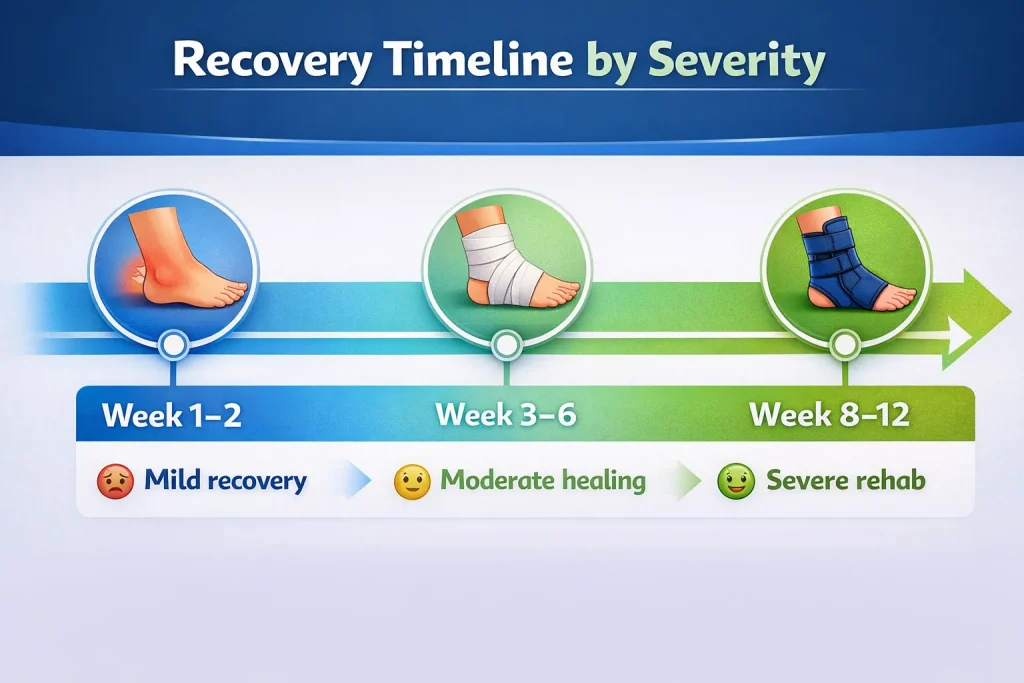
One of the most common questions patients ask is: how long does a sprained ankle take to heal?
Here is a realistic guide:
- Grade 1 Ankle Sprain: 1 to 3 weeks. You can return to normal activities within a week or two with proper rest and light exercise.
- Grade 2 Ankle Sprain: 3 to 6 weeks. Full return to sport or high-impact activity should not be attempted without physiotherapy clearance.
- Grade 3 Ankle Sprain: 8 to 12 weeks minimum. Some patients – especially those with chronic ankle sprain patterns – may require longer structured rehabilitation or surgical intervention.
Swelling is often the last symptom to resolve. A sprained ankle can stay swollen for 2 to 4 weeks for moderate injuries and up to 3 months for severe ligament tears. This does not necessarily mean the ankle is not healing – it reflects the degree of soft tissue damage.
Can a Torn Ankle Ligament Heal on Its Own?
Yes – in most cases, ankle ligaments do heal without surgery, including Grade 3 complete tears. The human body has a significant capacity to repair ligament tissue through structured scar formation.
However, “healing on its own” does not mean healing correctly on its own without guidance. An ankle ligament tear that is not supported, rehabilitated, and progressively loaded during recovery often heals in a lengthened or mechanically compromised position – leaving the ankle chronically unstable.
Surgery for an ankle ligament tear is typically reserved for:
- Persistent instability after 3 to 6 months of conservative treatment
- High-level athletes who require full ligament function
- Associated injuries such as osteochondral defects (cartilage damage) or avulsion fractures
Physiotherapy and Exercises for Ankle Ligament Injury

Physiotherapy is not optional for ankle sprains – it is the single most important factor in full recovery and preventing re-injury. The goal of ankle sprain physiotherapy is to restore range of motion, rebuild strength, and retrain balance (proprioception).
Phase-Wise Rehabilitation Plan
Phase 1 – Acute Stage (Days 1 to 4): Protection and Pain Control
The goal here is to manage swelling and protect the injured ligament.
- Apply the RICE protocol consistently
- Perform gentle ankle pumps – flex and point the foot slowly
- Trace the alphabet in the air with your big toe to maintain mobility without stressing the ligament
- Avoid any weight-bearing that causes sharp pain
Phase 2 – Sub-Acute Stage (Week 1 to 3): Restore Mobility and Introduce Strength
Once swelling begins to reduce and pain is manageable:
- Seated calf raises and ankle circles
- Towel calf stretches – place a rolled towel under the ball of your foot and gently pull the toes toward you
- Resistance band exercises – push the foot outward and inward against the band’s resistance to strengthen the ankle ligaments
- Begin single-leg balance: stand on the injured foot for 20–30 seconds
Phase 3 – Strengthening Stage (Week 3 to 6): Build Stability
This phase focuses on rebuilding the proprioceptive control that prevents future ankle twist injuries.
- Single-leg balance on a folded towel or foam pad
- Standing calf raises on the edge of a step
- Side-to-side stepping and lateral lunges
- Light jogging on a flat surface if pain-free
Phase 4 – Return to Activity (Week 6 and Beyond)
- Progressive running: straight lines first, then gradual introduction of direction changes
- Sport-specific drills under guidance
- Ankle taping or bracing during the return phase as a protective measure
Ankle sprain rehab done properly dramatically reduces the risk of developing chronic ankle sprain – a condition where repeated sprains occur because the ligament and surrounding muscles were never adequately restored to full function.
When to See a Doctor – Signs You Must Not Ignore
Some ankle sprains can be managed with home treatment. Others absolutely cannot. See an orthopaedic specialist without delay if:
- You heard or felt a pop at the time of injury
- You cannot bear any weight on the ankle at all
- The ankle looks deformed or is pointing at an abnormal angle
- Swelling is extreme and spreading rapidly to the foot and lower leg
- There is significant bruising within the first few hours
- You have numbness or tingling in the foot or toes
- Symptoms are not improving after 5 to 7 days of home treatment
- You have had multiple ankle sprains in the same joint
These signs may indicate a Grade 3 ankle ligament tear, an avulsion fracture, a distal fibula fracture, or damage to the peroneal tendons – all of which require proper clinical diagnosis and management.
Do not ignore a severe ankle sprain simply because you can eventually walk on it. Some Grade 3 tears temporarily become less painful once the initial shock passes – but the structural damage remains and will worsen without treatment.
How Is a Sprained Ankle Diagnosed?
When you visit an orthopaedic specialist for an ankle injury, the diagnosis follows a structured process:
Clinical Examination
Your doctor will:
- Ask how the injury occurred and where exactly the pain is located
- Perform the Anterior Drawer Test – gently moving the foot forward relative to the leg to assess ATFL (ATFL sprain) integrity
- Perform the Talar Tilt Test to evaluate the lateral ligaments
- Check for tenderness along bony structures to rule out fracture
Imaging
- X-ray: The first step. Rules out fractures. A normal ankle sprain X-ray will show no bony injury – but an abnormal one may reveal an avulsion fracture or ligament calcification in chronic cases.
- MRI for ankle sprain: The gold standard for soft tissue evaluation. An MRI ankle scan confirms the grade of ligament tear, identifies ATFL tear, and detects associated cartilage or tendon injuries invisible on X-ray.
- Ultrasound: Useful for dynamic assessment of ligament stability in experienced hands and is more accessible in most Indian clinical settings.
Not every ankle sprain requires an MRI. Your specialist will determine this based on the severity of symptoms and your response to initial treatment.
Footwear and Prevention – Avoid the Next Ankle Twist
The best ankle sprain treatment is the one you never need. Here is how to reduce your risk significantly:
- Choose footwear with firm lateral support and a non-slip sole. The right footwear for a sprained ankle during recovery – and for prevention – provides ankle structure without being rigid.
- Avoid walking on unfamiliar or uneven surfaces in poor lighting
- Warm up thoroughly before sports or physical training
- Include regular calf stretches and balance training in your fitness routine – even 5 minutes of single-leg balance practice daily makes a measurable difference
- If you have had a previous ankle ligament injury, use a prophylactic ankle brace during sports
- Strengthen the peroneal muscles on the outer side of the lower leg – these are the muscles most responsible for preventing inversion injuries
Conclusion
A sprained ankle is rarely just a minor inconvenience – it is a real ligament injury that demands the right response. The good news is that the vast majority of ankle sprains, even significant ligament tears, respond very well to the right treatment approach.
Key takeaways from this guide:
- Know the grade of your injury – Grade 1 can be managed at home, Grade 2 needs guided rehabilitation, and Grade 3 requires specialist evaluation.
- Start RICE immediately – within the first hour, ice and compression make a measurable difference in swelling and healing time.
- Do not skip physiotherapy – ankle sprain rehab is not optional. It is the difference between full recovery and a lifetime of repeated sprains.
- Recognising the warning signs – a pop, severe instability, inability to bear weight, and extreme swelling are all reasons to see an orthopaedic doctor without delay.
- A twisted ankle that keeps coming back is a chronic ankle sprain – and that is a condition that can be properly treated with the right diagnosis and structured care.
If you are unsure about the severity of your ankle injury or if symptoms are not improving, consult an orthopaedic specialist. Early, precise intervention prevents long-term joint damage – and that is always the better choice.
Read: Complete Guide to Ankle Fractures: Types, Classification, Treatment & Recovery
Frequently Asked Questions
How long does a sprained ankle stay swollen?
Mild (Grade 1) ankle sprains typically have swelling that resolves within 1 to 2 weeks. A Grade 2 sprain can remain swollen for 3 to 4 weeks. Severe sprains with a complete ligament tear may have visible swelling for up to 2 to 3 months, particularly after prolonged standing or activity.
Can I walk on a sprained ankle?
For Grade 1 sprains, walking is usually possible and even helpful for recovery. For Grade 2 and Grade 3 sprains, walking should be minimised initially and done only with proper support (brace or crutches) to avoid worsening the ligament damage.
What is the difference between an ankle sprain and an ankle strain?
A sprain is an injury to a ligament (bone-to-bone connective tissue). A strain is an injury to a muscle or tendon (muscle-to-bone connective tissue). Both cause pain and swelling, but affect different structures and require different treatment approaches.
What medicine is good for a sprained ankle?
Ibuprofen and naproxen (NSAIDs) are the most commonly recommended medicines for a sprained ankle. They reduce pain and control inflammation. Topical diclofenac gel is also effective for localised relief. Always use these as directed and consult a doctor if symptoms worsen or do not improve.
What are the signs that a sprained ankle needs surgery?
Surgery is considered when the ankle remains unstable after 3 to 6 months of proper physiotherapy, there is a complete Grade 3 ligament tear in an athlete requiring full functional restoration, or there is associated bone or cartilage damage that cannot heal conservatively.
How can I heal a sprained ankle faster?
The most reliable way to speed up recovery is to: start the RICE protocol immediately, use an NSAID as directed, begin gentle range- of-motion exercises within the first 48 hours, follow a structured physiotherapy plan, and avoid returning to high-impact activity before the ligament is fully healed. Skipping rehabilitation is the single biggest reason ankle sprains take longer or become chronic.