
Table of Contents
Key Takeaways:
- Ankle sprain swelling peaks within 24 to 48 hours of injury and should gradually reduce with proper RICE treatment applied consistently.
- Grade 1 mild sprains heal in 1 to 2 weeks, Grade 2 moderate sprains take 3 to 6 weeks, and Grade 3 severe sprains require 8 to 12 weeks or more.
- A sprained ankle often feels worse on day 2 or 3 because inflammation and bruising peak around 48 hours after injury.
- High ankle sprains affect the ligaments between the tibia and fibula and take significantly longer, around 10 to 16 weeks, to fully recover.
- Midfoot sprains involve ligaments in the middle of the foot and can take 2 to 4 months for severe cases, sometimes requiring surgery.
- Ice should be applied for 20 minutes, 3 to 4 times daily during the first 72 hours only; heat should not be used in the early phase.
- Limping while walking means you are returning to weight-bearing too early and placing incorrect stress on the hip, knee, and lower back.
- Persistent swelling beyond 4 weeks needs medical evaluation to rule out an undiagnosed fracture, tendon injury, or severe ligament damage.
- Completing full rehabilitation, including balance and proprioception training, is essential to prevent ankle sprain recurrence after initial recovery.
- Ankle sprains that keep recurring without treatment can lead to chronic ankle instability, cartilage damage, and early joint arthritis over time.
Twisted your ankle? Read this before you panic.
Twisting your ankle is one of the most common injuries people experience while walking on uneven surfaces, stepping off a curb, running, playing sports, or moving quickly indoors. One wrong step, the ankle rolls inward or outward, and suddenly there is sharp pain, swelling, or difficulty putting weight on your foot.
If you are reading this, you are likely dealing with a twisted ankle, a sprained ankle, or swelling that just will not go away. You may be asking: How long does a sprained ankle take to heal? How bad is my sprained ankle? Can I treat this at home without surgery?
This guide answers all of those questions in one place.
What Happens When You Twist Your Ankle?

When you twist your ankle, the joint moves beyond its normal range of motion. Inside your ankle are strong bands of tissue called ligaments that hold the bones together and keep the joint stable. When an ankle twist happens suddenly, these ligaments stretch too far, and in serious cases, they partially or completely tear.
This is why an ankle twist injury causes sudden ankle twist pain, ankle twist swelling within minutes or hours, difficulty bearing weight, and pain that increases over the first 24 to 48 hours. Swelling happens fast because small blood vessels are damaged alongside the ligaments.
This is why an ankle twist injury often causes:
- Sudden ankle twist pain
- Ankle twist swelling within minutes or hours
- Difficulty bearing weight
- Pain that increases over the first 24–48 hours
Want to know more about Human Anatomy and Joints?
When Does Ankle Sprain Swelling Peak?
This is one of the most searched questions after an ankle injury.
Ankle sprain swelling typically peaks within 24–48 hours of the injury. After this point, swelling should begin to plateau and gradually reduce with proper care.
Key points to understand:
- In mild sprains, the peak swelling is modest and reduces within a few days
- In moderate sprains, swelling can be significant and peak closer to 48 hours
- In severe sprains, swelling can remain high for several days before gradually easing
Twisted Ankle vs Sprained Ankle vs Rolled Ankle: Are They the Same?

A twisted ankle describes how the injury happened. A sprained ankle describes what was injured.
A twisted ankle refers to the sudden movement, may have mild or severe pain, and sometimes heals quickly. A sprained ankle means ligament damage has occurred, usually involves swelling and bruising, and requires structured recovery.
A rolled ankle means the ankle rolled inward or outward during injury. A rolled ankle inward (inversion) is the most common type and damages the ligaments on the outer ankle. A rolled ankle outward (eversion) is less common and affects the inner ligaments. Most twisted ankles are actually sprained ankles, even if the sprain is mild.
Common Sprained Ankle Symptoms
Sprained ankle symptoms vary depending on severity, but commonly include:
- Pain around the ankle joint
- Swelling and bruising around the foot and ankle
- Difficulty walking or putting weight on the foot
- Ankle stiffness after sprain
- Tenderness when touched
- Ankle pain while walking after a sprain
If your ankle swelled up suddenly or pain increases instead of improving after a few days, the injury may be more than mild.
Sprained Ankle Bruising: What Is Normal?
Bruising after a sprained ankle is very common and can look alarming. However, it is simply the result of bleeding under the skin from damaged blood vessels near the injured ligaments.
Bruising timeline after ankle sprain:
- Day 1–2: Little or no visible bruising; swelling dominates
- Day 2–4: Bruising appears, often dark purple or blue
- Day 4–7: Bruising spreads and may travel down toward the toes (this is normal gravity pull)
- Week 2: Color changes to green or yellow as bruising resolves
- Week 3–4: Bruising fades completely in most cases
When to be concerned about bruising:
- If bruising gets significantly worse after the first 48–72 hours
- If bruising is accompanied by numbness or loss of sensation
- If severe bruising appears with no significant mechanism of injury
Bruising alone does not tell you how bad the sprain is. A minor sprain can bruise heavily, and a moderate sprain may show minimal bruising depending on the person.
Ankle Swollen for a Week: Is This Normal?
One of the most common concerns is persistent swelling.
Yes, ankle swelling after a sprain can last longer than people expect. Mild sprains often swell for several days. Moderate and severe sprains can stay swollen for 1–3 weeks or more.
However, you should be cautious if:
- The ankle swelling is not going down at all
- Swelling is increasing instead of reducing
- There is severe pain at night
- You cannot bear weight after several days
In such cases, the issue could be a severe ankle sprain, a high ankle sprain, or rarely, a fracture or blood clot.
How Long Does Swelling Last After an Ankle Sprain?
Swelling is one of the most frustrating parts of ankle sprain recovery. People want to know when it will finally go down – and that depends largely on the grade of injury.
Here is what to expect at each stage:
| Grade | Initial Swelling | When Swelling Peaks | When Swelling Resolves |
| Grade 1 (Mild) | Minimal | 24–48 hours | 3–7 days |
| Grade 2 (Moderate) | Moderate | 48–72 hours | 1–3 weeks |
| Grade 3 (Severe) | Significant | 72 hours | 3–6 weeks or more |
Tips to bring swelling down faster:
- Keep the ankle elevated above heart level as much as possible
- Apply ice for 20 minutes at a time, 3–4 times a day, in the first 48–72 hours
- Use a compression bandage to prevent fluid accumulation
- Avoid prolonged standing or walking in the early days
- Gentle ankle pumping exercises (pointing the foot up and down) encourage fluid drainage
Important: If your ankle is still swollen after 3–4 weeks without clear improvement, consult a doctor. Persistent swelling can occasionally indicate a more serious ligament tear, fracture, or joint issue.
How Bad Is My Sprained Ankle?
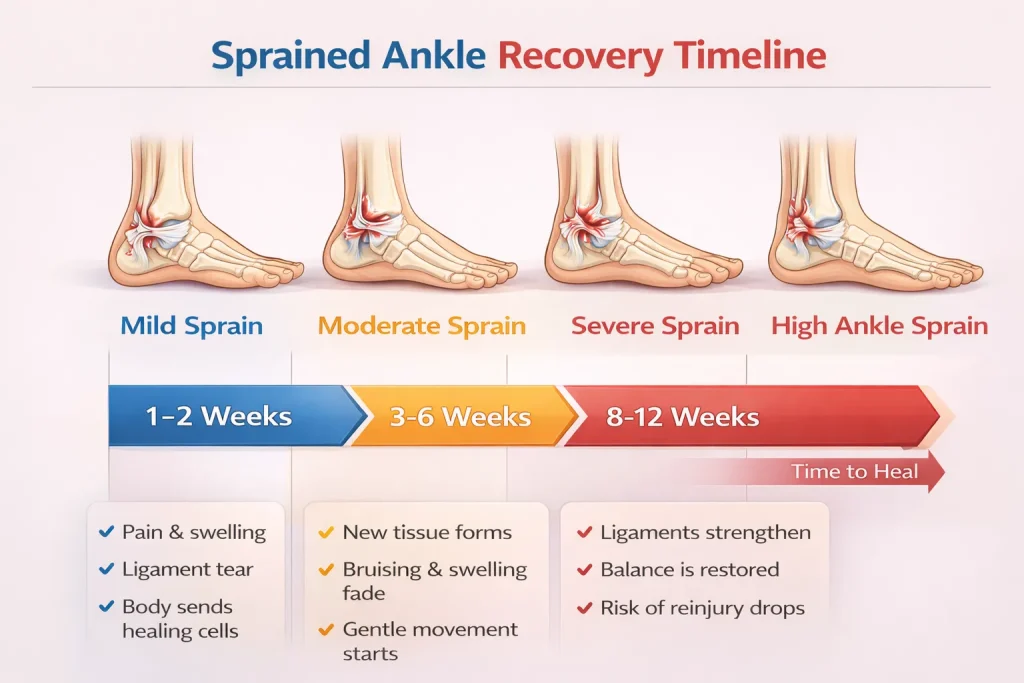
Grade 1 (Mild ankle sprain): Ligaments stretched but not torn, mild pain and swelling, minor ankle sprain recovery time of 1 to 2 weeks.
Grade 2 (Moderate ankle sprain): Partial ligament tear, noticeable swelling and bruising, moderate ankle sprain healing time of 3 to 6 weeks.
Grade 3 (Severe ankle sprain): Complete ligament tear, severe swelling and bruising, joint instability, severe ankle sprain recovery time of 8 to 12 weeks or more.
There is no universally accepted Grade 4 ankle sprain classification. Some clinicians informally use Grade 4 to describe complete ligament rupture combined with joint instability or an associated fracture requiring surgical repair.
Sprained Ankle Healing Stages (Ligament Healing)
Ligaments heal in predictable phases. Understanding this helps reduce anxiety and prevents rushing recovery.

Inflammation Phase (First few days): Pain, swelling, and warmth. The body sends blood and healing cells. Rest is critical during this stage.
Repair Phase (1 to 3 weeks): New collagen fibers form, swelling slowly reduces, and gentle movement begins.
Remodeling Phase (Weeks to months): Ligaments regain strength, balance and stability return, and risk of re-injury decreases.
Skipping proper care at any stage increases the risk of chronic ankle sprain or long-term instability.
Does a Sprained Ankle Get Worse Before It Gets Better?
Yes – and this surprises many patients.
It is completely normal for a sprained ankle to feel worse on day 2 or day 3 compared to the moment of injury. Here is why:
- Swelling continues to build for the first 24–48 hours
- Inflammation peaks around 48 hours, increasing pain and stiffness
- Bruising appears later, making the injury look more dramatic
- Initial adrenaline after injury can mask the true pain level
By day 3 to day 5, most mild to moderate sprains begin to feel noticeably better if proper rest and RICE treatment have been followed.
Signs that healing may not be progressing as expected:
- Pain that does not reduce at all over 2 weeks
- Swelling that is unchanged or increasing after the first week
- The ankle feels “giving way” or unstable when walking
- Numbness, tingling, or significant skin discolouration
If any of these are present, professional evaluation is recommended. Sometimes what appears to be a sprain is a partial fracture or a more significant ligament injury requiring specific treatment.
Sprained Ankle Recovery Timeline (Realistic Expectations)
Day 1 to 2: Swelling peaks within 48 hours, pain is at its highest, keep the ankle elevated and apply ice regularly.
Day 3 to 5: Swelling begins to plateau, pain starts to ease in mild sprains, and very gentle ankle movement can begin.
Week 1 to 2: Swelling reduces noticeably, pain during walking decreases, and mild sprains often allow a gradual return to normal walking.
Week 2 to 4: Bruising resolves, strengthening exercises begin, and balance and proprioception exercises are introduced.
Week 4 to 6: Most people with Grade 2 sprains reach pain-free daily walking with physiotherapy guidance.
Week 6 to 12: Running and sport-specific activities gradually resume for severe sprains, with ankle bracing advised.
| Injury Type | Expected Recovery Time |
| Mild sprain (Grade 1) | 1 to 2 weeks |
| Moderate sprain (Grade 2) | 3 to 6 weeks |
| Severe sprain (Grade 3) | 8 to 12 weeks |
| High ankle sprain | 10 to 16 weeks |
| Midfoot sprain | 4 to 8 weeks |
| Ligament tear (partial) | 4 to 8 weeks |
| Ligament tear (complete) | 3 to 6 months |
Can You Walk on a Sprained Ankle?
This depends on severity.
- Mild sprains: Light walking is often okay after a few days
- Moderate sprains: Walking may be painful and should be limited
- Severe sprains: Walking too early can worsen damage
If walking causes sharp pain or limping, reduce weight-bearing and focus on healing first.
Signs a Sprained Ankle Is Healing
Patients often ask: “How do I know my sprained ankle is getting better?”
Here are the clear signs that recovery is progressing well:
- Swelling is visibly reducing compared to the first few days
- Bruising is changing color from dark purple to yellow or green
- Pain during rest is decreasing without needing regular pain relief
- You can bear weight more comfortably with each passing day
- Range of motion is improving – you can move the ankle in all directions with less restriction
- No new pain with the gentle exercises introduced by a physiotherapist
Signs That Healing Is NOT Going As Expected:
- Pain and swelling remain the same or worsen after one week
- You still cannot bear weight at all after 3–4 days
- The ankle feels unstable or “gives way” when you try to walk
- Numbness or tingling develops in the foot
- Night pain is severe and wakes you up regularly
These signs require medical evaluation rather than continued home treatment.
High Ankle Sprain: Why It Takes Longer

A high ankle sprain affects ligaments between the tibia and fibula (lower leg bones). This injury often happens when the foot twists outward.
High ankle sprain symptoms
- Pain above the ankle joint
- Pain while walking or climbing stairs
- Less visible swelling
- Longer healing time
High ankle sprain recovery time is longer because these ligaments stabilize the entire lower leg during walking.
High Ankle Sprain Recovery Timeline
| Grade | Recovery Time |
| Grade 1 high ankle sprain | 4–6 weeks |
| Grade 2 high ankle sprain | 6–10 weeks |
| Grade 3 high ankle sprain | 10–16 weeks or more |
Midfoot Sprain: Recovery Time and What to Expect
A midfoot sprain involves ligaments in the middle of the foot rather than around the ankle joint. It is less common but often slower to heal because the midfoot takes significant load during every step.
Midfoot sprain symptoms:
- Pain and swelling in the middle of the foot
- Difficulty pushing off while walking
- Tenderness across the top of the foot
- Worsening pain with activity, improving with rest
Midfoot sprain recovery time:
| Severity | Recovery Time |
| Mild midfoot sprain | 2–4 weeks |
| Grade 2 midfoot sprain | 6–8 weeks |
| Severe midfoot sprain | 3–4 months |
A severe midfoot injury, particularly involving the Lisfranc ligament, is serious and may require surgery. If midfoot pain is severe after trauma and not improving within a week, medical imaging is essential.
Sprain on Bottom of Foot (Foot Sprain)

Not all ankle-area pain comes from the ankle itself.
A foot sprain involves ligaments in the midfoot or plantar area.
Symptoms include:
- Pain in the arch or bottom of the foot
- Swelling after walking
- Difficulty pushing off while walking
Foot sprain recovery timeline
- Mild: 2–4 weeks
- Moderate: 6–8 weeks
Foot sprains heal more slowly because the foot bears weight constantly.
How to Treat a Sprained or Twisted Ankle at Home
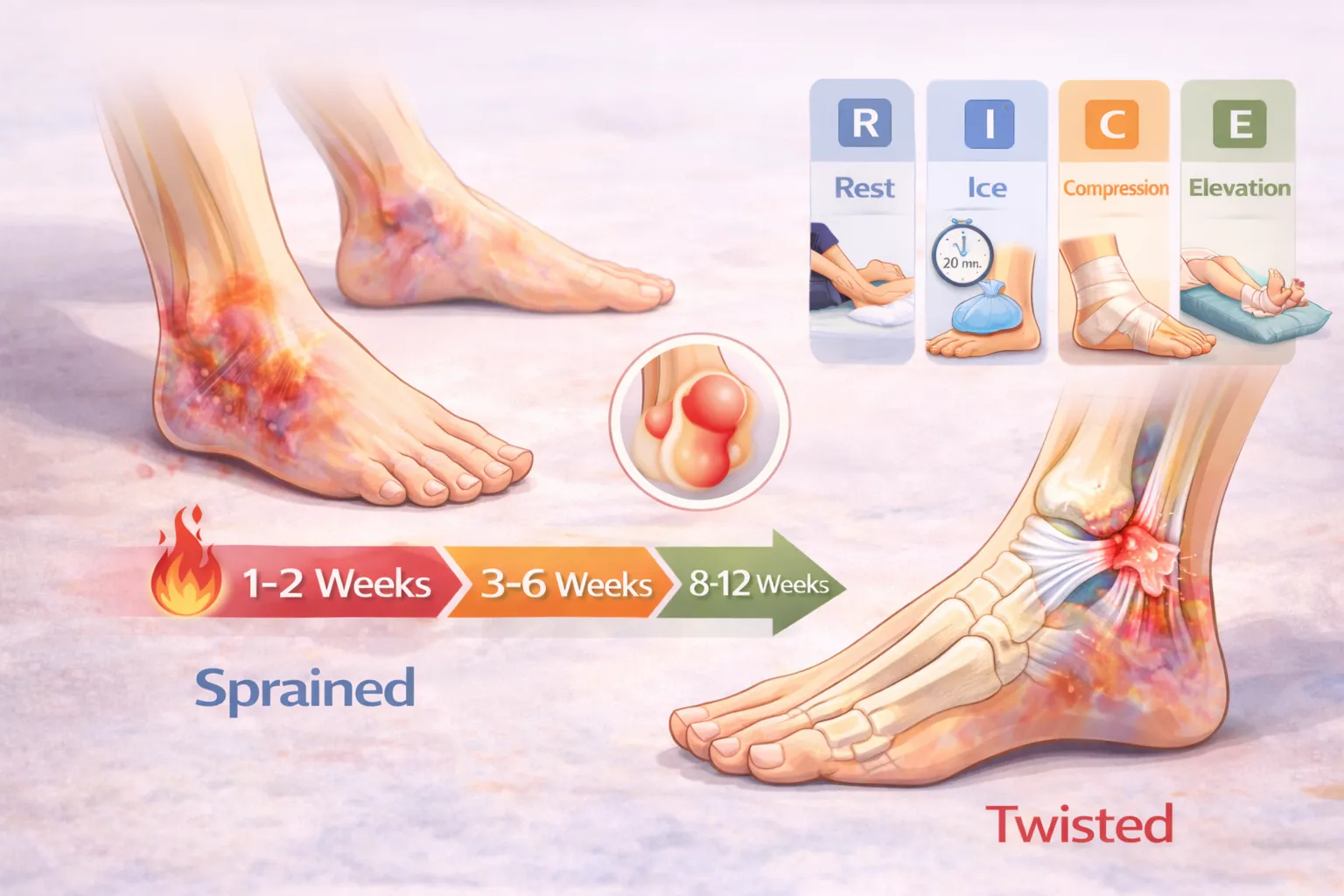
Most ankle sprains heal without surgery if treated correctly using the RICE method.

Rest: Avoid activities that cause pain. Do not push through early.
Ice: Apply ice for 20 minutes, 3 to 4 times daily. Ice helps reduce swelling and pain.
Compression: Use an ankle sprain bandage or support wrap to control swelling.
Elevation: Keep the ankle elevated above heart level whenever possible.
Ice should be applied during the first 48 to 72 hours when swelling and inflammation are at their peak. Never apply ice directly to skin. After 72 hours, apply ice only after activity if the ankle feels warm or swollen. Heat should not be applied in the early phase, as it increases swelling. Gentle heat may be introduced after week 2 to ease stiffness.
Elevation is most critical in the first 72 hours. Elevate for at least 2 to 3 hours total throughout the day with the ankle above the level of the heart. Sleeping with the ankle propped on a pillow helps reduce morning swelling.
Additional Home Care Tips
Beyond the RICE method, a few simple habits support recovery at home. Avoid uneven surfaces, wear supportive footwear, and begin gentle range-of-motion exercises once pain allows.
Practical tips to follow during recovery:
- Avoid uneven or unstable surfaces until the ankle feels fully stable
- Wear supportive footwear with good lateral support throughout recovery
- Begin gentle ankle circles once pain eases, usually after the first few days
After the first 72 hours, add 2 tablespoons of Epsom salt to warm water and soak for 15 to 20 minutes to ease stiffness and provide temporary pain relief. Avoid warm soaks in the first 72 hours as heat can increase swelling.
Ankle Sprain Not Healing: When Should You Worry?
Most ankle sprains follow a predictable recovery path, but some do not improve as expected. Common reasons include returning to activity too early, an undiagnosed fracture, incomplete rehabilitation, repeated re-injury, and peroneal tendon involvement alongside the sprain.
Seek medical help if any of the following apply:
- Significant pain and swelling persists after 3 to 4 weeks for a mild sprain
- You still cannot walk properly after 6 weeks for a moderate sprain
- The ankle feels unstable or gives way when walking
- Numbness or tingling develops in the foot at any stage
- Severe night pain continues beyond the first two weeks
A proper physiotherapy assessment and imaging review can identify the cause and get recovery back on track. Delaying evaluation increases the risk of chronic ankle instability and long-term joint damage.
Preventing Future Ankle Sprains
Once you have had one sprain, the risk of re-injury increases significantly. Completing full rehabilitation, including proprioception training, is the most effective way to prevent ankle sprain recurrence.
Key prevention habits to follow:
- Strengthen ankle muscles and improve balance with single-leg exercises
- Always warm up properly before physical activity or sport
- Use ankle bracing during high-risk activities and wear supportive footwear
- Gradually train on uneven surfaces to rebuild proprioception and joint awareness
Strong, well-conditioned ankles are far less likely to roll or give way during everyday movement and sport.
When Should You See a Doctor?

Most ankle sprains heal well at home, but certain signs mean you need professional evaluation without delay.
Seek medical care if:
- You cannot bear weight after 48 to 72 hours
- Pain or swelling keeps worsening instead of improving
- The ankle sprain is not healing after several weeks
- Numbness, extreme bruising, or visible deformity appears
The Ottawa Ankle Rules recommend an X-ray if you cannot take more than 4 steps after injury, or if there is tenderness over the bony ankle prominences or midfoot bones. When in doubt, always get it checked.
Sprained Thumb & Thumb Sprain Rehab
A sprained thumb joint happens when the thumb ligaments stretch or tear, often from a fall or sudden impact. Ignoring a thumb sprain can affect grip strength long-term, so early treatment matters.
Thumb sprain rehab includes:
- Rest and splinting to protect the ligament during healing
- Ice and compression to reduce swelling in the early phase
- Gradual strengthening exercises as pain and mobility improve
Frequently Asked Questions
How long does a Grade 2 moderate ankle sprain take to fully heal at home?
Grade 2 moderate ankle sprains typically take 3 to 6 weeks to heal with consistent RICE treatment, compression support, and gradual physiotherapy exercises introduced from week two onward.
Why is my ankle still swollen after 2 weeks and not getting better?
Swelling at 2 weeks can be normal for moderate sprains, but it should be noticeably reduced. If unchanged or worsening, get a medical evaluation to rule out an undiagnosed fracture or tendon injury.
What are the early signs that a sprained ankle is healing properly?
Key signs include visibly reducing swelling, bruising turning from purple to yellow, decreasing pain during rest, and the ability to bear more weight comfortably without limping each day.
Can walking on a sprained ankle too early make it worse and delay healing?
Yes. Walking too early prevents ligament repair and can cause re-injury. Walk only when you can do so without limping, as limping strains the knee, hip, and lower back.
How long should you ice a sprained ankle to reduce swelling effectively?
Apply ice for 20 minutes, 3 to 4 times daily during the first 72 hours. After that, use ice only after activity if the ankle feels warm or swollen.
What is the difference between a high ankle sprain and a regular ankle sprain recovery time?
Regular sprains heal in 1 to 12 weeks, depending on grade. High ankle sprains affect ligaments between the tibia and fibula and take 10 to 16 weeks to stabilize the entire lower leg during walking.
Why does a sprained ankle throb and hurt more when blood rushes to it?
When lowering the ankle from elevation, blood rushes rapidly back into the injured tissue, causing throbbing. Lowering the ankle slowly and using compression bandaging reduces this painful sensation.
How do I know if I have a foot sprain or a fracture in my foot after injury?
Fractures cause pinpoint bone tenderness, rapid bruising within minutes, and complete inability to bear weight. If unsure, always get an X-ray, as walking on a fracture worsens displacement.
Is swimming a good low-impact exercise during sprained ankle recovery?
Yes, after the acute swelling phase at week 1 to 2. Swimming maintains fitness without ankle loading. Avoid forceful kicking that strains the healing ligament during early recovery sessions.
How can I prevent my sprained ankle from becoming a recurring chronic ankle sprain?
Complete full rehabilitation, including balance and proprioception training, strengthen the peroneal muscles, use ankle bracing during sport, and avoid returning to full activity before the ankle feels completely stable.