Injuries to the upper arm can change everyday life very quickly. Simple actions like lifting a bag, pushing a door, or bending the elbow can suddenly become painful or impossible. A bicep injury, bicep muscle tear, bicep tendon tear, or torn tricep muscle is more common than people think, especially among active adults, gym-goers, and those who do physical work. These injuries range from mild strains to serious conditions like a distal biceps rupture or a ruptured tendon in the elbow.
This guide explains bicep & tricep tendon tears and muscle injuries in clear language. You will learn how these injuries happen, what symptoms to watch for, how doctors diagnose them, and what recovery really looks like.
Table of Contents
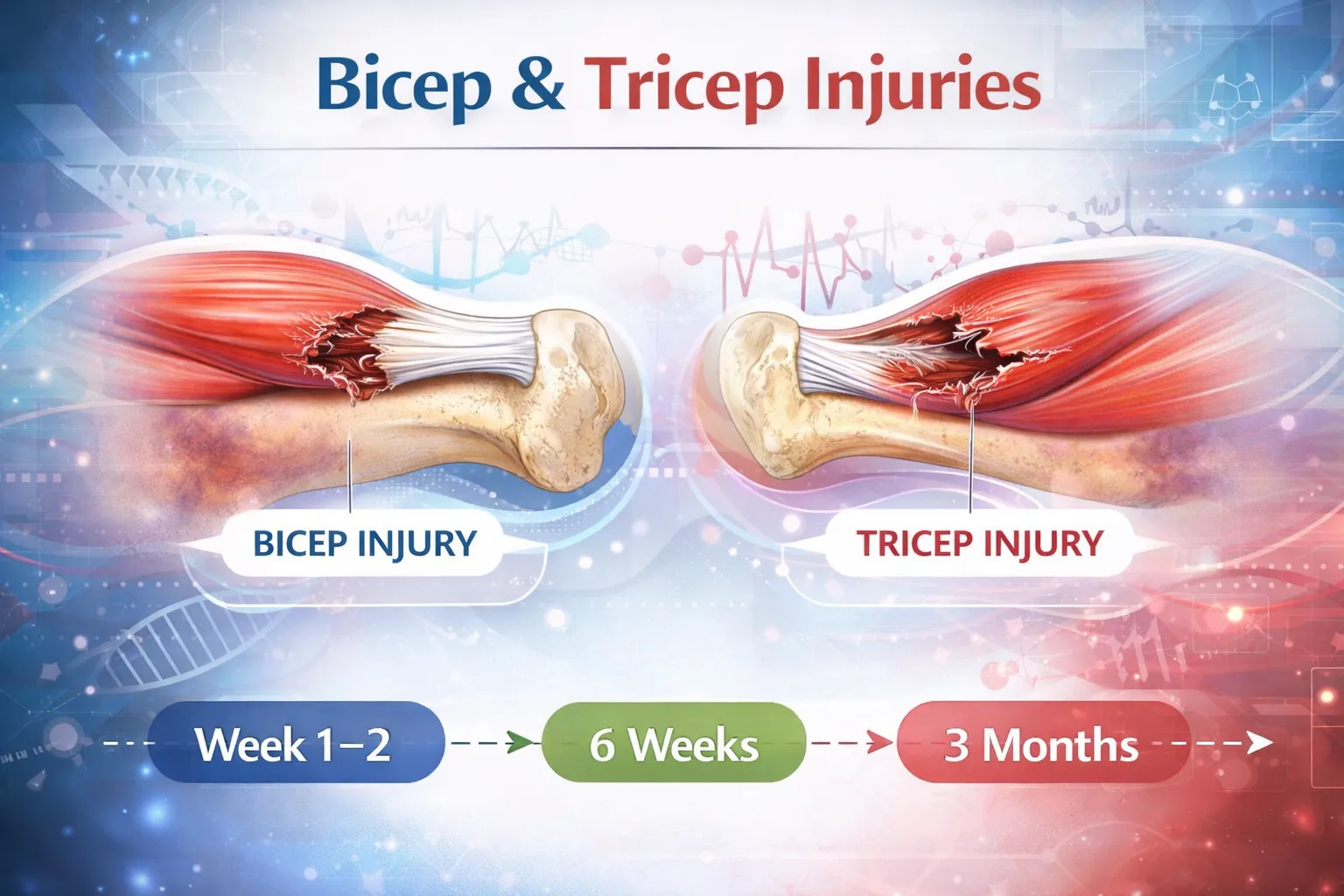
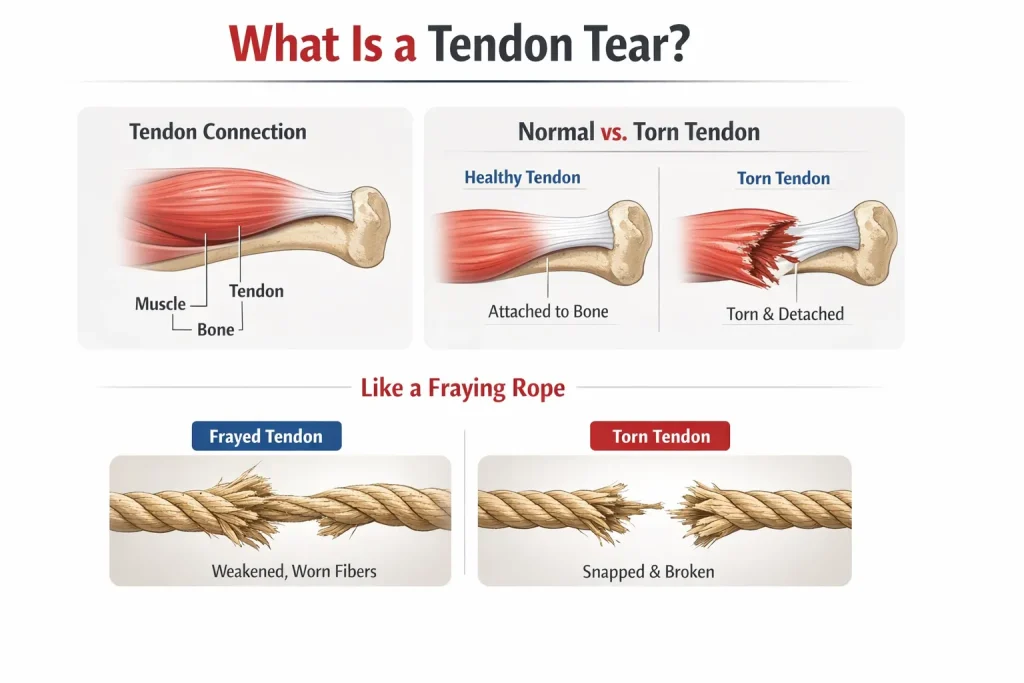
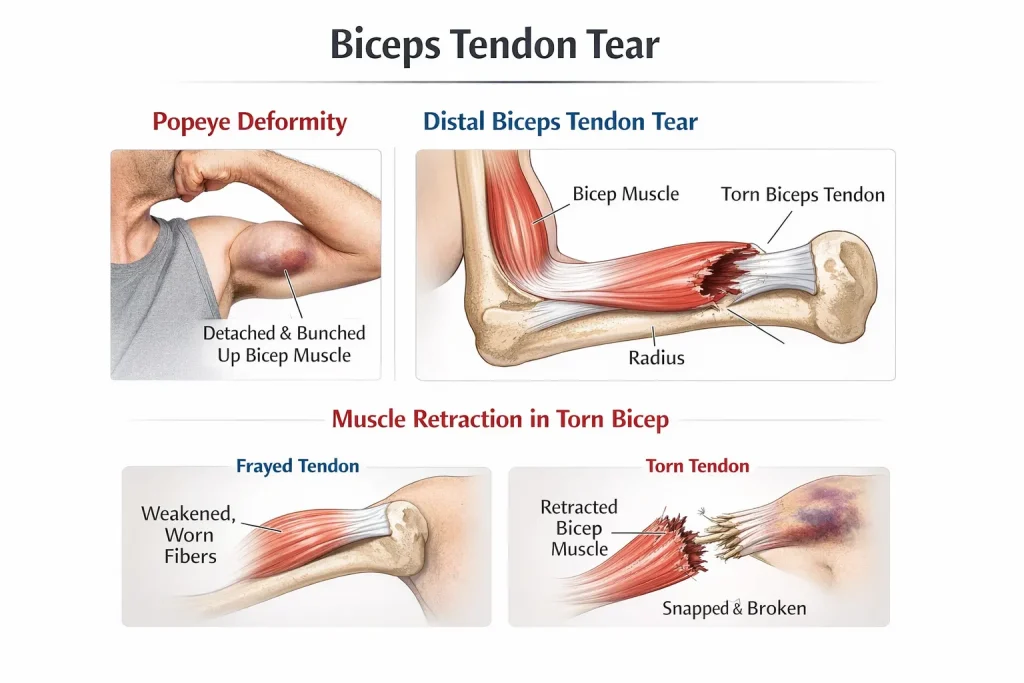
A bicep or tricep tendon tear happens when the strong cord that connects muscle to bone gets damaged or breaks, much like a rope that frays over time or snaps under sudden force. Some people feel it during heavy lifting, others during sports, and some during simple daily tasks. A loud pop, sudden pain, swelling, and weakness are common warning signs. In biceps injuries, the muscle may bunch up, creating what doctors call a Popeye deformity, often seen with a detached bicep muscle or ruptured bicep.
Triceps injuries usually cause pain at the back of the elbow and make it hard to straighten the arm. Not every tendon tear needs surgery, but ignoring symptoms can lead to long-term strength loss. Early diagnosis, proper rest, and the right treatment plan make recovery smoother and more complete. Think of a tendon like a bridge cable. Small damage can sometimes be repaired with care, but a full break often needs professional repair to restore strength and function.
Understanding the Biceps and Triceps Muscles
The biceps brachii is the muscle on the front of your upper arm. It helps bend the elbow and rotate the forearm. The triceps muscle sits at the back of the upper arm and straightens the elbow.
This difference matters. Many people search for triceps vs biceps because symptoms and treatment are not the same. A bicep tear usually affects lifting and twisting. A triceps injury affects pushing and straightening.
Where Exactly Is the Triceps Muscle?
Many people are unsure about the exact location of the triceps. The triceps brachii is the large muscle at the back of the upper arm. It has three heads:
- Long head – runs from the shoulder blade down the inner back of the arm
- Lateral head – on the outer back of the upper arm
- Medial head – deeper, sits closest to the bone
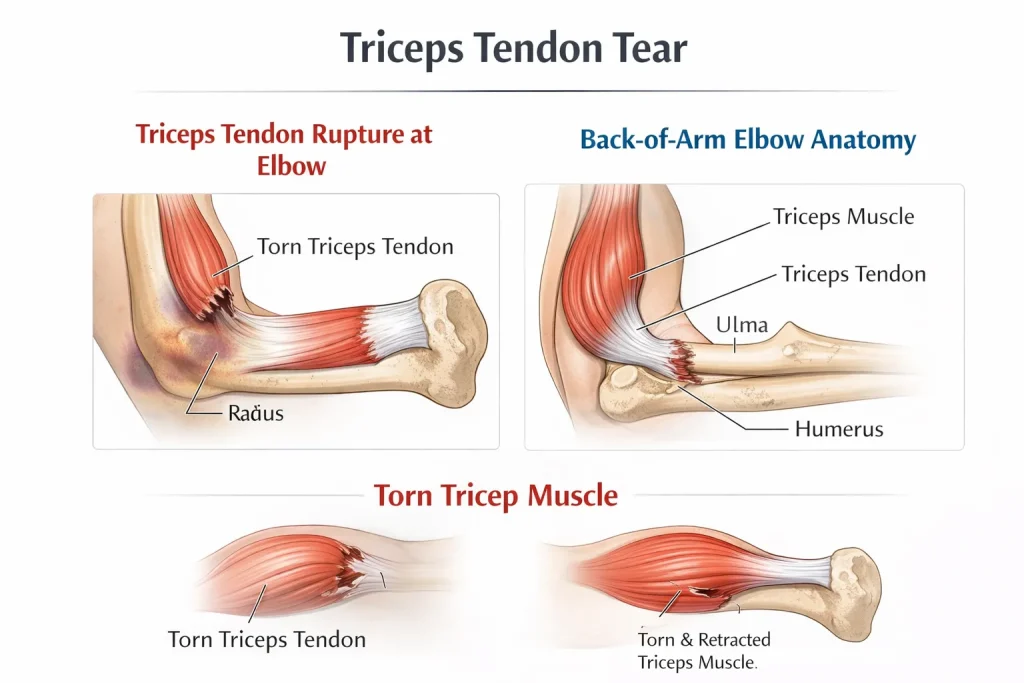
The long head of the triceps is the most commonly injured head, particularly during heavy pressing movements or overhead activities. Pain in the lateral head of the triceps is often felt on the outer back of the arm and can be confused with elbow problems.The triceps connect to the elbow via the triceps tendon – a thick band that attaches to the olecranon (the pointy bone at the back of the elbow). This is where most serious triceps tears occur.
What is a Biceps Tendon Tear
A biceps tendon tear means the tendon connecting the biceps muscle to the shoulder or elbow has partially or completely torn. This injury often occurs near the shoulder or at the elbow.
Think of the tendon as a thick cable. When it stretches too much or wears down over time, it can fail.
Common Types of Biceps Injuries
- Bicep muscle tear
- Torn bicep muscle
- Torn bicep tendon
- Bicep tendon injury
- Distal biceps tendon tear
- Distal biceps rupture
A distal bicep tear happens near the elbow and often causes more strength loss than shoulder-level injuries. A proximal bicep tendon tear at the shoulder is more common and often less functionally disabling.
Types of Bicep Tears: Full Comparison
Not all bicep tears are the same. Understanding the type helps set realistic expectations for recovery.
Proximal biceps tendon tear (at the shoulder):
- Affects the long or short head tendon at the shoulder attachment
- Long head tears are most common
- Often causes mild pain and a visible “Popeye” bulge in the upper arm
- Many people retain good arm function and do not need surgery
- More common in people over 40 due to degenerative changes
Distal biceps tendon tear (at the elbow):
- Far less common but more functionally significant
- Causes significant weakness in bending the elbow and rotating the forearm
- More likely to need surgical repair, especially in active individuals
- The biceps “snap” away from the elbow bone completely in a full rupture
Bicep muscle belly tear:
- Rare; occurs in the middle of the muscle rather than at the tendon
- Usually caused by very high-force trauma
- May require surgical repair in complete cases
Micro tear in bicep:
Heals with rest and nutrition; not a significant clinical injury in most cases
Tiny fiber damage caused by heavy training or overuse
Usually causes delayed onset muscle soreness (DOMS) rather than acute injury
Causes of Biceps Tendon Tears
1. Acute Injury
A sudden force can tear the tendon. This may happen while lifting something heavy or during a fall.
2. Overuse
Repeated overhead movements or heavy weight training can weaken the tendon slowly. Over time, it becomes easier to tear.
3. Age-Related Degeneration
As we age, tendons lose flexibility. This makes a bicep injury more likely, even with normal activity.
Symptoms of a Biceps Tear
Common bicep tear symptoms include:
- Sudden pain in the upper arm or elbow
- A popping sound during injury
- Swelling and bruising
- Weakness when bending the arm
- Torn bicep symptoms, like reduced grip strength
- A visible bulge in the arm, often linked to a detached bicep muscle
- Biceps brachii tear symptoms, such as fatigue with simple movements
- A visible dent in the bicep where the muscle has retracted
What Does a Torn Bicep Feel Like?
Patients often describe the moment of a bicep tear in very similar ways:
- A sudden, sharp pain – often described as a “burning snap” in the upper arm or elbow
- An audible pop that may be heard and felt at the same time
- Immediate weakness – the arm feels like it “has nothing left” when trying to lift or bend
- The arm may look different – a soft, bunched-up muscle higher up the arm (Popeye sign)
After the initial injury, some patients describe the pain settling into a dull ache, which leads them to underestimate the severity. Weakness, particularly during forearm rotation and elbow bending, is a clearer sign of a significant tear than pain alone.
What does a torn bicep muscle feel like vs a tendon tear?
A muscle belly tear tends to feel like a deep, sharp internal pain in the middle of the upper arm. A tendon tear at the elbow feels more like a sudden release or “snap” near the elbow, with immediate loss of pulling strength.
Bicep Tear Signs: Popeye Deformity and Dent Explained
Two visible signs are associated with biceps tears:
Popeye deformity: When the biceps tendon detaches from the shoulder, the muscle bunches downward, creating an exaggerated bulge in the middle of the upper arm. This is called the Popeye sign (after the cartoon character). It is most visible when the elbow is bent against resistance.
Dent in the bicep: A dent or depression near the elbow or shoulder indicates where the tendon or muscle has retracted. In a distal bicep rupture, the dent appears near the elbow. In a proximal tear, it may appear higher on the arm.
Both signs are indicators of a significant tear and warrant prompt orthopedic evaluation.
What is a Triceps Tendon Tear
A triceps tendon tear affects the tendon that attaches the triceps muscle to the elbow. This injury makes it hard to straighten the arm.
People often describe it as a pulled tricep muscle, ripped tricep muscle, or torn tricep muscle.
Causes of Triceps Tendon Tears
1. Sudden Trauma
A fall on an outstretched hand or a direct hit to the elbow can tear the tendon.
2. Overuse
Activities that involve forceful elbow extension, like bench pressing or throwing, increase risk.
3. Degeneration
With age, the tendon weakens, increasing the chance of a torn tendon.
Symptoms of a Triceps Tear
Common torn tricep symptoms include:
- Sharp pain in the back of the elbow
- Swelling and tenderness
- Trouble straightening the arm
- Weakness when pushing
- Longer torn tricep recovery time if not treated early
What Does a Torn Tricep Feel Like?
The experience of a triceps tear is often described as:
- A sudden, sharp pain in the back of the elbow at the moment of injury
- A sensation that something “gave way” or “snapped” behind the elbow
- Immediate inability to push or straighten the arm with any force
- Throbbing pain that worsens when attempting elbow extension
Why does my tricep feel like it is tearing? During heavy training or repetitive pushing movements, patients sometimes describe a painful “tearing” sensation in the tricep area. This could indicate an acute muscle strain, tendon irritation, or, in some cases, early degeneration of the triceps tendon. If this sensation appears suddenly or is accompanied by weakness, it should be evaluated by a doctor.
What Does a Torn Tricep Look Like?
Visible signs of a tricep tear include:
- Swelling and bruising at the back of the elbow within hours of injury
- Tricep tear, bruising that can track down the forearm due to gravity
- A visible gap or defect near the elbow where the tendon has detached
- In severe cases, the triceps muscle may appear to “bunch up” higher on the arm, creating visible asymmetry
Bruising from a tricep tear often appears 24–48 hours after injury and can be quite dramatic – spreading from the elbow toward the forearm. This is normal and reflects internal bleeding from the torn tissue, not additional damage.
Bicep Tear vs Strain and Tricep Strain vs Tear
A strain is like overstretching a rubber band. A tear is when the band snaps.
A bicep tear vs strain comparison matters because tears often need medical care, while strains usually heal with rest.
The same applies to tricep strain vs tear.
| Feature | Tricep Strain | Tricep Tear |
| Pain onset | Gradual or moderate | Sudden and severe |
| Popping sensation | Rare | Common |
| Strength loss | Mild | Significant |
| Swelling | Mild | Significant |
| Bruising | Minimal | Often visible |
| Ability to push | Reduced but present | Severely limited |
| Recovery time | 2–8 weeks | 8 weeks to months |
| Surgery needed | Usually not | Sometimes, if complete |
What does a tricep strain feel like?
A tricep strain causes aching pain, tightness, and fatigue in the back of the upper arm. It worsens with pushing movements but does not completely prevent elbow extension. There is no popping sensation, and bruising is minimal.
What does a tricep tear feel like?
A tricep tear causes immediate, sharp pain, a sensation of something giving way, and significant weakness in straightening the arm. Bruising and swelling develop quickly, and pushing activities become very difficult or impossible.
Tricep Strain Recovery Time: Grade by Grade
Understanding recovery timelines by grade helps set realistic expectations.
Grade 1 Tricep Strain Recovery Time
- Mild overstretching; fibers intact
- Pain and tightness, but no significant weakness
- Recovery: 1–3 weeks with rest and gradual return to activity
- No imaging is usually needed
Grade 2 Tricep Strain Recovery Time
- Partial fiber tear; moderate pain and weakness
- Swelling and bruising present
- Recovery: 4–8 weeks with physiotherapy
- May benefit from an ultrasound or an MRI to assess the extent
Grade 3 Tricep Tear Recovery Time
- Complete rupture; significant functional loss
- Surgical repair is often required
- Recovery after surgery: 4–6 months for full return to strength
- Physiotherapy is essential throughout
Pulled Tricep Recovery Time
A “pulled tricep” – which most commonly refers to a Grade 1 or mild Grade 2 strain – typically heals in 2–6 weeks, depending on:
- How much rest is taken early
- Whether the activity was reduced promptly
- The person’s overall health and nutrition
- Whether physiotherapy was started appropriately
Bicep Micro Tear: What It Is and When to Worry
Micro tears in the bicep are tiny, microscopic fiber damages that occur during intense training – particularly after heavy bicep curls, chin-ups, or eccentric loading exercises.
These are actually a normal part of muscle building. The repair process is what causes muscle soreness (DOMS – delayed onset muscle soreness) and eventual muscle growth.
Bicep micro tear symptoms:
- Dull aching pain in the bicep muscle 24–48 hours after training
- Muscle tightness and sensitivity to touch
- Slight reduction in strength temporarily
- No visible bruising or deformity
Are micro tears in the bicep dangerous? In most cases, no. Micro tears are a normal physiological response to exercise stimulus. They resolve with rest, protein intake, and adequate recovery time.
When micro tears become a concern:
- Pain is sharp or severe rather than a dull ache
- Symptoms do not improve after 5–7 days
- Weakness persists beyond normal DOMS duration
- A sudden pop or snap accompanied the onset of pain
If pain is sharp, sudden, or accompanied by visible changes in the arm shape, a clinical assessment is needed to rule out a more significant muscle or tendon injury.
Long Head Tricep Tear Symptoms
The long head of the triceps is the most frequently injured portion because it spans two joints – the shoulder and the elbow – making it more vulnerable to strain and tearing.
Long head tricep tear symptoms include:
- Deep aching pain in the back of the shoulder and upper arm
- Pain that worsens with overhead reaching or throwing
- Weakness when extending the arm from an overhead position
- Tenderness along the inner back of the upper arm
- In severe cases, swelling and bruising near the armpit or upper arm
Long head tricep tears are more common in athletes involved in throwing sports, powerlifting, and contact sports. They can be difficult to distinguish from shoulder injuries, which is why imaging – particularly MRI – is important for accurate diagnosis.
Long head tricep tear vs lateral head:
- Long head injuries cause deeper, more shoulder-related symptoms
- Lateral head injuries cause pain on the outer back of the upper arm, closer to the surface
Pain Between the Bicep and Tricep
A frequently searched symptom is pain in between the bicep and tricep, or pain in the left arm between the bicep and tricep (or right arm).
This type of pain is felt in the inner upper arm and can arise from several sources:
- Medial triceps strain – the medial head is closest to the inner arm and can be strained during pressing movements
- Bicipital tendinitis – inflammation of the biceps tendon can radiate around the arm
- Nerve irritation – the ulnar nerve runs along the inner arm and can cause aching or tingling between the bicep and tricep
- Muscle overuse – training both muscle groups intensely can cause generalized arm muscle soreness
Pain in the upper left arm between the elbow and the shoulder should also be evaluated medically to rule out referred pain from the neck or shoulder, which can mimic arm muscle pain.
If the pain is associated with numbness, tingling, or weakness traveling into the hand, nerve assessment is a priority.
Biceps vs Triceps Injuries: Key Differences
| Feature | Biceps Injury | Triceps Injury |
| Location | Front of the arm | Back of the arm |
| Main problem | Bending and rotating weakness | Straightening weakness |
| Common sign | Popeye bulge/dent in bicep | Elbow pain, gap near the elbow |
| Bruising location | Upper arm/elbow front | Back of elbow/forearm |
| Common cause | Heavy lifting, curl overload | Bench press, fall, direct blow |
| Surgery frequency | Common for distal tears | Less frequent, reserved for complete tears |
Diagnosis of Tendon and Muscle Tears
Doctors diagnose injuries through:
- Physical examination
- Strength testing
- Imaging tests
An MRI or ultrasound helps confirm a tendon tear, snapped tendon in the elbow, or ruptured tendon in the elbow.
Tricep Tear Test: How Doctors Check for Tricep Injury
A simple clinical test used to detect tricep tendon tears is the triceps extension test:
- The patient is asked to extend the elbow against gravity or against resistance
- If the patient cannot extend the elbow at all, a complete tear is suspected
- If there is weakness, but some extension remains, a partial tear is more likely
Another test involves feeling along the triceps tendon near the elbow for a gap or defect. A palpable gap combined with weakness and swelling is a strong clinical indicator of a complete triceps tendon rupture requiring surgical review.For confirmation, an MRI is the most reliable imaging method and shows the degree of tendon retraction, the extent of tearing, and associated damage.

Treatment Options for Biceps and Triceps Injuries

Non-Surgical Treatment
Used for partial tears and mild injuries:
- Rest and activity modification
- Ice and pain relief medication
- Physical therapy
- Gradual strengthening
This approach works well for many cases of tendon injury in arm.
Surgical Treatment
Surgery may be recommended for:
- Complete tears
- Severe weakness
- Active individuals
Procedures like bicep tear surgery or tricep tear surgery involve reattaching the tendon to the bone. This is common in distal biceps rupture cases.
Can a Torn Tricep Heal on Its Own?
This is one of the most frequently asked questions.
The answer depends on the severity:
- Grade 1 and partial Grade 2 tears: Yes. With rest, physiotherapy, and time, many partial tricep tears heal without surgery. Strength may return to near-normal levels.
- Complete (Grade 3) tears: Generally, no. A fully detached triceps tendon does not reattach on its own. Without surgery, permanent weakness in elbow extension is likely.
Factors that affect the decision for surgery:
- Patient’s age and activity demands
- Degree of tear (partial vs complete)
- How much strength loss is present
- Time from injury (early repair gives better results)
If surgery is indicated, earlier repair – ideally within 4–6 weeks of injury – provides significantly better outcomes than delayed repair.
Strained Tricep Treatment
For a strained tricep (Grade 1 or 2), the treatment approach includes:
Week 1–2:
- Complete rest from pushing and pressing activities
- Ice applied for 20 minutes, 3–4 times daily
- Gentle compression if swelling is present
- Anti-inflammatory medication as directed by a doctor
Week 2–4:
- Gradual return to light movement
- Gentle elbow extension stretching within pain limits
- Light resistance exercises introduced by a physiotherapist
Week 4–8:
- Progressive strengthening with resistance bands and light weights
- Return to gym training with modified programming (no heavy bench press or dips)
- Full return to activity when pain-free at full strength
Recovery and Rehabilitation

Biceps Recovery
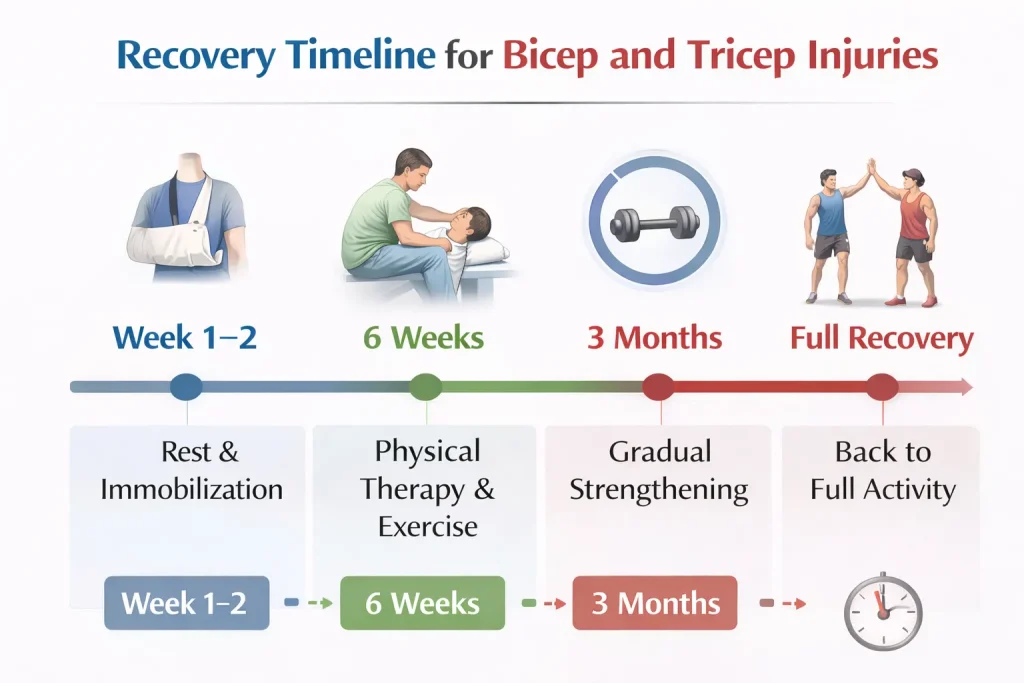
Bicep muscle tear recovery depends on severity. Mild cases heal in weeks. Surgical cases may take months. Understanding bicep tear recovery time helps manage expectations.
Bicep Tear Recovery Timeline
| Type of Bicep Tear | Recovery Time |
| Micro tear / Grade 1 strain | 1–2 weeks |
| Partial proximal bicep tear | 4–8 weeks |
| Complete proximal bicep tear (no surgery) | 6–10 weeks |
| Distal bicep tear (with surgery) | 3–5 months |
| Distal bicep tear recovery time without surgery | 6–10 weeks (reduced strength) |
Bicep tear recovery time without surgery is shorter, but residual weakness – particularly in forearm rotation – is common after non-surgical management of complete distal tears.
Bicep tear recovery timeline after surgery (month by month):
- Week 1–2: Arm in a sling; no elbow movement; focus on pain and swelling control
- Week 2–6: Gentle range of motion exercises begin; sling use continues
- Week 6–10: Active elbow bending and light strengthening start
- Month 3–4: Progressive resistance training; most daily activities resume
- Month 4–6: Return to heavier activity and gym work; sport-specific training begins
Month 6+: Full strength recovery; return to heavy lifting or sport
Triceps Recovery
Torn tricep recovery time varies. Physical therapy is key to regaining strength and motion.
Recovery is like rebuilding a bridge. Rushing can cause failure again.
Torn Tricep Recovery Time: Full Breakdown
| Injury Type | Recovery Time |
| Pulled tricep (Grade 1 strain) | 1–3 weeks |
| Grade 2 partial tear | 4–8 weeks |
| Torn tricep tendon (Grade 3, no surgery) | Limited recovery possible |
| Torn tricep surgery recovery time | 4–6 months |
| Tricep tendon tear recovery time (post-op) | 4–6 months |
| Partial tricep tear recovery time | 6–10 weeks |
Tricep recovery time after surgery: Following surgical repair of a triceps tendon, the general recovery programme is:
- 0–4 weeks: Immobilization in a cast or brace; no elbow movement
- 4–8 weeks: Gradual range of motion started by a physiotherapist
- 8–12 weeks: Active strengthening begins; light resistance exercises
- 3–4 months: Return to daily pushing activities without pain
- 4–6 months: Return to gym, sport, and heavy physical work
Are Bicep Tears Permanent?
A very commonly searched question. The honest answer is nuanced.
Without treatment:
- A complete distal bicep tear that is not surgically repaired leads to permanent weakness – particularly in forearm supination (rotating the palm upward) and elbow flexion strength. This can be a 30–40% reduction in supination strength.
- A proximal bicep tear left untreated may cause a visible Popeye deformity permanently, but the functional impact is often mild because the short head compensates.
With appropriate treatment:
- Most bicep tears – when treated properly – do not result in permanent functional loss
- Surgical repair of distal tears achieves very good strength restoration in most patients
- Proximal tears managed conservatively still allow excellent overall arm function
So the key message is: bicep tears are not automatically permanent, but delayed or missed treatment increases the risk of lasting weakness and deformity. Early evaluation by an orthopedic specialist gives the best outcome.
Bicep and Tricep Recovery Time: Combined Overview
Many gym-goers and active individuals ask about biceps and triceps recovery time after training, either for normal muscle soreness or after injury.
Normal muscle recovery (DOMS after training):
- Biceps and triceps typically recover from a training session in 48–72 hours
- Intense or high-volume sessions may require 72–96 hours
- Micro tears from training resolve with rest, sleep, and adequate protein intake
Recovery from injury:
| Injury | Bicep Recovery Time | Tricep Recovery Time |
| Grade 1 strain | 1–2 weeks | 1–3 weeks |
| Grade 2 partial tear | 4–8 weeks | 4–8 weeks |
| Grade 3 complete tear (conservative) | 6–10 weeks (limited) | Poor without surgery |
| Grade 3 complete tear (surgical) | 3–5 months | 4–6 months |
Biceps vs Triceps Injuries: Key Differences
| Feature | Biceps Injury | Triceps Injury |
| Location | Front of arm | Back of arm |
| Main problem | Bending weakness | Straightening weakness |
| Common sign | Popeye bulge | Elbow pain |
| Search intent | biceps vs triceps injury | bicep vs tricep tear |

When to See a Doctor
You should seek care if you notice:
- Severe pain
- Arm deformity
- Loss of strength
- Ongoing swelling
- Signs of a ruptured bicep or torn tendon
Early care prevents long-term damage.
Conclusion
Biceps and triceps tendon injuries are serious but treatable. Whether it is a bicep muscle tear, bicep tendon tear, torn tricep muscle, or ruptured tendon in the elbow, early diagnosis and proper care make a major difference.
Listen to your body. Pain is not something to push through when tendons are involved. With the right treatment and patience, most people return to full strength and daily activity.
FAQs
What is the difference between a bicep muscle tear and a bicep tendon tear?
A bicep muscle tear affects the muscle fibers in the upper arm, while a bicep tendon tear involves the cord that connects the muscle to the shoulder or elbow bone. Tendon tears usually cause more weakness and may require surgery for full recovery.
What are the most common symptoms of a torn bicep tendon?
Common torn bicep tendon symptoms include sudden arm or elbow pain, a popping sound, swelling, bruising, and weakness when lifting or rotating the forearm. Some people also notice a visible bulge in the upper arm called a Popeye deformity.
How serious is a distal biceps tendon tear?
A distal biceps tendon tear is considered serious because it affects elbow strength and forearm rotation. Without proper treatment, it can lead to long-term weakness. Many active individuals need surgery to restore strength and normal arm function.
Can a torn bicep muscle heal without surgery?
A torn bicep muscle can sometimes heal without surgery if the tear is partial and the strength loss is mild. Rest, physical therapy, and gradual strengthening are often effective. Complete tears or ongoing weakness may need surgical repair for the best results.
What does a triceps tendon tear feel like?
A triceps tendon tear often causes sudden pain at the back of the elbow, swelling, and weakness when trying to straighten the arm. Some people feel a pop at the time of injury and notice difficulty pushing objects or supporting body weight.
How long is the recovery time for a torn tricep muscle?
Torn tricep recovery time depends on injury severity. Mild tears may heal in six to eight weeks with therapy. Complete tears that require surgery can take several months before full strength and elbow function safely return.
What causes a ruptured tendon in the elbow?
A ruptured tendon in the elbow is usually caused by sudden force, heavy lifting, falls, or long-term overuse. Age-related tendon weakening, smoking, and repetitive strain increase the risk of a tendon snapping during everyday or athletic activities.
How can you tell the difference between a tricep strain and a tricep tear?
A tricep strain causes mild pain and tightness but usually improves with rest. A tricep tear leads to sharp pain, swelling, weakness, and trouble straightening the arm. Imaging tests help confirm whether the tendon or muscle is torn.
Is surgery always required for a ruptured bicep tendon?
Surgery is not always required for a ruptured bicep, especially in older or less active individuals. However, complete tears in the dominant arm often need surgery to restore strength, prevent muscle deformity, and improve long-term arm function.
When should I see a doctor for a bicep or tricep injury?
You should see a doctor if you experience severe arm pain, swelling, bruising, weakness, or a visible muscle bulge. Early evaluation of a bicep injury, tendon tear, or snapped tendon in elbow helps prevent permanent strength loss.

What does a torn tricep look like?
A torn tricep typically shows swelling and bruising behind the elbow within 24–48 hours. In complete tears, a visible gap near the elbow and abnormal muscle bunching may appear.
How long does a tricep strain take to heal?
Grade 1 tricep strains heal in 1–3 weeks. Grade 2 partial tears take 4–8 weeks. Recovery depends on rest quality, physiotherapy adherence, and return-to-activity timing.
What are micro tears in the bicep?
Micro tears are tiny fiber damages from intense training. They cause normal post-workout soreness (DOMS) and resolve with rest in 48–72 hours. They are not clinically significant injuries.
Can a torn tricep heal on its own?
Partial tears can heal with rest and physiotherapy. Complete triceps tendon ruptures do not reattach without surgery. Delayed repair significantly worsens long-term outcomes.
What does a long head tricep tear feel like?
Long head tricep tears cause deep aching pain at the back of the shoulder and upper arm, worsening with overhead movements and arm extension from overhead positions.
What causes pain between the bicep and tricep?
Pain in this region can come from medial triceps strain, bicep tendon irritation, ulnar nerve irritation, or general muscle overuse. Numbness or tingling suggests nerve involvement.
Are bicep tears permanent?
Without treatment, complete tears – especially at the elbow – can cause permanent strength reduction. With appropriate surgery and rehabilitation, most patients recover excellent arm function.
What is the recovery time for biceps and triceps after training?
Normal post-training soreness resolves in 48–72 hours. Injury recovery ranges from 1–3 weeks for mild strains to 4–6 months for surgically repaired complete tendon tears.
How do I know if I tore my tricep?
Signs include a sudden pop at the elbow, immediate sharp pain, inability to push or straighten the arm, swelling behind the elbow, and visible bruising developing within hours.
What is the tricep tear test doctors use?
The most common test asks the patient to extend the elbow against gravity or resistance. Inability to extend suggests a complete tear. A palpable gap near the elbow confirms significant rupture.
How long does a pulled tricep take to heal?
A pulled tricep (Grade 1 strain) typically heals in 1–3 weeks with rest, ice, and gradual return to activity. Returning to heavy pressing too early significantly increases re-injury risk.
What does a bicep snap or pop mean?
A snap or pop during a bicep exercise typically means the tendon has ruptured or significantly torn. It is usually followed by immediate pain, weakness, and visible arm shape change.
Can you train with a strained tricep?
Training through a tricep strain is not recommended. It delays healing and risks progression to a more serious tear. Rest and physiotherapy should come before returning to pushing exercises.