Table of Contents
Key Takeaways
- Bow legs in toddlers under two years old are completely normal and typically resolve on their own without any treatment.
- Massage, stretching, calcium supplements, and traditional remedies cannot correct bow leg bone alignment in children or adults under any circumstances.
- Persistent or worsening bow legs after age three need medical evaluation because natural correction becomes unlikely without professional intervention.
- Untreated bow legs cause real long-term harm, including early knee arthritis, cartilage damage, abnormal gait, and reduced activity tolerance over time.
- Guided growth surgery is minimally invasive, safe, and uses the child’s own growth to gradually straighten legs without large incisions.
- Adults cannot correct bow leg bone alignment without surgery because growth plates close permanently between the ages of sixteen and eighteen.
- Severe bow legs can reduce standing height by one to three centimeters, and corrective surgery can restore some of that lost height.
- Bow legs in adults are most commonly caused by progressive knee osteoarthritis wearing down the medial cartilage on the inner knee.
- Offloader knee braces significantly reduce inner knee pain in adults with bow legs but cannot correct the underlying structural bone deformity.
- The guided growth surgery window closes with skeletal maturity, making early orthopedic evaluation between ages three and fourteen critically important for children.
Why Parents Look for Natural Solutions
When parents first notice bow legs in their child, it’s common to hope that the condition will correct itself with time, exercise, or simple remedies. Relatives and well-wishers often advise “wait and watch,” “give more calcium,” or “massage the legs daily.” While some of these suggestions come from experience, others are myths that can delay proper treatment.
This blog will separate correcting bow legs naturally myths from medical facts—so you know when bow legs are part of normal growth, and when medical help is necessary.
Understanding Bow Legs in Children
What Are Bow Legs?
Bow legs (medical term: genu varum) occur when the legs curve outward at the knees, creating a gap between them even when the ankles touch.
Normal vs Abnormal Bow Legs
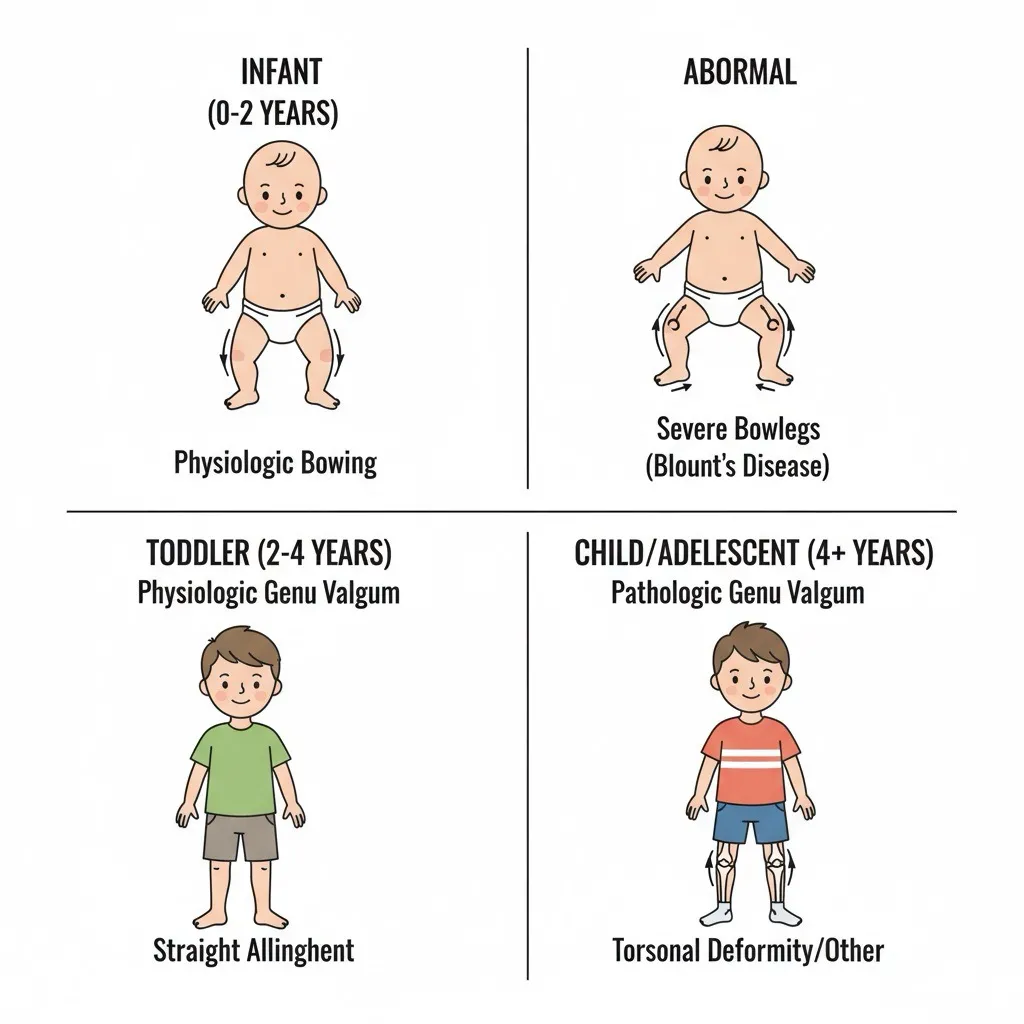
- Normal: In toddlers under 2 years old, bowing is often a part of natural development and usually corrects on its own.
- Abnormal: Persistent or worsening bowing after age 3, or bowing accompanied by pain, limping, or difficulty walking, may indicate an underlying condition such as Blount’s disease or rickets.
Normal Legs vs Bow Legs: How to Tell the Difference
Many parents and adults are unsure whether their leg alignment falls within the normal range or represents a genuine deformity.
| Feature | Normal Legs | Bow Legs (Genu Varum) |
| Knee position when standing | Knees touch or nearly touch | Knees stay apart |
| Ankle position | Ankles together | Ankles together but knees separated |
| Leg shape | Straight vertical line | Outward curve at the knee |
| Walking pattern | Smooth, balanced gait | May have waddling or abnormal gait |
| X-ray alignment | Mechanical axis through knee center | Mechanical axis falls medial to knee |
A simple standing test: when feet are together, if there is a gap between the knees of more than 5–6 cm in an adult, this warrants orthopedic evaluation.

Common Myths About Correcting Bow Legs
Myth 1: “Bow legs always straighten out naturally.”
Fact: While mild bowing is normal in toddlers, if it continues beyond age 3 or gets worse, natural correction is unlikely. Early evaluation is key.
Myth 2: “Massaging or stretching the legs can fix bow legs.”
Fact: No amount of massage, stretching, or traditional remedies can realign bones if the growth plate is causing the deformity. Massages may improve circulation, but won’t correct bone alignment.
Myth 3: “Extra calcium or vitamins will make the legs straight.”
Fact: Nutritional support is important, especially in cases of rickets. But in structural deformities like Blount’s disease, vitamins alone won’t correct the curve. Medical guidance is needed.
Myth 4: “Special shoes or braces can cure bow legs in all cases.”
Fact: Braces may help in select conditions like very early Blount’s disease. But for most cases, especially after age 3, braces alone are rarely effective.
Myth 5: “Surgery for bow legs is always major and risky.”
Fact: Modern options like guided growth surgery are minimally invasive, safe, and use the child’s own growth to straighten the legs gradually—avoiding large cuts or long recovery times.
Myth 6: “Bow legs are only a cosmetic problem.”
Fact: Untreated moderate to severe bow legs cause real long-term health consequences including:
- Early-onset knee osteoarthritis from medial compartment overloading
- Meniscus and cartilage damage
- IT band syndrome and hip pain
- Progressive gait abnormalities
- Reduced activity tolerance
Bow legs are not just about appearance – they affect joint health, walking efficiency, and quality of life over time.
Myth 7: “Bow legs make you shorter.”
Fact: This is a nuanced question that many people search for. Bow legs can affect perceived and measured height in the following ways:
- The outward curvature of the bones reduces the vertical height that the leg contributes
- Severe bow legs can cause a measurable height reduction of a few centimeters compared to what the person’s height would be with straight legs
Medical Facts Parents Should Know
1. Age Matters
- Natural correction is expected only up to age 2–3.
- After that, persistent bowing needs a medical assessment.
2. Diagnosis Is Crucial
- X-rays and clinical evaluation help determine whether bowed legs are part of natural growth or due to an underlying disease.
3. Early Treatment = Better Results
- Guided growth surgery works best when growth plates are still open (between ages 3–14).
- Delayed correction can lead to permanent deformity, early arthritis, and joint pain.
4. Non-Surgical vs Surgical Options
- Observation and nutritional correction (for rickets) may be enough in mild cases.
- Significant or progressive bowing often needs guided growth surgery or, in older children, osteotomy.
Bow Legs vs Normal Legs: Physiologic vs Pathological
Understanding the difference between physiologic (normal developmental) and pathological bow legs is essential for deciding when to act.
Physiologic Bow Legs
- Present from birth to approximately 18 months – completely normal
- Both legs are equally affected
- The child walks normally and has no pain
- Gradual improvement occurs between age 2 and age 4
- No treatment required – monitoring only
Pathological Bow Legs
Signs that suggest an abnormal cause include:
- Bowing that continues or worsens after age 3
- Bowing that is unequal between both legs
- Short stature alongside bowing (may suggest skeletal dysplasia)
- Child limps or complains of pain
- Bowing that is severe or rapidly progressing
- Associated signs of rickets (widened wrists, delayed walking, dental problems)
Common pathological causes:
- Blount’s disease – abnormal growth plate on the inner tibia
- Rickets – vitamin D deficiency causing soft bone deformation
- Skeletal dysplasia – genetic conditions affecting bone growth
- Fractures healed in incorrect alignment
- Knee osteoarthritis in adults, causing progressive varus
Bow Legs in Adults: Can They Be Corrected?
Adults frequently ask: “Can bow legs be corrected in adults?” and “How to fix bow legs in adults without surgery?”
Can bow legs be corrected without surgery in adults?
The honest answer is: true bone alignment correction is not possible without surgery in adults. Once the growth plates have closed (typically by age 16–18), the bones are fixed in their current shape. No exercise, brace, massage, or natural remedy changes the bony angle.
However, non-surgical management in adults can:
- Reduce knee pain significantly
- Improve walking pattern and balance
- Slow the progression of arthritis
- Improve quality of life
Non-surgical options for adults with bow legs:
- Physiotherapy and targeted exercises – strengthening hip abductors, quadriceps, and glute muscles
- Offloader knee braces – reduce medial compartment pressure, significantly improving pain
- Orthotic insoles – improve load distribution during walking
- Weight management – reducing body weight decreases medial knee stress
- Activity modification – choosing low-impact exercise like cycling and swimming
How to Fix Bow Legs in Adults Without Surgery: Realistic Expectations
Non-surgical management does not correct the outward bone curve. It manages symptoms and slows deterioration. For patients with moderate to severe bow legs causing pain, progressive arthritis, or significant functional limitation, corrective osteotomy surgery is the most effective long-term solution.
How to Correct Bow Legs in Teens Without Surgery
Teenagers occupy an important middle ground. Depending on age and growth plate status:
- Teenagers aged 13–16 who still have open growth plates may still be candidates for guided growth surgery – a minimally invasive procedure that uses small implants to guide the remaining bone growth toward better alignment
- Teenagers who have completed growth need osteotomy surgery for structural correction
- For mild bowing without pain, physiotherapy and monitoring may be sufficient
Important: Teenagers with bow legs should be evaluated by an orthopedic specialist early – the window for guided growth closes with skeletal maturity.
Does Bow Legs Affect Running and Sports Performance?
Many people ask whether bowed legs affect running, sports, or athletic performance.
Do bow legs affect running?
Yes, bow legs can affect running in several ways:
- Altered biomechanics – the mechanical axis deviation changes how force is transmitted through the leg during running
- Increased medial knee stress – the inner knee takes more load with each stride
- IT band tension – the lateral structures are under greater tension, increasing risk of IT band syndrome
- Shin splints – abnormal lower leg alignment increases tibial stress during impact
Mild bow legs may cause no running problems at all. Moderate to severe bow legs can limit running distance and speed, and cause pain over time.
Are bow-legged people better athletes?
There is no evidence that bow legs provide an athletic advantage. Many successful athletes have neutral leg alignment. Some people with bow legs are highly athletic, but this is because of conditioning, technique, and talent – not because of their leg shape.
Famous athletes with bowed legs
Several well-known footballers and athletes appear to have bow-legged alignment. This is sometimes due to:
- Natural anatomical variation
- Muscle bulk around the thighs and calves that visually accentuates the gap
- Camera angles during play
Playing football does not cause bow legs, and bow legs do not make someone a better footballer. Many athletes with apparent bowing have been evaluated and found to have normal mechanical axes.
Are bow legs allowed in the army?
Military medical fitness standards vary by country and branch. In general:
- Mild, asymptomatic bow legs are typically acceptable in most military fitness assessments
- Significant bowing affecting running, marching, or load-bearing can be considered disqualifying
- In India, the armed forces fitness boards assess bow legs based on functional impact and severity – mild cases that do not affect performance are generally passed
Candidates concerned about bow legs should get a formal orthopedic assessment and measurement before their medical examination.
Bow Legs and Height: The Complete Answer
Height is one of the most frequently searched concerns related to bow legs.
Do bow legs affect height?
Yes, in the following ways:
- The outward curvature of the bones reduces the vertical contribution of the leg to standing height
- In severe bow legs, this can reduce standing height by 1–3 centimeters compared to equivalent straight-legged height
- The effect is proportional to the severity of the varus angle
Does being bow-legged make you shorter?
Technically, yes – but the effect varies:
- Mild bow legs: minimal to no measurable height difference
- Moderate bow legs: small but measurable reduction (0.5–1.5 cm)
- Severe bow legs: more noticeable reduction (1–3 cm or more)
Does fixing bow legs increase height?
Corrective surgery that straightens the leg alignment does increase standing height. The amount depends on how much correction is achieved. Patients should expect:
- A modest height increase – typically a few millimeters to 2 centimeters
- Not a dramatic change – bow leg surgery is not a height-gain procedure
- The primary goal of surgery is pain relief, alignment correction, and joint preservation
Does bow leg surgery make you taller?
Yes, by a small amount. The straighter the corrected leg, the taller the standing measurement. However, patients should have realistic expectations – the gain is modest and depends on original deformity severity.
How to Hide Bow Legs When Walking and Dressing
For people managing bow legs non-surgically, practical day-to-day strategies can reduce the visual appearance.
How to hide bow legs when walking:
- Focus on walking with feet pointing straight forward rather than outward
- Engage core and glute muscles during walking to improve posture
- Physiotherapy for gait retraining can significantly improve the walking pattern
Clothing strategies:
- Straight-leg or relaxed-fit trousers are more flattering than tapered or skinny fits
- Darker trouser colours reduce visual contrast
- Avoid very wide-leg trousers that accentuate the gap
- Longer lengths that cover the knee area reduce focus on the bowing
- Avoid shorts that end exactly at the knee
Footwear:
- Supportive footwear with good arch support improves lower limb alignment during walking
- Avoid completely flat shoes (flip-flops, ballet flats), which worsen medial knee stress
- A slight heel elevation (2–3 cm) can slightly improve the knee angle during walking
These are comfort and cosmetic strategies – they do not correct the underlying deformity. For lasting structural improvement, medical evaluation remains the appropriate path.
When Should Parents Seek Medical Advice?
- Bow legs worsening after age 3
- Unequal bowing between legs
- Pain, limping, or difficulty running
- Family history of bone deformities
- Concerns about appearance affecting confidence

Dr. Divya Ahuja’s Approach: Balancing Reassurance and Expertise
Dr. Divya Ahuja, an expert in pediatric limb deformities and guided growth surgery, understands both the worries of parents and the science of bone growth. His approach:
- Careful evaluation to distinguish normal from abnormal bowing
- Honest guidance on whether observation, nutrition, or surgery is needed
- Minimally invasive correction when necessary, with focus on quick recovery and long-term joint health
Our Clinical Locations
Tap a location to view timings, contact, and map.
Broadway Healthcare, Dadar East
Clinic Info
- 📍 Broadway Healthcare, Dadar East, Mumbai
- 🕒 Wednesdays · 10:00 AM – 12:00 NOON
- 📞 Appointments: +91 93213 17227
Sweet Clinics, Vashi, Navi Mumbai
Clinic Info
- 📍 Sweet Clinics, Vashi, Navi Mumbai
- 🕒 Fridays · 10:00 AM – 12:00 NOON
- 📞 Appointments: +91 93213 17227
Heal Well Speciality Clinic, Thane West
Clinic & OPD Info
- 📍 Heal Well Speciality Clinic, Thane West
- 🕒 Every Wednesday 10:00 AM – 11:00 AM
- 📞 Appointments: +91 81691 04438
Mangal Anand Hospital, Chembur Mumbai
Clinic & OPD Info
- 📍 Mangal Anand Hospital, Chembur Mumbai
- 🕒 Monday, Wednesday, Friday 03-07 PM, Thursday 06-07 PM, Free OPD Saturday 02-04 PM
- 📞 Appointments: +91 70212 18182
SRV Hospitals, Tilaknagar, Chembur
Clinic Info
- 📍 SRV Hospitals, Tilaknagar, Chembur
- 🕒 Monday, Wednesday, Friday 11 AM-12 PM
- 📞 Appointments: +91 84518 00800
Conclusion: Myths Delay, Facts Heal
Correcting bow legs is not about home remedies or waiting forever. It’s about knowing the facts, acting early, and choosing the safest medical option. With Dr. Divya Ahuja’s expertise, families in Mumbai and Navi Mumbai can be confident that their child will get the right care at the right time.
FAQs
Can bow legs be corrected naturally?
Often, yes—in infants and toddlers. Physiologic bowing is common up to ~2 years and usually straightens on its own by ages 3–4 without treatment. Past that age, persistent or worsening bowing should be assessed.
Do bow legs always need treatment?
No. Treat only when there’s pain, progressive deformity, asymmetry, limp, functional limits, short stature, or an underlying disease (rickets, Blount disease, skeletal dysplasia). Cosmetic concerns alone are a personal choice.
Can vitamin D fix bow legs?
It can help if the cause is rickets (vitamin D ± calcium deficiency). In those cases, correcting the deficiency lets bones mineralize and often improves alignment in growing children. It won’t straighten structural bowing in teens/adults by itself.
Is it too late to treat bow legs as an adult?
No. Adults can be treated, but not with growth-guided methods. Options include bracing for symptoms, targeted physio, and corrective osteotomy (bone realignment surgery) when deformity causes pain, arthritis risk, or gait issues.
At what age do normal bow legs usually correct?
Birth–18 months: bowed alignment is common.
~2 years: legs approach straight.
~3–4 years: mild knock-knee phase is common.
~7–8 years adult-like alignment.
Are bow-legged people more athletic?
Not inherently. Many athletes have neutral alignment. Some sports tolerate or even incidentally select for certain builds, but bowing doesn’t guarantee better speed, power, or agility. Training, conditioning, and technique matter far more.
Why do some footballers look bow-legged?
Several reasons: natural alignment variation, muscle development around the thighs/calf that accentuates the gap, and camera angles. It isn’t caused by playing football, and most have normal biomechanics.
Does fixing bow legs make you taller?
Surgery can slightly increase measured height if a large varus angle is corrected (straightening increases vertical stature by a small amount). Expect millimeters to a couple of centimeters at most, not a dramatic change.
Are bow legs genetic?
Alignment has a heritable component. Family patterns exist, but many cases are physiologic (normal variation) or due to nutritional/metabolic causes. A family history raises likelihood, not certainty.
Are bow legs allowed in the army?
Standards vary by country and branch. Generally, mild, asymptomatic bowing is acceptable; significant deformity affecting running, marching, or load-bearing can be disqualifying. In India, fitness boards consider function and severity—get an ortho assessment before applying.
Who is most at risk for rickets-related bowing?
Rapidly growing infants/toddlers with low sun exposure
Diets low in vitamin D and calcium
Exclusive breastfeeding without vitamin D supplementation (in some cases)
Darker skin living at higher latitudes
Malabsorption (celiac, IBD) or chronic kidney/liver disease
Can insoles or braces correct bow legs?
Insoles don’t realign bones. They may ease knee/foot pain by improving load distribution. Bracing can help young children with specific conditions (e.g., early Blount disease) but won’t correct established bony varus in teens/adults.
What happens if bow legs go untreated?
If mild and physiologic, nothing. If moderate/severe, risks include medial knee overload, meniscus wear, early osteoarthritis, IT-band/hamstring strain, and gait inefficiency. Progression depends on angle, weight, activity, and cause.
Which muscles tend to be weak or tight in a bow-legged posture?
Common patterns (varies by person):
Weak/underused: hip abductors (gluteus medius), external rotators, core stabilizers.
Tight/overused: adductors, hamstrings, iliotibial band, calf.
A physio can tailor a program focusing on hip abductor strength, single-leg control, and mobility.
How can I make bow legs less noticeable without surgery?
Physio program: hip/glute strengthening, neuromuscular control, weight management to reduce knee load.
Footwear/insoles: for comfort and load sharing (cosmetic effect minimal).
Style hacks: straight/relaxed-fit trousers, darker colors, avoid highly tapered legs.
Activity choices: low-impact cardio (cycling, swimming) plus strength training.

Do bow legs get worse with age?
Yes. Without treatment, bow legs worsen progressively in adults due to increasing medial knee cartilage wear, muscle weakness, and weight gain accelerating joint degeneration over time.
What causes bow legs in adults?
Common causes include knee osteoarthritis, old fractures healed incorrectly, Paget’s disease, obesity increasing medial knee load, rickets during childhood, and untreated developmental bow legs persisting into adulthood.
How to prevent bow legs from worsening?
Maintain healthy weight, strengthen hip and knee muscles, wear supportive footwear, use offloader braces when needed, and seek early orthopedic evaluation before deformity and arthritis progress significantly.
What is mild bow legs and does it need treatment?
Mild bow legs show slight outward curvature without significant pain or functional limitation. Treatment focuses on physiotherapy and monitoring. Surgery is considered only if deformity progresses or symptoms worsen.
How to fix sakang legs?
Sakang legs refer to bow-legged appearance. Mild cases improve with physiotherapy and exercises. Structural bony sakang legs require corrective osteotomy surgery for permanent alignment correction in adults.
Does bow legs affect posture?
Yes. Bow legs alter the entire lower limb chain including hip, pelvis, and spine alignment. This can cause compensatory postural changes including forward pelvic tilt and lower back discomfort over time.
What is a mermaid splint for bow legs?
A mermaid splint is a traditional folk remedy that ties legs together hoping to straighten them. It has no medical evidence of effectiveness and can be harmful, potentially causing circulation and skin problems.