Table of Contents
Introduction
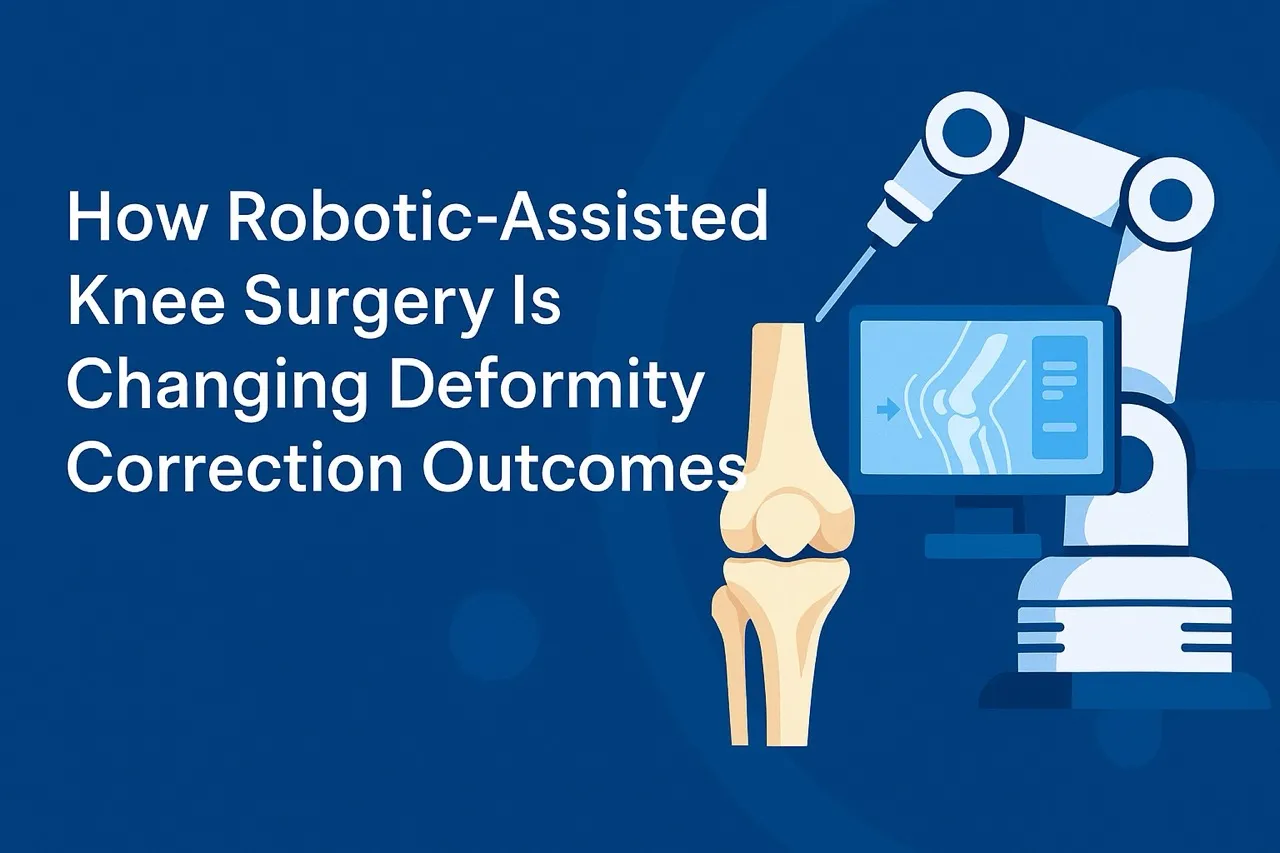
Over the last decade, robotic-assisted knee surgery has emerged as one of the most significant advancements in orthopedics. For patients with complex knee deformities—such as severe varus, valgus, or post-traumatic conditions—traditional surgery often comes with challenges in alignment, ligament balance, and long-term outcomes. Robotic technology is changing that story.
At deformity.co.in, under the leadership of Dr. Divya Ahuja, robotic technology is being used to plan and execute surgeries with unprecedented accuracy. By combining 3D imaging, data-driven planning, and real-time surgical guidance, robotic-assisted techniques help deliver precise alignment, better ligament balance, and faster recovery – all of which are critical in complex deformity correction cases.
Why Robotic-Assisted Surgery is a Game-Changer for Deformity Correction
Precision in Complex Anatomies
In knees affected by deformities, even a few millimeters of error can affect joint function and implant longevity. Robotic systems allow surgeons to create a 3D digital model of the patient’s knee before surgery. This detailed map helps the surgeon plan exact bone resections and implant placement, even in cases where bone loss or rotational deformities complicate the procedure.
During surgery, the robot provides real-time feedback, helping maintain near-perfect alignment throughout the procedure. This level of accuracy is extremely difficult to achieve with conventional instruments alone.
Ligament Balancing With Sub-Millimetric Control
Achieving proper ligament balance is one of the most critical steps in knee replacement, especially in deformity correction. Traditional methods rely on manual judgment, which can vary. Robotic technology, on the other hand, allows the surgeon to measure and adjust ligament tension with sub-millimeter precision.
This ensures that the knee feels stable after surgery, reduces the need for extensive soft tissue releases, and minimizes postoperative pain. Proper balance also plays a major role in improving implant longevity and reducing revision rates.
Personalized Implant Positioning
No two knees are identical. Robotics helps tailor the implant position to each patient’s unique anatomy. Instead of using standard alignment guides, the system places the implant based on patient-specific 3D data, which optimizes biomechanics and improves overall function after surgery.
Robotic vs Conventional Knee Arthroplasty Techniques
When it comes to total knee arthroplasty (TKA) for deformities, the differences between conventional and robotic-assisted techniques are striking:
Robotic vs Conventional Knee Surgery
A quick comparison of planning, precision, recovery & outcomes
Research consistently shows that robotic-assisted knee replacement improves alignment, reduces variability, and lowers the chance of “outliers” in deformity correction. Some studies have shown alignment errors reduced by up to 66% compared to manual techniques.
Patient Recovery and Functional Outcomes
Faster Recovery After Surgery
One of the most noticeable benefits for patients is how quickly they recover after robotic-assisted surgery. Because the robot enables more precise bone cuts and ligament balancing, there is less trauma to surrounding soft tissues, smaller incisions, and reduced blood loss.
Most patients can start walking sooner, experience less pain in the immediate postoperative period, and often leave the hospital earlier compared to those who undergo conventional surgery.
Long-Term Functional Results
Long-term results are equally impressive. Proper alignment and ligament balance translate to:
- Better implant longevity
- Higher patient satisfaction scores
- Lower risk of revision surgery
For example, a patient with a severe varus deformity underwent robotic-assisted knee replacement under Dr. Divya Ahuja’s care. Within weeks, she regained stable mobility, minimal pain, and improved joint function – all thanks to precise correction achieved during surgery.
Step-by-Step: Robotic-Assisted Knee Surgery Workflow
From 3D planning to faster recovery — a clear, guided pathway for complex deformity correction.
-
3D Planning
CT/MRI scans create a precise 3D model of your knee to map bone cuts and ideal implant alignment.
Patient-specific 3D model → fewer surprises in the OR. -
Virtual Surgery
The surgeon rehearses the operation digitally, fine-tuning alignment, sizing, and implant position.
Digital rehearsal → optimized plan before the first cut. -
Real-Time Guidance
Intra-operative sensors and a robotic arm help deliver sub-millimetric precision at every step.
Live feedback → consistent, reproducible accuracy. -
Precise Ligament Balancing
Quantified tensioning preserves soft tissue and stabilizes the joint for natural movement.
Measured balance → stability, comfort, longevity. -
Faster Recovery
Less tissue trauma often means earlier mobilization, less pain, and predictable outcomes.
Efficient healing → back to daily life sooner.
The Future of Robotic Surgery in Deformity Correction
Robotic surgery is still evolving rapidly. Here’s what’s on the horizon:
Integration of AI and Data-Driven Planning
Artificial intelligence will soon play a larger role in predicting outcomes based on patient data. AI algorithms will help surgeons plan surgeries even more precisely, especially for complex deformities.
Expanding Indications
Robotic systems are increasingly being used in revision surgeries, post-traumatic deformities, and cases with severe bone loss—areas where conventional techniques face significant limitations.
Greater Accessibility in India
As technology becomes more widespread and cost-effective, more patients in India will have access to these advanced surgical options.
With her specialized training and early adoption of robotics, Dr. Divya Ahuja is at the forefront of this movement in India.
The Future of Robotic Surgery in Deformity Correction
From data-driven planning to AI-guided execution and AR navigation — where precision orthopedics is headed next.
-
2025 · Now AI-Assisted Planning & Sub-mm Precision
Routine 3D mapping, quantified ligament balance, and reproducible alignment reduce outliers in complex deformities.
Standardized precision → fewer revisions, predictable outcomes. -
2026–2028 Predictive Models & Workflow Automation
Outcome prediction using large datasets; automated cut plans; live dashboards to guide soft-tissue strategy.
Decision support → faster, more consistent intra-op choices. -
2027–2029 AR Navigation & Haptics
Augmented reality overlays alignment targets; haptic feedback refines resections and balancing in real time.
See-through guidance → fewer soft-tissue releases, safer cuts. -
2029–2031 Connected Robotics & Tele-Mentoring
Cloud-based updates, remote oversight for complex cases, standardized protocols across centers.
Scalable quality → consistent outcomes beyond metros. -
2032+ Autonomy & Cost-Accessible Robotics
Semi-autonomous execution within surgeon-set boundaries; lean platforms expand access across India.
More patients → precision care becomes the default.
Why Choose Robotic-Assisted Knee Surgery by Dr. Divya Ahuja
Choosing where to have your surgery is just as important as the procedure itself. At deformity.co.in, patients benefit from:
- Expertise: Dr. Divya Ahuja has extensive experience in managing complex deformities using robotic-assisted arthroplasty.
- Technology: The clinic uses state-of-the-art robotic systems for planning and execution.
- Patient-Centric Care: Focus on precision, safety, faster recovery, and long-lasting results.
Our Clinical Locations
Tap a location to view timings, contact, and map.
Broadway Healthcare, Dadar East
Broadway Healthcare, Dadar East
Clinic Info
- 📍 Broadway Healthcare, Dadar East, Mumbai
- 🕒 Wednesdays · 10:00 AM – 12:00 NOON
- 📞 Appointments: +91 93213 17227
Sweet Clinics, Vashi, Navi Mumbai
Sweet Clinics, Vashi, Navi Mumbai
Clinic Info
- 📍 Sweet Clinics, Vashi, Navi Mumbai
- 🕒 Fridays · 10:00 AM – 12:00 NOON
- 📞 Appointments: +91 93213 17227
Heal Well Speciality Clinic, Thane West
Heal Well Speciality Clinic, Thane West
Clinic & OPD Info
- 📍 Heal Well Speciality Clinic, Thane West
- 🕒 Every Wednesday 10:00 AM – 11:00 AM
- 📞 Appointments: +91 81691 04438
Mangal Anand Hospital, Chembur Mumbai
Mangal Anand Hospital, Chembur Mumbai
Clinic & OPD Info
- 📍 Mangal Anand Hospital, Chembur Mumbai
- 🕒 Monday, Wednesday, Friday 03-07 PM, Thursday 06-07 PM, Free OPD Saturday 02-04 PM
- 📞 Appointments: +91 70212 18182
SRV Hospitals, Tilaknagar, Chembur
SRV Hospitals, Tilaknagar, Chembur
Clinic Info
- 📍 SRV Hospitals, Tilaknagar, Chembur
- 🕒 Monday, Wednesday, Friday 11 AM-12 PM
- 📞 Appointments: +91 84518 00800
FAQs
Is robotic-assisted knee surgery safe for severe deformities?
Yes. In fact, it’s particularly beneficial in complex cases because it allows for more accurate alignment and planning.
How does robotic technology improve ligament balance during surgery?
It provides real-time data that helps surgeons achieve optimal tension and alignment, which is critical for stability.
Are outcomes better than conventional knee surgery?
Yes. Robotic surgery typically results in better alignment, more predictable results, and faster recovery.
How long is the recovery after robotic knee replacement?
Most patients begin walking within 24–48 hours and return to normal activities earlier than those with traditional surgery.
Does robotic surgery cost more? Is it worth it?
It can be slightly more expensive, but the precision, reduced complications, and improved longevity make it a worthwhile investment for long-term joint health.