You reach out to stop a fall – and the sharp pain that follows tells you something is seriously wrong. A broken collarbone, or clavicle fracture, is one of those injuries that can happen in seconds and change your daily life for weeks.
This guide covers everything you need to know about a clavicle fracture – from understanding what the clavicle bone is and what causes it to break, to how it is treated, how long recovery takes, and what happens if it goes untreated. Whether you are a patient, a parent, or a caregiver, this article will give you clear, medically sound answers without the confusing jargon.
What is the Clavicle? Anatomy and Function
Before understanding a fracture, it helps to understand the bone itself.
Where is the Clavicle Located?
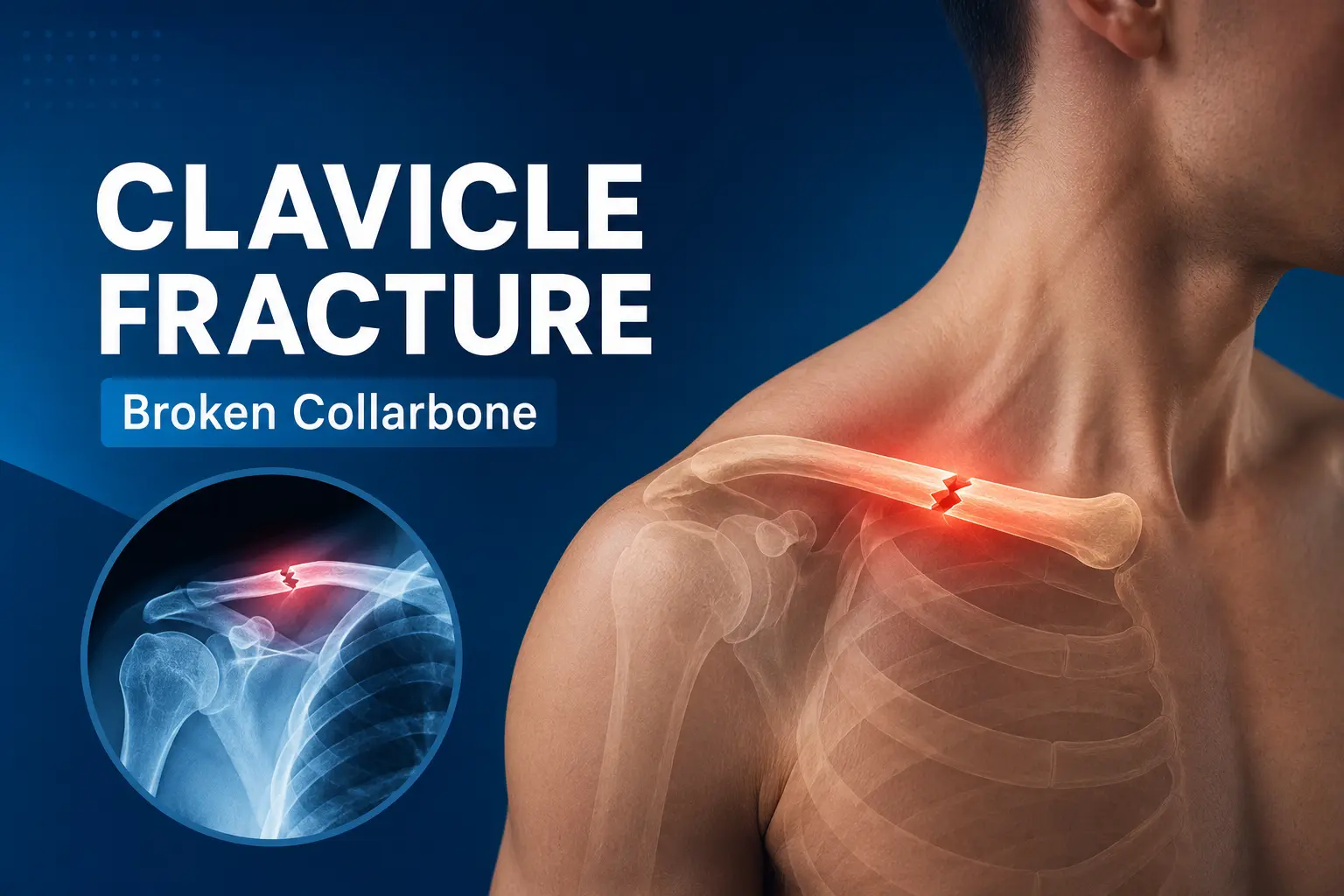
The clavicle – also known as the collarbone – is a long, S-shaped bone that sits horizontally at the top of your chest. It connects the sternum (breastbone) on one side to the scapula (shoulder blade) on the other. You can feel it easily by running your fingers along the front of your shoulder toward your neck.
The clavicle lies just beneath the skin, which is why fractures are often visible as a lump or deformity. Below it run important nerves and blood vessels that supply the arm, making this bone’s position clinically significant.
What Does the Collarbone Do?
The collarbone function goes beyond just being a structural bone:
- It acts as a strut that holds the shoulder away from the chest wall, allowing full arm movement
- It protects the major nerves and blood vessels running underneath it
- It transmits forces from the arm to the central skeleton
- It provides attachment points for important muscles of the neck and shoulder, including the clavicle muscle groups like the sternocleidomastoid and trapezius
Without an intact clavicle, the shoulder loses its structural support and drops downward and forward.
Structure of the Clavicle Bone
The clavicle has three parts:
- Medial end (sternal end): Connects to the sternum at the sternoclavicular joint
- Shaft (mid-portion): The long middle section – this is where most fractures occur
- Lateral end (acromial end): Connects to the acromion of the scapula at the acromioclavicular (AC) joint
The clavicle is one of the first bones to ossify during fetal development (clavicle ossification begins early in embryonic life) and one of the last to fully mature, completing ossification around age 25.
What is a Clavicle Fracture?
A clavicle fracture is a break in the collarbone. It accounts for approximately 5% of all adult fractures, making it one of the more frequently seen bone injuries in orthopaedic practice. It affects people across all age groups – from newborns to elderly adults.
Types of Clavicle Fractures
Clavicle fractures are not all the same. Understanding the type of fracture helps determine the right treatment approach.
- Non-displaced fracture: The bone cracks, but the broken ends remain in alignment. This type often heals well without surgery.
- Displaced fracture: The broken ends of the bone shift out of their normal position. A displaced clavicle fracture is more likely to require surgical intervention.
- Comminuted clavicle fracture: The bone breaks into three or more fragments. This is a more complex injury and often results from high-energy trauma.
- Lateral end clavicle fracture (distal clavicle fracture): A break near the shoulder end of the bone. Classification of lateral end clavicle fractures follows the Neer or Edinburgh system, which guides surgeons on whether surgery is needed.
- Midshaft clavicle fracture: A break in the middle third of the bone – this is the most common site of clavicle fracture.
- Newborn clavicle fracture: Can occur during delivery when a baby passes through the birth canal. It usually heals quickly without intervention.
Most Common Site of Clavicle Fracture
The middle third, or shaft, of the clavicle is where the majority of fractures occur. This section is structurally narrower and lacks the ligament support present at both ends, making it the weakest point under direct impact or load.
Left Clavicle Fracture vs Right Clavicle Fracture
There is no major clinical difference in how a left clavicle fracture or a right clavicle fracture is managed. The side affected doesn’t matter for practical recovery – a fracture on your dominant side will impact daily activities more significantly. In terms of ICD-10 coding (used in medical records), a left clavicle fracture ICD-10 and a right clavicle fracture ICD-10 are documented separately for administrative purposes.
What Causes a Broken Collarbone?
Clavicle fractures are most often caused by:
- A direct fall onto the shoulder: The most common cause. When you land on the point of your shoulder, the full force travels through the clavicle.
- Falling on an outstretched arm: The impact travels up through the arm and concentrates at the clavicle.
- A sports injury: Contact sports like football, wrestling, cycling, and cricket are common settings for this fracture.
- Road traffic accidents: High-energy collisions can cause comminuted or severely displaced fractures.
- Birth trauma: In newborns, the clavicle is the bone most commonly fractured during a difficult vaginal delivery.
The collarbone absorbs and redirects enormous force during these events. When the force exceeds what the bone can handle, it breaks – usually at its weakest midpoint.
Symptoms of a Clavicle Fracture
Knowing the symptoms of a clavicle fracture helps you act quickly and seek appropriate care. The most common signs include:
- Sudden, severe pain at the time of injury, directly over the collarbone
- Swelling (collarbone swelling) and bruising appearing within hours
- A visible bump or deformity at the fracture site – this is the broken ends of bone shifting under the skin
- The shoulder drooping downward and forward due to lost structural support
- Difficulty or inability to lift the arm because of pain
- A grinding or crackling sensation (crepitus) when trying to move the shoulder
- Clavicle bone pain radiating into the neck or upper arm
- Collarbone pain on the left side or right side, depending on which clavicle is fractured
- In some cases, an uneven clavicle – one side appears visibly higher or deformed compared to the other
Skin Tenting – What It Means
In some cases, the sharp end of the fractured clavicle pushes against the skin from underneath without actually breaking through. This is called skin tenting. While it looks alarming, it is not the same as an open fracture. However, it is a sign that the fracture is significantly displaced and requires urgent evaluation. Persistent tenting can compromise the blood supply to the skin and may become a surgical priority.
How is a Clavicle Fracture Diagnosed?
If you suspect a broken collarbone, visit an orthopaedic specialist. The diagnosis involves:
- History and physical examination: Your doctor will ask how the injury occurred, examine the shoulder, gently palpate the collarbone for tenderness and deformity, and check for nerve or vascular injury.
- Neurological check: Since the clavicle lies above major nerves, the doctor will test sensation and movement in the hand and arm to rule out nerve damage.
Clavicle X-Ray and Imaging
X-ray is the primary imaging tool for diagnosing a clavicle fracture. A standard clavicle X-ray shows the location and degree of displacement. Your doctor will typically order:
- AP (anteroposterior) view – the standard clavicle X-ray view
- Cephalic tilt view – helps visualise fracture displacement more clearly (clavicle fracture X-ray views)
- CT scan – ordered when the fracture involves the joints at either end (medial or lateral), or when the fracture is complex
A normal collarbone X-ray shows a smooth, continuous bone with no breaks or angulation. A fractured clavicle on X-ray shows a clear break, often with overlapping or displaced fragments. A clavicle plate X-ray after surgery will show the metal hardware holding the bone in proper alignment.
Clavicle Fracture Treatment
Treatment depends on the type of fracture, degree of displacement, patient age, and activity level. The two broad approaches are non-surgical and surgical.
Non-Surgical Treatment: Sling and Conservative Management
Most clavicle fractures – particularly non-displaced midshaft fractures – can be managed without surgery. This is called conservative or non-operative management.
The standard clavicle fracture treatment protocol for non-surgical cases includes:
- Arm sling for broken collarbone: A simple arm sling (also called a clavicle fracture sling) is used to support the arm, reduce pain, and immobilise the shoulder while the bone heals. It is worn for 3 to 6 weeks, depending on the severity.
- Clavicle brace (figure-of-8 bandage): A clavicle brace or strapping for clavicle fracture (including Jones strapping for clavicle fracture) was historically used to pull the shoulders back and maintain alignment. Current evidence shows it offers no significant advantage over a sling for most patients, though some surgeons still use it.
- Pain management: Non-steroidal anti-inflammatory drugs (NSAIDs) and paracetamol are used for pain control. Ice application over the collarbone area for the first 48–72 hours reduces swelling.
- Gradual mobilization: Once pain begins to settle, gentle elbow, wrist, and hand exercises are started. Shoulder mobility exercises are introduced progressively as healing is confirmed on follow-up X-rays.
- Follow-up X-rays: Your doctor will monitor healing with repeat clavicle X-rays at regular intervals to confirm the bone is staying in alignment and progressing toward union.
The collarbone fracture healing time with conservative treatment is typically 6 to 12 weeks for bone union, though return to daily activities often begins around 6 weeks.
Clavicle Fracture Surgery: When Is It Needed?
Not every clavicle fracture needs an operation. Surgery is generally recommended when:
- The fracture is severely displaced (the bone ends are far out of alignment)
- There is a significant shortening of the clavicle (more than 2 cm)
- Skin tenting is present and at risk of skin breakdown
- The fracture is comminuted with multiple fragments
- Neurovascular structures (nerves or blood vessels) are at risk
- A lateral end clavicle fracture with ligament disruption is present
- The patient is an athlete or has high functional demands
- Non-surgical management has failed, and nonunion has developed
The collar bone operation carries real benefits for the right patient – it restores bone alignment precisely, allows faster rehabilitation, and reduces the risk of malunion.
Clavicle Fracture Plating and Internal Fixation
The most commonly performed surgery for a clavicle fracture is Open Reduction and Internal Fixation (ORIF). Here is what the collarbone plate surgery involves:
- The surgeon makes an incision over the clavicle area
- The displaced bone fragments are carefully repositioned (reduced) into their correct anatomical position
- A metal plate is secured along the top or front surface of the bone using screws – this is called clavicle fracture plating
- Alternatively, intramedullary pins or screws may be used for fixation, particularly in younger patients or specific fracture patterns
- The wound is closed, and the arm is placed in a sling for post-operative comfort
After clavicle bone surgery, the plate and screws are usually left in place permanently. Removal is considered only if the hardware causes discomfort from seatbelts, backpack straps, or direct pressure. Since the clavicle lies just beneath the skin, the plate is often palpable and occasionally visible.
A clavicle bone fracture surgery recovery time is typically 8 to 16 weeks before returning to full activity. Physiotherapy begins within the first few weeks and is critical to restoring full shoulder strength and range of motion.
Clavicle Fracture Recovery Time
One of the most common questions patients ask is: how long does a broken collarbone take to heal?
The answer depends on several factors:
- Age: Children and adolescents heal faster than adults. A fractured collarbone recovery time in children can be as short as 3 to 4 weeks.
- Fracture type: Non-displaced fractures heal faster than displaced or comminuted ones.
- Treatment method: Surgically fixed fractures often allow earlier, more aggressive rehabilitation.
- Overall health: Patients with diabetes, osteoporosis, or those who smoke experience delayed collarbone fracture healing.
General recovery timeline:
- Weeks 1–3: Pain and swelling gradually decrease. The arm is supported in a sling. Gentle finger, wrist, and elbow movements are encouraged.
- Weeks 3–6: Early shoulder movement begins. Bone callus is forming (early healing phase visible on X-ray).
- Weeks 6–12: Progressive strengthening exercises. Most patients can return to light daily activities.
- Months 3–6: Return to sports and strenuous activity. Full strength restoration.
Recovery Tips for a Broken Collarbone at Home
Here are practical broken collarbone recovery tips for day-to-day life:
- Sleep on your back or slightly elevated – avoid sleeping on the injured side
- Wear loose-fitting clothing that is easy to put on without raising your arm
- Apply ice wrapped in a cloth for 15–20 minutes to reduce swelling in the early days
- Do not remove the sling unless your doctor advises – premature movement can displace the fracture
- Eat calcium-rich foods and ensure adequate Vitamin D intake to support bone healing
- Avoid smoking – nicotine significantly delays bone healing and increases the risk of nonunion
- Attend all follow-up appointments and repeat X-rays as scheduled
Complications of a Broken Collarbone
While most clavicle fractures heal well, complications can occur:
- Nonunion: The fracture fails to heal even after the expected time. This causes persistent collarbone pain and weakness. Nonunion is more common in smokers, elderly patients, and those with significantly displaced fractures that were managed conservatively.
- Malunion / Collarbone malunion: The bone heals, but in a shortened or angulated position. Mild malunion is often asymptomatic. Severe malunion can cause shoulder weakness, asymmetry, and restricted movement.
- Broken collarbone bump: A visible or palpable bump at the healed fracture site is common and usually permanent, though it tends to reduce in size over time. This is the bone callus and is not dangerous.
- Nerve or blood vessel injury: Rare but serious. The brachial plexus nerves running below the clavicle can be stretched or compressed by displaced bone fragments.
- Broken clavicle complications after surgery: These include infection, hardware irritation, hardware failure, and, rarely, lung injury (pneumothorax) in high-energy fractures.
- Collarbone fracture complications long-term: Shoulder stiffness, persistent weakness, and post-traumatic arthritis of the AC joint may develop if rehabilitation is inadequate.
Collarbone Malunion and Nonunion
Malunion and nonunion are the two most clinically significant complications of a clavicle fracture. Both require specialist evaluation.
- A nonunion is diagnosed when there is no evidence of bone healing after 4 to 6 months. Treatment usually involves surgery – bone grafting with plate fixation.
- A collarbone malunion may need surgical correction only if it causes functional impairment. Many patients with mild malunion live comfortably without any intervention.
Untreated Broken Collarbone – What Happens?
Leaving a clavicle fracture untreated is not advisable. An untreated broken collarbone can lead to:
- Progressive displacement of the fracture fragments
- Permanent collarbone swelling and deformity
- Chronic collarbone pain
- Loss of shoulder strength and range of motion
- Risk of neurovascular injury if sharp bone ends migrate
- Malunion that significantly alters the biomechanics of the shoulder
Early diagnosis and appropriate clavicle fracture management – whether with a sling or surgery – gives the best chance of full functional recovery.
Conclusion
A clavicle fracture is a common but painful injury that affects people of all ages. The good news is that with timely diagnosis and the right treatment plan, most patients make a complete recovery and return to their normal lives.
Key takeaways from this guide:
- The clavicle is a critical structural bone connecting your arm to your body – when it breaks, shoulder function is immediately compromised
- Most clavicle fractures occur at the midshaft and are caused by falls or direct blows to the shoulder
- A broken collarbone does not always need surgery – many heal well with a sling and guided physiotherapy
- Severely displaced, comminuted, or lateral end fractures often benefit from surgical fixation using plates and screws
- Full recovery typically takes 3 to 6 months, depending on age, fracture type, and treatment
- Complications like nonunion, malunion, and a permanent broken collarbone bump are real but manageable with proper care
- Smoking, diabetes, and ignoring follow-up appointments are the most common reasons healing fails
If you or someone you know has sustained a collarbone injury, consult an orthopaedic specialist promptly. Early and accurate management is the most reliable path to a pain-free shoulder.
FAQs
Is a clavicle a collarbone?
Yes. The clavicle and collarbone refer to the same bone. It is the S-shaped bone connecting the sternum to the shoulder blade, sitting horizontally across the top of the chest.
What is the most common site of a clavicle fracture?
The middle third or midshaft of the clavicle is the most common fracture site, as it is the structurally weakest portion with the least ligament support.
How long does a broken collarbone take to heal?
Most broken collarbones heal within 6 to 12 weeks with conservative treatment. Surgical cases may require 8 to 16 weeks before returning to full activity.
Does a clavicle fracture always need surgery?
No. Non-displaced and minimally displaced fractures are treated with a sling and physiotherapy. Surgery is reserved for severely displaced, comminuted, or specific lateral end fractures.
What is a displaced clavicle fracture?
A displaced fracture is one where the broken bone ends have shifted significantly out of their normal alignment. Displacement increases the likelihood of surgical treatment being recommended.
Can a broken collarbone heal on its own?
Many clavicle fractures do heal without surgery when properly immobilised with a sling and monitored with regular X-rays. However, the fracture still requires medical supervision throughout healing.
What does skin tenting mean in a clavicle fracture?
Skin tenting occurs when a sharp bone fragment pushes the skin outward without breaking through it. It indicates significant displacement and requires urgent orthopaedic evaluation.
What are the long-term complications of an untreated broken collarbone?
An untreated clavicle fracture can lead to malunion, permanent deformity, chronic pain, restricted shoulder movement, and in rare cases, injury to nearby nerves or blood vessels.
What is collarbone malunion?
Collarbone malunion occurs when the bone heals in an incorrect position. Mild cases may cause no symptoms, but severe malunion can affect shoulder strength and require corrective surgery.
What is the function of the collarbone in the human body?
The collarbone supports the shoulder away from the chest, protects nerves and blood vessels beneath it, transmits arm forces to the skeleton, and provides muscle attachment points for neck and shoulder muscles.