Key Takeaways:
- A hip labral tear without surgery typically shows noticeable improvement within 6 to 12 weeks of physiotherapy and rest.
- Hip labrum surgery recovery takes 3 to 6 months for daily activities and up to 9 months for sports return.
- The labrum is a cartilage ring inside the hip socket that provides stability, cushioning, and smooth joint movement.
- Anterior hip labral tears at the front are the most common type, especially in athletes and active individuals.
- The labrum has poor blood supply and cannot repair itself, which is why some tears eventually require surgical treatment.
- Hip impingement and labral tears often occur together, and treating both during one arthroscopy procedure gives the best long-term results.
- Hip arthroscopy is minimally invasive with small cuts, but the internal labrum repair still needs 3 to 6 months to heal.
- Skipping physiotherapy after hip labrum surgery is one of the most common reasons recovery slows down or fails completely.
- Strengthening the glutes and core is the most important step in both non-surgical and post-surgical hip labral tear recovery.
- Persistent hip clicking, catching, groin pain while sitting, or pain returning after activity are all signs requiring proper orthopedic evaluation.
Hip pain can be confusing. One day, you feel fine. The next day, your hip clicks, feels stuck, or hurts while sitting. Many people describe it like this: “It feels like something is catching inside my hip.” If that sounds familiar, you might be dealing with a hip labral tear.
A hip labral tear can affect daily life in small but annoying ways. You may struggle to sit comfortably. You may avoid walking too much. You may stop doing sports or gym. And naturally, the first question that comes to mind is simple:
How long does a hip labral tear take to heal?
This blog gives you a clear and practical answer. It covers the hip labral tear recovery timeline without surgery and also recovery after hip labrum surgery. You’ll learn what happens in each phase, how soon you can walk, and what habits make recovery smoother.
Table of Contents
How Long Does a Hip Labral Tear Take to Heal?
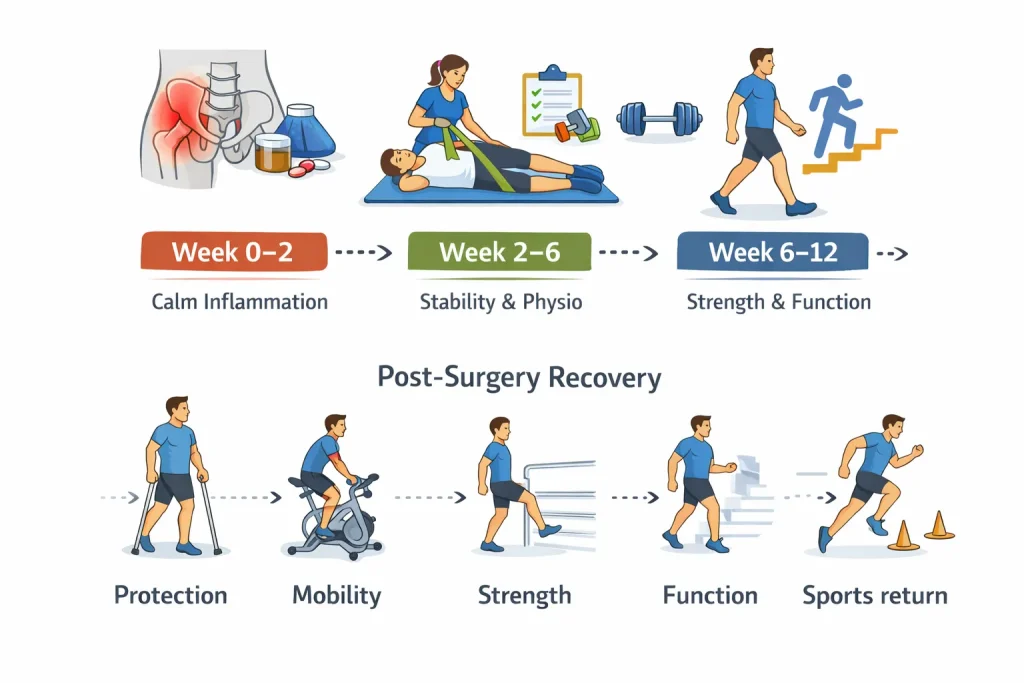
A hip labral tear recovery time depends on the tear type, your daily activity, and whether you need surgery. Many people feel improvement with rest and physiotherapy in 6 to 12 weeks. If symptoms continue, surgery may be advised. Hip labrum surgery recovery time usually takes 3 to 6 months for normal activities, and longer for sports.
Think of it like a cracked phone screen. A small crack might not bother you much, and you can still use the phone. But a bigger crack can spread, and then you need repair. Hip labrum tears are similar. Some heal well with care. Some need surgical repair.
What is the Hip Labrum and Why Does It Matter?
To understand a labral tear, let’s first understand the labrum in simple words.
The hip is a “ball and socket” joint. The ball is at the top of your thigh bone. The socket is part of your pelvis.
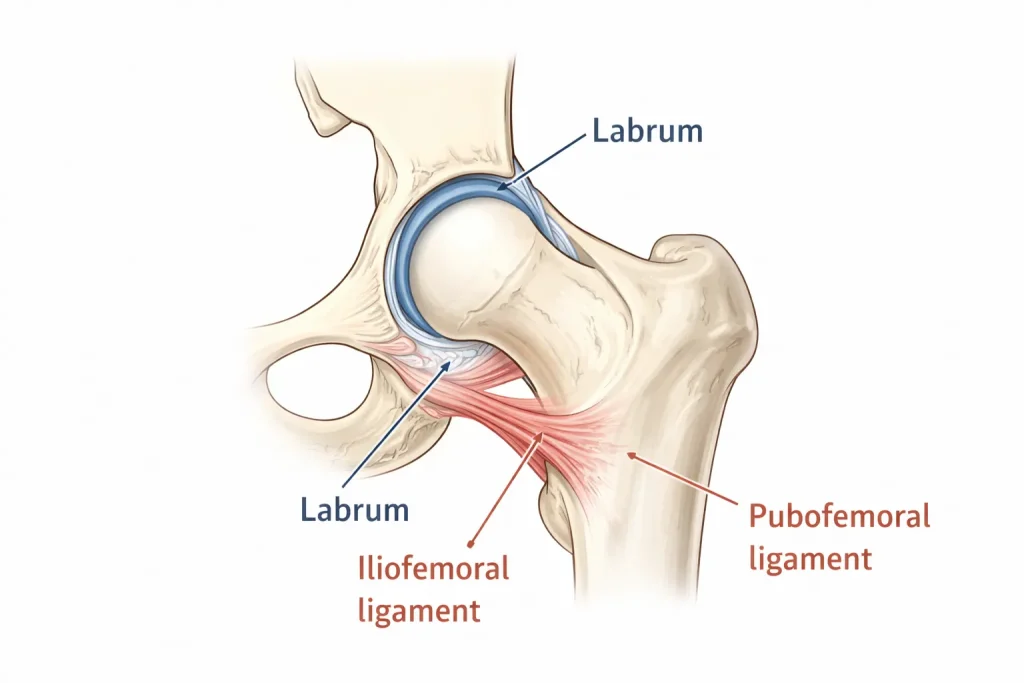
The labrum is a ring of cartilage around the socket. It acts like a soft rim or seal.
Here’s an easy example.
Imagine a bottle with a tight rubber seal on the cap. That seal helps prevent leakage and keeps the cap stable. The hip labrum works similarly. It helps:
- Keep the hip stable
- reduce friction during movement
- improve the “fit” of the joint
- support smooth walking, running, and twisting
When the labrum tears, the seal becomes weak. That can create pain and strange sensations like clicking.
Many people search for terms like labral, labrum tear hip, or even “hip labrum tear.” All of these point to the same issue: a tear in that cartilage ring.
Types of Hip Labral Tears: Where the Tear Occurs
Not all hip labral tears are in the same location. The position of the tear affects symptoms and recovery.
The most common type is the anterior hip labral tear. This is a tear at the front of the labrum.
Why is the front most commonly affected?
Because most hip movements that stress the labrum – sitting, squatting, walking, twisting – create the most load at the front of the socket. Athletes in sports like football, cricket, and martial arts often develop anterior labral tears from repeated hip flexion under load.
Posterior hip labral tears (at the back) are less common. They tend to occur with falls or high-energy impacts.
Superior hip labral tears (at the top) often happen alongside hip impingement, where the ball and socket pinch together.
Knowing which part of the labrum is torn helps your physiotherapist design exercises that load the hip safely during recovery.
Hip Labrum Tear vs Hip Ligament Injury: What’s the Difference?
This part is important because many patients mix up the words labrum, ligament, and tendon.
Let’s keep it simple.
A hip labrum tear means:
- Damage to the cartilage rim around the hip socket
- This often causes clicking, catching, and groin pain
A hip ligament injury means:
- A stretch or tear in the strong bands that hold the joint stable
- This often causes deep pain and instability
People commonly search:
- ligaments in the hip
- torn ligament in the hip
- pulled ligament in the hip
- hip ligament injury
- torn hip ligament
So, what are the ligaments in the hip?
The main hip ligaments include:
- Iliofemoral ligament
- Pubofemoral ligament
- Ischiofemoral ligament
You can think of ligaments like strong ropes. They hold the joint in place. The labrum is more like a soft rubber ring that improves the joint’s fit.
Both problems can cause pain. But treatment and recovery can be different. A doctor can help confirm what is going on with an exam and imaging.
Iliofemoral Ligament Tear Recovery Time
The iliofemoral ligament is the strongest in the hip – and in the entire human body. It runs from the pelvis to the thigh bone at the front of the hip.
When this ligament is injured or torn, it causes:
- Deep aching pain at the front of the hip or groin
- Pain when the leg is extended behind the body
- Instability and difficulty bearing weight
- Discomfort while walking uphill or climbing stairs
Iliofemoral ligament tear recovery time depends on severity:
| Severity | Treatment | Recovery Time |
| Mild sprain (Grade 1) | Rest, physiotherapy | 4-6 weeks |
| Partial tear (Grade 2) | Physiotherapy, bracing | 6-12 weeks |
| Complete tear (Grade 3) | May need surgery | 3-6 months |
The iliofemoral ligament heals slowly because it has limited blood supply – similar to the labrum itself. This means patience in recovery is not optional. It is essential.
How to tighten loose hip ligaments after injury:
This is a question many people ask during recovery. Ligaments do not “tighten” on their own through exercises. However, the muscles around the hip can be strengthened to compensate and protect the joint while the ligament heals.
Key exercises for hip ligament support:
- Glute bridges – strengthen gluteus maximus to support the back of the hip
- Side-lying hip abduction – strengthen gluteus medius for lateral stability
- Hip flexor strengthening – protect the iliofemoral region through controlled loading
- Core stability work – a strong core reduces excessive load on hip ligaments
These exercises should always be prescribed and supervised by a physiotherapist in the early stages of recovery.
Hip Tendon Tear: Recovery Time and Differences from Labral Tear
A hip tendon tear is a different injury from a labral tear, though both cause hip pain and can occur together.
Tendons connect muscles to bones. In the hip, the most commonly injured tendons include:
- Gluteal tendons (connecting the glute muscles to the outer hip)
- Hip flexor tendons (iliopsoas – connecting the psoas and iliacus muscles to the thigh)
- Hamstring tendons (connecting the hamstrings to the sitting bone)
How is a hip tendon tear different from a labral tear?
| Feature | Hip Labral Tear | Hip Tendon Tear |
| Structure affected | Cartilage ring in hip socket | Tendon attaching muscle to bone |
| Pain location | Deep groin, front of hip | Side of hip, buttock, or back of thigh |
| Clicking or catching | Common | Rare |
| Cause | Impingement, twisting, sports | Overuse, fall, sudden force |
| Diagnosed with | MRI arthrogram | Ultrasound or MRI |
Hip tendon tear recovery time:
| Severity | Recovery Time |
| Partial tendon tear | 6-12 weeks with physiotherapy |
| Complete tendon tear (gluteal) | 3-6 months; surgery may be needed |
| Hip flexor tendon strain | 4-8 weeks |
A key difference in recovery is that tendon injuries respond well to a structured eccentric loading programme – exercises that slowly load the tendon as it lengthens. This is usually introduced by 6-8 weeks into physiotherapy.
If hip pain persists without a clear diagnosis, imaging that differentiates between a labral tear and tendon injury is important, because the rehabilitation approach is different for each.
Symptoms of a Hip Labral Tear
Not all hip pain is a labral tear. But labral tears have some common patterns.
Common signs people notice
- Pain in the groin or front of the hip
- Pain while sitting for long
- Pain while walking long distances
- Clicking or popping in the hip
- Catching or locking feeling
- Stiffness when you stand up after sitting
- Pain during twisting movements
Many people say the pain feels sharp during certain actions. Like turning quickly. Or getting out of a car.
A good way to picture it is this.
Imagine a door that does not close smoothly because a small piece of the rubber lining is damaged. The door may still close, but it may catch and make noise. A torn labrum can make the hip feel like that.
Hip Impingement and Labral Tear: Understanding the Connection
Many people who are diagnosed with a hip labral tear are also told they have hip impingement – also called Femoroacetabular Impingement (FAI). These two conditions are closely related, and understanding the difference between them is important for planning recovery.
FAI vs Labral Tear: What Is the Difference?
FAI (Hip Impingement) refers to abnormal bone shape at the hip joint. The ball or socket has an irregular shape that causes bones to pinch together during movement.
There are two types:
- Cam impingement – the ball is not perfectly round; there is a bump on the thigh bone
- Pincer impingement – the socket overcovers the ball
- Combined – both cam and pincer are present
Hip labral tear is the result. When impingement is present, repeated pinching of the hip joint damages the labrum over time. This is why many labral tears do not happen from one single injury – they build up gradually.
Think of it this way. If a door has a bad hinge that makes the door hit the frame every time it opens, the frame will eventually crack. The crack (labral tear) is the result. But the bad hinge (FAI) is the cause.
Hip Impingement Recovery Time Without Surgery
| Stage | What Happens | Timeline |
| Initial rest and activity modification | Reduce painful movements | 2-4 weeks |
| Physiotherapy (core and hip strengthening) | Reduce impingement forces | 6-12 weeks |
| Activity modification long-term | Avoid positions that trigger impingement | Ongoing |
Hip impingement without surgery can be managed successfully in many people – particularly those with mild symptoms and good response to physiotherapy. The goal is not to change the bone shape (only surgery can do that) but to strengthen the muscles around the hip so that the joint moves more cleanly and impingement forces are reduced.
However, if impingement is severe and repeatedly damages the labrum, surgery to address the bone shape at the same time as labral repair gives the best long-term results. This is why many surgeons perform combined hip arthroscopy – they address both the labrum and the impingement during the same procedure.
Labral Tear and Hip Impingement Surgery Recovery
When both FAI and a labral tear are treated together arthroscopically, recovery follows the same general timeline as standard hip labral repair – but with slightly more caution in the first 6 weeks because the bone has also been reshaped.
Most patients undergoing combined FAI and labral repair surgery return to normal daily activity by 3-4 months and to sports by 6-9 months.
Can a Hip Labral Tear Heal Without Surgery?
This is one of the most searched questions about hip labral tears. The honest answer is: it depends.
The labrum has poor blood supply. This means that like cartilage elsewhere in the body, it does not regenerate well on its own. A torn labrum does not “grow back” or repair itself the way a muscle does.
However, this does not mean surgery is always required.
Many people with confirmed labral tears live comfortably without surgery by managing symptoms through:
- Physiotherapy that strengthens the muscles around the hip
- Activity modification to avoid movements that provoke pain
- Anti-inflammatory medication and injections if needed
- Core strengthening to reduce load on the hip joint
Who can manage without surgery:
- People with mild or moderate symptoms
- Tears that are partial rather than complete
- Individuals whose pain does not interfere significantly with daily life
- Those who do not need to return to high-impact sports
- Older patients where the balance of surgical risk and benefit favours conservative care
Who is more likely to need surgery:
- People whose pain significantly limits daily activity despite months of physiotherapy
- Those with persistent clicking, locking, or catching that does not settle
- Athletes who need to return to high-demand sports
- Patients with associated hip impingement that is damaging the labrum progressively
- People with instability symptoms
Think of it this way. Not every cracked tile in a floor needs to be replaced. If the crack is small and does not grow, you can live with it. But if the crack spreads and makes the floor uneven, repair becomes necessary.
The decision between conservative care and surgery should be made with an orthopedic specialist who can assess the specific tear, your symptoms, your lifestyle, and your goals.
How Doctors Confirm a Hip Labral Tear
Before we talk more about labral tear hip recovery time, it helps to know how this injury is diagnosed. Because correct diagnosis leads to correct recovery planning.
1) Clinical examination
A doctor checks:
- Your walking pattern
- hip range of motion
- areas of pain
- Strength of hip muscles
- special tests that stress the hip joint
2) Imaging tests
A hip labral tear is often confirmed with:
- MRI
- MR arthrogram (a special MRI with dye for clearer labrum view)
- X-ray (to check bone shape and hip impingement)
Why an X-ray?
Many labral tears occur due to bone shape abnormalities, such as hip impingement. If this is not treated, recovery can become slower, or symptoms may return.
Hip Labral Tear Recovery Without Surgery: Timeline
| Procedure | What is done | Recovery speed |
|---|---|---|
| Labral repair | Labrum stitched | Slower, stronger |
| Debridement | Torn edge cleaned | Faster early |
| Reconstruction | New labrum | Longest |
Not everyone needs surgery. Many people improve with non-surgical treatment, especially if the tear is small and the hip joint is stable.
This is also called conservative care. It includes rest, physiotherapy, and careful return to activity.
Let’s look at a simple labral tear recovery timeline without surgery.
Week 0 to 2: Calm down the hip
This is the “settling phase.” Pain and irritation are usually high in the beginning.
What you may feel
- Sharp pain with certain movements
- discomfort while sitting
- clicking or tightness
- stiffness in the morning
What helps during this phase
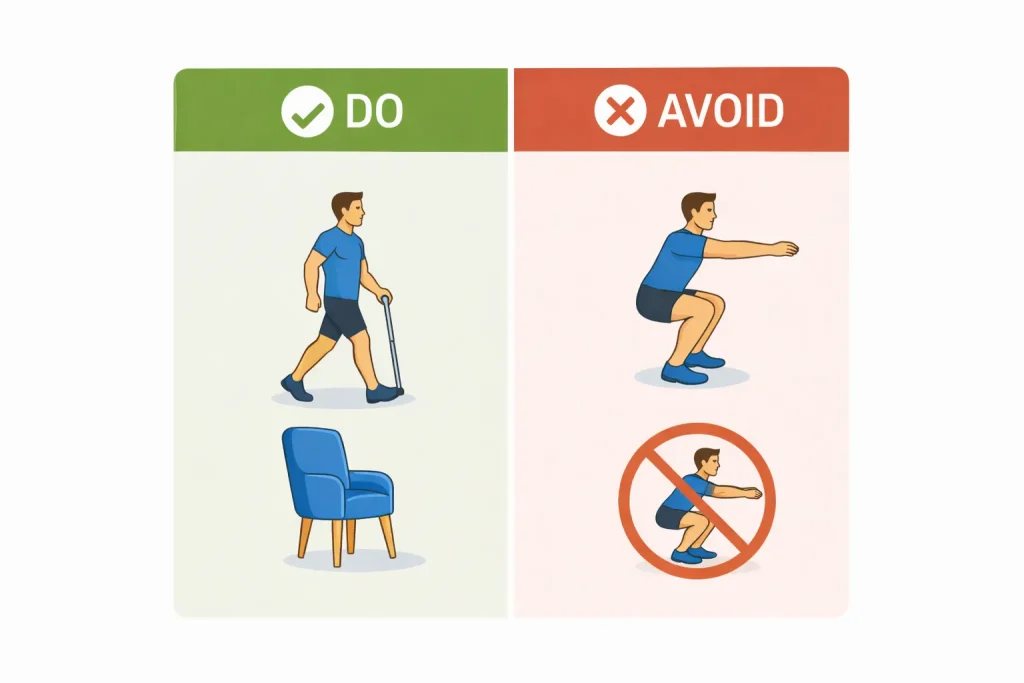
- Reducing long walks
- avoiding deep squats
- avoiding twisting on one leg
- using ice if advised
- Taking medicines only if prescribed
This phase is like giving a twisted ankle some rest. If you keep jumping on it, it won’t calm down. Your hip needs the same respect.
Week 2 to 6: Start guided physiotherapy
Once pain settles, physiotherapy becomes important. It is not about heavy workouts. It is about controlled movement.
Focus of physio
- improving hip stability
- strengthening glute muscles
- improving core control
- gentle mobility exercises
You may still avoid:
- high-impact activities like running
- deep lunges or heavy leg press
- sudden side movements
Think of this stage like fixing a weak chair. You don’t sit and jump on it immediately. First, you tighten the screws slowly. Then the chair becomes stable.
Week 6 to 12: Build strength and return to normal walking
This stage is where most people start feeling more confident.
What usually improves
- less pain during sitting
- fewer clicking sensations
- better walking comfort
- improved hip strength
What the rehab may include
- strengthening exercises for hips and thighs
- better balance and posture work
- careful increase in activity
Many people ask:
How long does a torn hip labrum take to heal without surgery?
A common answer is 6 to 12 weeks for noticeable improvement, but full recovery can take longer depending on activity level.
Hip Labral Tear Physical Therapy Duration: What to Expect
One of the most common questions patients have is not just “how long will I take to heal” – it is specifically “how long will I need physiotherapy?“
The answer is honest: longer than most people expect. And that is not a bad thing.
Without surgery: Physiotherapy duration
For patients managing a hip labral tear conservatively, physiotherapy typically continues for:
- Weeks 1-4: Pain management, gentle range of motion, muscle activation
- Weeks 4-8: Progressive strengthening of glutes, core, and hip stabilisers
- Weeks 8-12: Return to daily activity with good movement quality
- Months 3-6: Maintenance and sport-specific training if needed
Total physiotherapy duration: 3 to 6 months for most patients, with sessions typically reducing in frequency as strength improves.
After surgery: Hip Labral Repair Protocol
Post-surgical physiotherapy follows a structured protocol. Here is what a standard hip labral repair rehabilitation protocol looks like:
Phase 1 (Weeks 0-2) – Protection
- Goal: Protect the repaired labrum. No loading.
- Crutches, limited weight bearing
- Gentle ankle pumps and quad sets only
- Ice and elevation for swelling control
Phase 2 (Weeks 2-6) – Early Range of Motion
- Goal: Recover movement without stressing the repair
- Stationary cycling (seat raised high, minimal resistance)
- Prone hip extension, side-lying abduction
- No hip flexion beyond 90 degrees in most protocols
Phase 3 (Weeks 6-12) – Strengthening
- Goal: Build hip and core strength
- Glute bridges, clamshells, step-ups
- Standing balance exercises
- Pool walking if available
Phase 4 (Months 3-5) – Functional Movement
- Goal: Return to daily activity and light sport
- Lunges, squats with controlled depth
- Light jogging on flat surface
- Sport-specific drills begin
Phase 5 (Months 5-9) – Return to Sport
- Goal: Full return to athletic activity
- Running, lateral movements, jumping
- Strength testing to confirm readiness
- Sport clearance from surgeon and physiotherapist
The exact protocol varies depending on whether labral repair, debridement, or reconstruction was performed, and whether FAI correction was done simultaneously. Your treating physiotherapist will adjust exercises based on your specific procedure and progress.
In Mumbai, Thane, and Navi Mumbai, patients of Dr. Divya Ahuja follow a structured, individualised physiotherapy protocol that progresses based on their healing milestones rather than a fixed calendar.
When is Hip Labral Tear Surgery Recommended?
Hip surgery is not the first option for everyone. But it becomes useful when symptoms do not settle with conservative care.
Your doctor may suggest surgery if:
- Pain continues after several weeks of physiotherapy
- Hip catching and locking remain strong
- Daily life becomes difficult
- Sports activity is not possible
- Hip impingement needs correction along with labrum repair
Common surgery-related searches include:
- hip labral tear surgery
- acetabular labral tear surgery
- labrum tear in hip surgery
- How to repair a torn hip labrum
Most hip labrum surgeries are done using hip arthroscopy. That is a minimally invasive technique. Small cuts are made, and tiny instruments are used to repair the labrum.
Hip Arthroscopy: What It Is and What Recovery Looks Like
Hip arthroscopy is the surgical technique used in most hip labral tear repairs today. It is a minimally invasive procedure – meaning the surgeon does not need to open the hip joint fully.
Here is how it works in simple terms.
The surgeon makes two or three small cuts around the hip – each about the size of a buttonhole. A tiny camera (arthroscope) is inserted through one cut. Small instruments are inserted through the others. The surgeon watches the camera image on a screen and repairs the labrum using sutures (stitches).
Because the cuts are small, there is less blood loss, less tissue damage, and generally faster recovery compared to open surgery.
Hip Arthroscopy Recovery Timeline
| Phase | Timeline | Key Milestones |
| Hospital stay | Same day or 1 night | Wound checked, initial walking with crutches |
| Crutches | 2-6 weeks | Depending on repair type |
| Drive a car | 4-6 weeks | Right-side surgery delays this longer |
| Return to desk work | 2-4 weeks | Depending on sitting comfort |
| Light walking without pain | 6-10 weeks | Gradual progression |
| Light gym activity | 3-4 months | No high-impact work |
| Return to sport | 6-9 months | After full strength and balance testing |
What Makes Hip Arthroscopy Recovery Different from Open Hip Surgery?
- Smaller wounds mean less infection risk and faster wound healing
- Less trauma to the surrounding muscle means less post-operative pain
- Early mobilisation is possible with physiotherapy starting within days
- Most patients go home the same day
However, the labrum itself still needs 3-6 months to fully heal inside the joint, regardless of how small the external cuts are. This is the most important thing to understand about hip arthroscopy recovery.
The outside heals fast. The inside takes time.
Rushing activity because the wound looks healed is one of the most common reasons for slow recovery or re-injury after hip arthroscopy.
Pros and Cons of Hip Labral Tear Surgery
Before surgery, it helps to understand both sides. People often search pros and cons of hip labral tear surgery, and it’s a fair question.
Pros
- Reduces catching and locking sensations
- Improves joint stability
- Helps return to daily activity with less pain
- Can treat the cause if the bone impingement is corrected too
Cons
- Recovery takes time and patience
- Physiotherapy is needed for months
- There are movement restrictions early on
- Some people may still feel stiffness for a while
It’s like repairing a damaged zipper in your jacket. Repair helps. But you still need time to stitch it properly and let it settle. If you pull too hard too soon, it can tear again.
Recovery After Hip Labrum Surgery: Timeline Overview
Now let’s talk about the main topic: recovery after hip labrum surgery.
People search for this in many ways:
- labrum surgery hip recovery
- hip labrum surgery recovery timeline
- hip labrum tear surgery recovery
- Recovery time for hip labrum surgery
- torn labrum hip surgery recovery time
- hip labral tear surgery recovery time
The goal is the same. They want a clear timeline.
Remember one thing. Recovery is not like flipping a switch. It’s more like cooking rice. You cannot rush it. If you do, it stays hard inside.
Phase 1: First 1 to 2 Weeks After Surgery
This phase is all about protecting the repair.
What you might feel
- soreness in the hip
- swelling around the joint
- tightness while moving
- tiredness and sleep issues
Some people also feel mild bruising. That can be normal after surgery.
What recovery usually involves
- crutches (often needed)
- limited weight bearing as advised
- Basic exercises given by the physiotherapist
- wound care and pain control
How soon can you walk after hip labrum surgery?
Most patients can walk with support early. But usually with crutches and limited weight. Walking normally without a limp takes time. It depends on the repair type and doctor’s instructions.
The key here is control. Not speed.
Phase 2: Weeks 2 to 6 (Early Rehab Phase)
This is the stage where rehab becomes more active, but still careful.
Main goals
- improve hip movement safely
- reduce stiffness
- start gentle strengthening
- improve walking pattern
What you may do during this stage
- light stationary cycling (if allowed)
- gentle range-of-motion exercises
- glute strengthening with safe movements
- core stability training
What you should avoid
- deep squats
- sudden twisting
- heavy lifting
- sitting cross-legged (in most cases early)
This phase is like learning to write again after a hand injury. You start slow. The goal is smooth movement. Not speed or force.
Phase 3: Weeks 6 to 12 (Strength and Control Phase)
This is the stage where many patients feel they are “finally getting better.” Pain is usually lower. Walking becomes smoother.
Focus areas
- stronger hip muscles
- better balance
- better posture
- improving endurance
What may improve
- sitting comfort
- walking longer without pain
- climbing stairs with less discomfort
- Daily activities are becoming easier
This is an important part of the hip labrum surgery recovery timeline because the hip starts trusting itself again. But you still need to respect healing time.
Phase 4: 3 to 6 Months (Return to Normal Function)
This is where people return to most regular activities.
What you can usually do
- longer walks
- light gym work with correct form
- basic cardio activities
- controlled strengthening
What still needs care
- running too early
- fast twisting sports
- deep lunges with a heavy weight
Think of this phase like upgrading from a bicycle to a motorbike. You are faster now. But you still need to learn control.
Phase 5: 6 to 9+ Months (Sports Return Phase)
For athletes, recovery takes longer. Some sports need sudden movements, jumping, and twisting. That loads the hip more.
This phase may include:
- running drills (slowly)
- sport-specific movements
- agility and balance training
- strength testing
This phase relates to searches like:
- Hip labral tear recovery time with surgery
- Recovery time for labral hip tear surgery
- hip labral tear surgery recovery timeline
Walking, Driving, Sitting, and Work: Common Questions
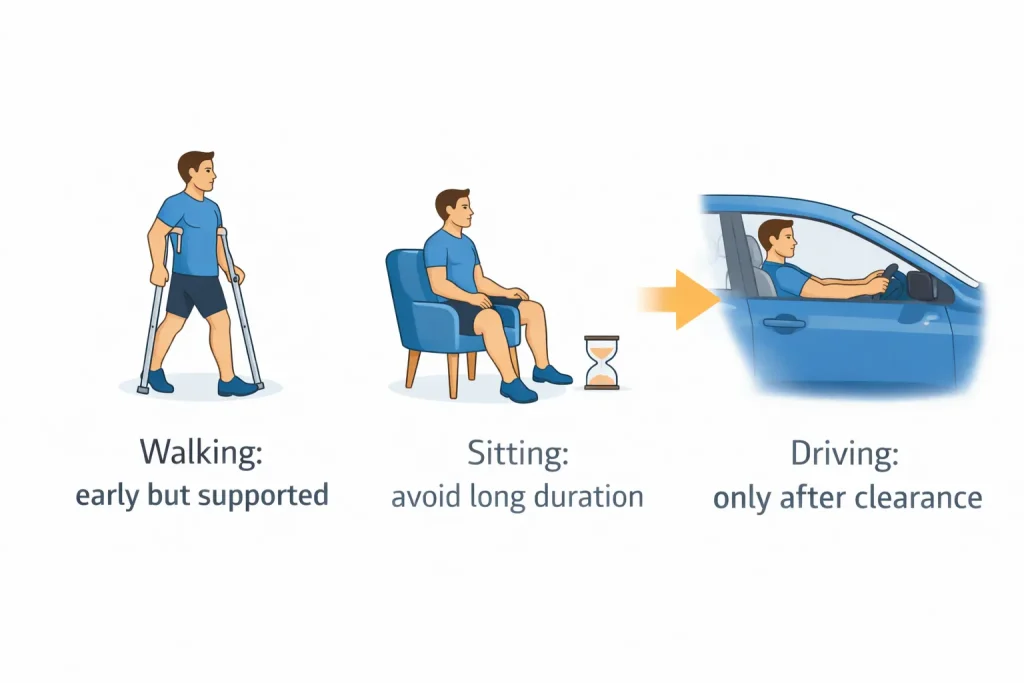
Recovery is not only about healing. It’s also about daily life.
Walking after surgery
Most people walk with crutches early. Then slowly progress to normal walking.
If you rush walking without support, it can irritate the hip.
Driving after hip surgery
Driving depends on:
- Which side of the surgery was done
- pain control
- reaction time
- doctor approval
Office work
Many people can return to desk work earlier than heavy manual work. But long sitting can still be uncomfortable in the early weeks. Small breaks matter.
Stairs
Stairs can feel difficult early on. It improves with strength and balance training.
Hip Labral Repair Recovery vs Other Procedures
Not all hip labrum surgeries are the same. That changes recovery speed.
Labral repair
The labrum is stitched back. Recovery can take longer because the labrum needs to heal properly.
Labral debridement
The torn edges are cleaned. Recovery may be slightly faster in some cases.
Labral reconstruction
A new labrum is used if the original is badly damaged. Recovery can be longer and needs strict rehab.
Many people search:
- labral hip repair recovery
- labral repair surgery recovery
- labrum hip repair surgery
Your doctor will tell you what procedure was done and how rehab should be planned.
Hip Labrum Surgery Recovery Tips That Actually Help
This section can make recovery smoother. These are practical tips.
1) Follow weight-bearing instructions
If your doctor says to follow partial weight-bearing, do so. It protects healing tissues.
2) Don’t skip physiotherapy
Physiotherapy is like the steering wheel of recovery. Without it, you may heal but still move wrongly.
3) Avoid sitting for long in the early weeks
Long sitting can increase hip stiffness. Short walks and breaks help.
4) Use ice and rest as advised
Swelling control improves comfort.
5) Focus on glute and core strength
These muscles support hip stability. Weak glutes can make the hip overwork.
6) Sleep with support pillows
Many patients sleep better with a pillow between their knees. It reduces pulling sensation.
These tips support overall labrum surgery recovery and help avoid unnecessary setbacks.
Warning Signs During Hip Labral Tear Recovery
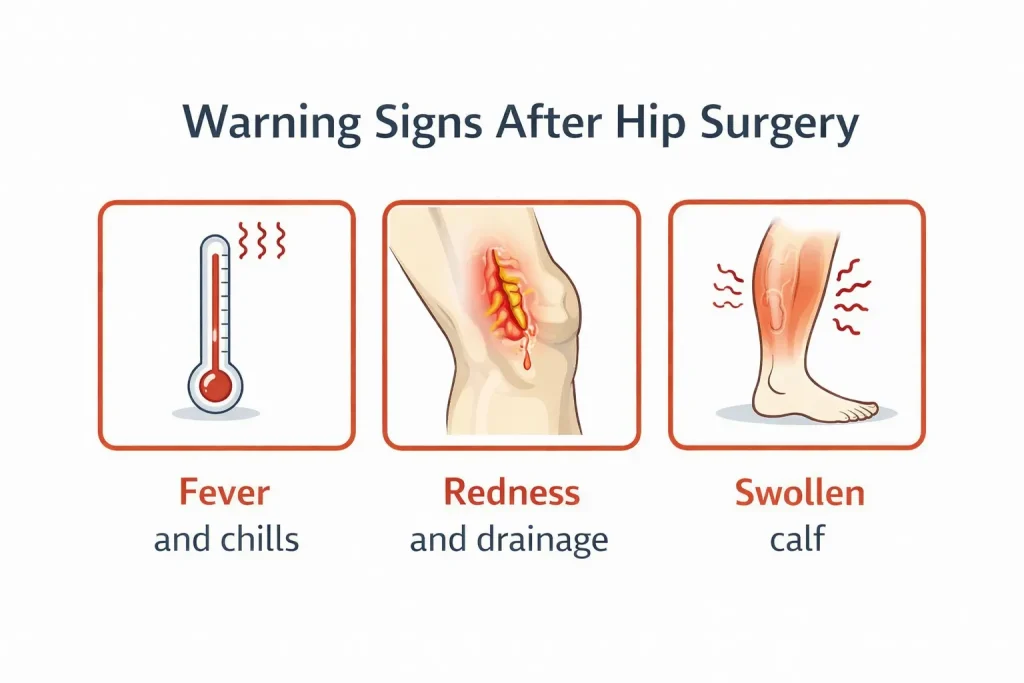
Most people recover well. But it’s important to know red flags.
Contact your doctor if you notice:
- fever and chills
- severe redness or drainage from the wound
- sudden increase in pain
- calf swelling or calf pain
- breathing difficulty
- numbness or weakness that is worsening
These signs need medical attention. It’s always better to ask early instead of waiting.
Preventing a Hip Labral Tear
While not all hip labral tears can be prevented – especially those caused by bone shape abnormalities – many can be avoided or delayed through good habits and training practices.
Who is at higher risk?
- Athletes in football, cricket, martial arts, hockey, and dance (sports requiring repeated hip flexion and rotation)
- People with hip impingement (FAI) who continue high-impact activity without management
- Those with poor hip and core muscle strength
- People who sit for very long hours without movement breaks
Prevention strategies that work:
1) Strengthen your hip and core muscles
Weak glutes and core muscles place excessive load on the labrum during movement. Regular glute, hip flexor, and core strengthening reduces the mechanical stress on the hip socket.
2) Warm up before sport
The hip joint needs lubrication and circulation before being loaded intensely. A 10-15 minute warm-up that includes hip mobility drills reduces injury risk significantly.
3) Avoid sudden increases in training load
Labral tears often build up gradually. Increasing running distance, squatting weight, or training intensity too quickly overloads the hip before muscles can adapt.
4) Correct poor movement patterns early
Hip dropping during walking, knee caving during squats, or excessive forward lean are movement faults that increase labral stress. A physiotherapist can identify and correct these before they lead to injury.
5) Get hip pain evaluated early
Many people ignore clicking or occasional groin pain for months or years. Early evaluation can identify hip impingement before it causes a significant labral tear – when conservative management is most effective.
In Mumbai, Thane, and Navi Mumbai, Dr. Divya Ahuja offers hip assessments for athletes and active individuals who want to identify and address hip risk factors before they become injuries.
When to Consult Dr. Divya Ahuja (Mumbai, Thane, Navi Mumbai)
If your hip pain is not improving, it’s better to get a proper evaluation. A labral tear can sometimes stay mild. But in some cases, it can lead to ongoing pain and movement limits.
You should consider a consultation if you have:
- hip pain while sitting or walking
- clicking, catching, or locking sensation
- pain that returns again and again
- difficulty returning to sports
- Symptoms not improving with physiotherapy
Dr. Divya Ahuja evaluates hip labral tears and recovery planning for patients across Mumbai, Thane, and Navi Mumbai, with a focus on safe movement, joint protection, and long-term function.
Conclusion
A hip labral tear can feel frustrating, but recovery is possible. The timeline depends on your injury and the treatment plan.
Some people improve with physiotherapy and lifestyle changes within a few months. Others need surgery for better stability and long-term relief. In both cases, the key is patience. Also consistency.
If you respect the healing process and follow rehabilitation properly, the hip usually becomes stronger and more reliable over time.
And if you ever feel confused about your symptoms, remember this simple rule: getting the right diagnosis is the first step to the right recovery.
FAQs
1) How long does a hip labral tear take to heal without surgery?
Many people improve within 6 to 12 weeks using rest and physiotherapy. Recovery depends on tear size, activity level, and hip stability. Some take longer, especially if the hip joint has bone impingement or repeated twisting movements.
2) What is the recovery time for hip labrum surgery?
Hip labrum surgery recovery time is usually around 3 to 6 months for normal daily activity. Full recovery for sports may take 6 to 9 months or longer. Following physiotherapy and avoiding early running helps prevent re-injury.
3) How soon can you walk after hip labrum surgery?
Most patients can walk with crutches early after surgery, depending on the surgeon’s advice. Walking without support takes time and happens step by step. The goal is stable, pain-free walking, not fast walking, in the first few weeks.
4) What is the typical labrum tear surgery recovery timeline?
Most recovery timelines have phases: first 2 weeks for protection, 2 to 6 weeks for gentle movement, 6 to 12 weeks for strength building, and 3 to 6 months for full daily function. Sports return can take longer.
5) What is hip labral repair recovery like compared to debridement?
Hip labral repair recovery may take longer because the labrum is stitched and needs healing time. Debridement can feel quicker in some cases since torn edges are cleaned. Your surgeon’s rehab plan depends on the exact procedure done.
6) How long does a torn hip labrum take to heal after surgery?
A torn hip labrum takes months to heal after surgery. Pain often improves gradually. Hip strength and walking comfort return step by step. Full recovery depends on rehab quality, muscle control, and whether hip impingement was corrected.
7) What causes slow recovery after hip labral tear surgery?
Slow recovery can happen due to weak hip muscles, poor physiotherapy routine, early overactivity, or stiffness buildup. Sometimes, untreated hip impingement or cartilage damage can affect outcomes. Following rehab instructions strictly helps improve progress safely.
8) Can a pulled ligament in the hip feel like a labrum tear?
Yes, a pulled ligament in the hip can feel similar because both cause deep hip pain and discomfort while walking. But labrum tears often cause clicking and catching. A doctor can differentiate them using examination and imaging tests.
9) What are the pros and cons of hip labral tear surgery?
Pros include reduced catching pain and improved hip stability. Cons include long rehab time and temporary restrictions. Surgery is usually suggested when physiotherapy does not help enough, or when bone impingement needs correction for better long-term results.
10) Is the shoulder labrum surgery recovery timeline similar to the hip labrum recovery?
Not exactly. Shoulder and hip joints work differently, so recovery timelines differ. Shoulder labral tear recovery time depends on arm movement and lifting restrictions. Hip labrum surgery recovery focuses more on walking, weight bearing, and hip stability training.