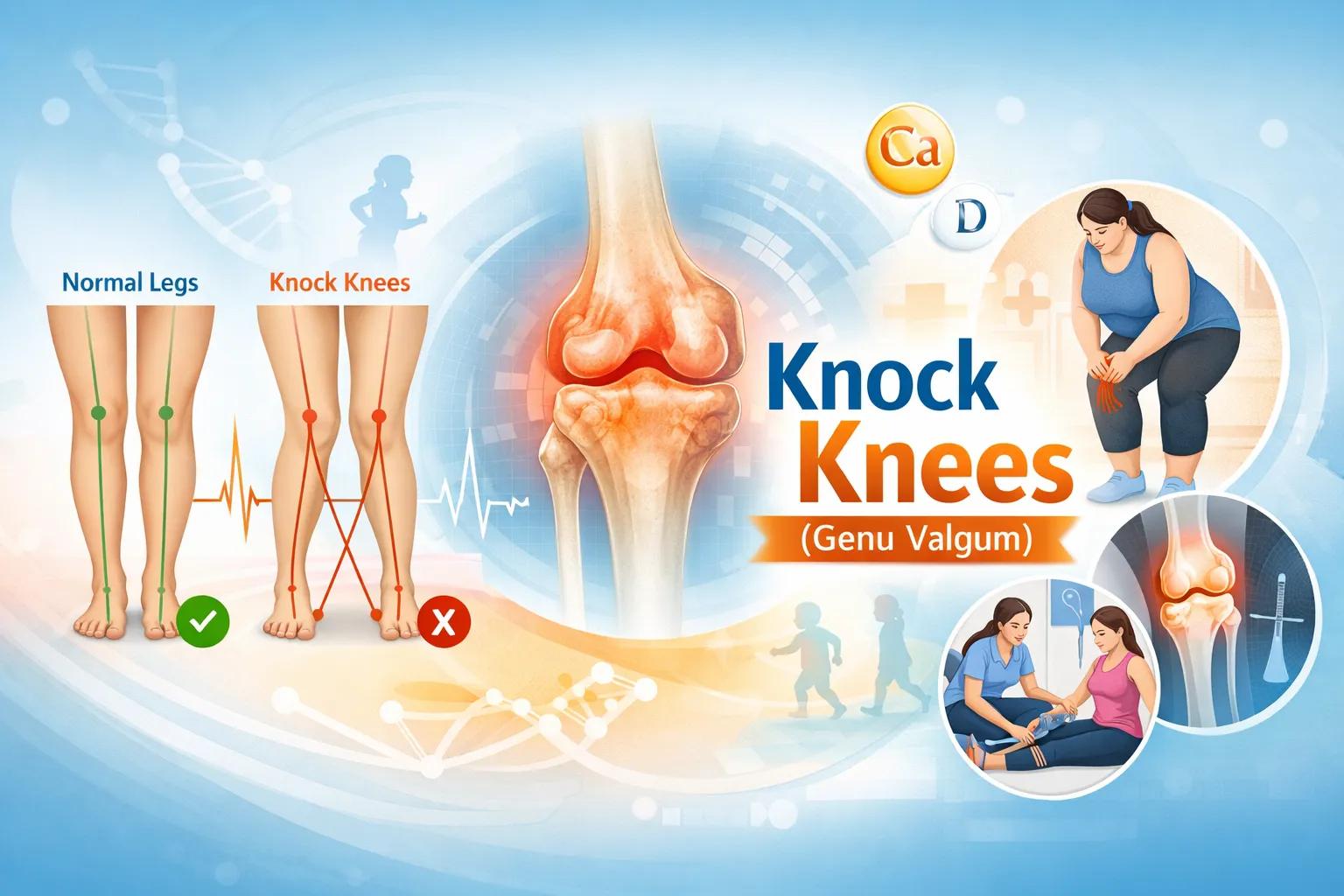
If you stand in front of a mirror and notice your knees touching each other while your ankles stay apart, you might be dealing with knock knees. Many people call it knee knocking, inward knees, or knees bending inward. The medical name for this condition is genu valgum.
Now, don’t worry. Seeing knock knees does not always mean something is seriously wrong. In children, it can even be a normal part of growth. But in teenagers and adults, knock knees can sometimes cause pain, balance problems, and extra stress on the knee joint.
In this blog, we will talk about knock knees in a very simple way. No complicated words. No confusing medical language. We will cover what it is, why it happens, how to check it, and what treatments can help. We’ll also explain when you should visit a doctor, and what options exist if exercises and physiotherapy are not enough.
Table of Contents
What are Knock Knees (Genu Valgum)?
Knock knees means your knees point inward instead of facing straight. Because of this, your knees come closer to each other than they should.
Here’s a simple way to imagine it.
Think of your legs like two straight poles holding up a roof. If those poles start leaning inward, the roof will still stand. But the load will not be evenly balanced. One side will take more pressure. Over time, that side may start to wear out.
That is what can happen inside the knees when they bend inward too much.
Knock knees are also called:
- Knock-knees
- Genu valgum
- Knee valgus
- Valgus knee deformity
- Knock-kneed posture
- Inward-bending knees
- Knees that turn in
It is not just about appearance. Sometimes, it is only a visual issue. But in many cases, it can affect the way a person walks and moves.
Normal Knees vs Knock Knees: How to Tell the Difference
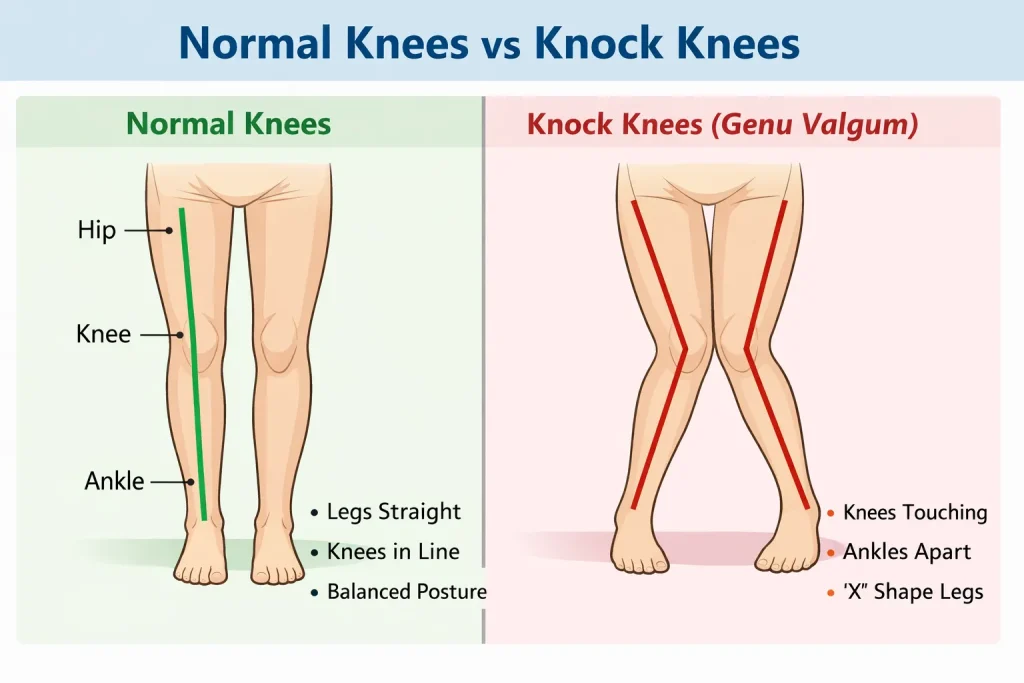
A lot of people ask, “Are my knees normal or not?”
This is a fair question. Because not every small inward angle is a problem.
Normal knee alignment usually looks like this
- The legs appear mostly straight.
- The knees are in line with the hips and ankles.
- Your weight feels balanced on both feet.
Knock knees usually look like this
- The knees move inward and may touch each other.
- The ankles stay apart.
- The legs can look like an “X” shape.
- Walking may look slightly different.
Here’s a small example.
If you draw a straight line from your hip to your ankle, the knee should stay close to that line. In knock knees, the knee moves inside that line.
Some people have mild knock knees and no pain at all. They walk normally and live a normal life. That’s why looking at the leg is not enough. You also have to look at symptoms and body function.
How to Know If You Have Knock Knees (Simple Home Test)
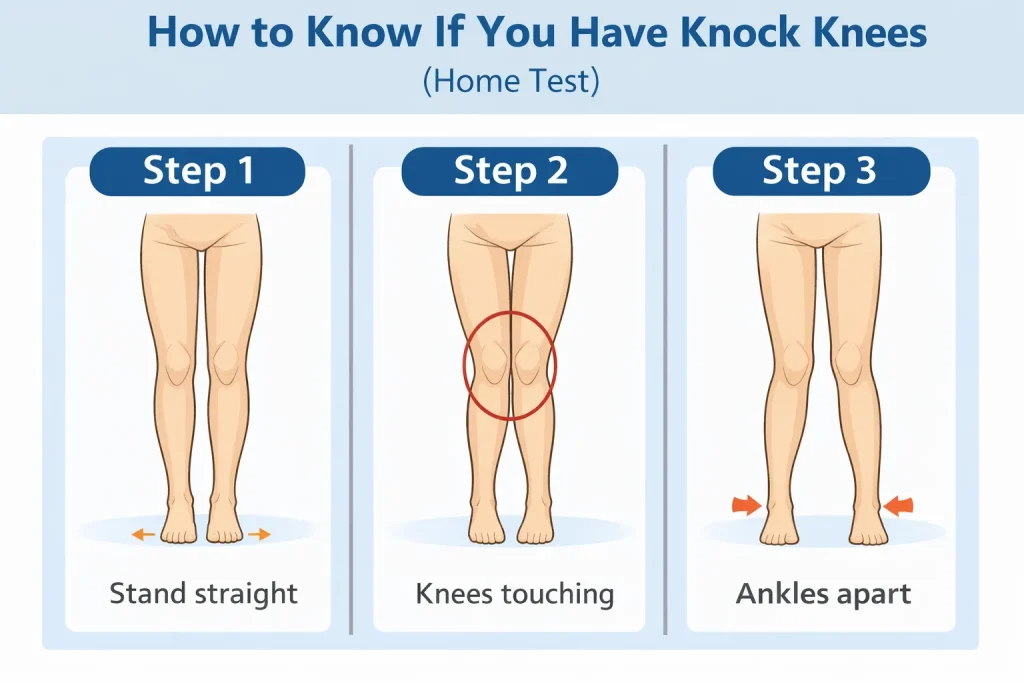
You don’t need any fancy equipment for a basic check. You can do a simple test at home in under one minute.
Home test for knock knees
- Stand straight with your feet pointing forward.
- Try to bring your knees together naturally.
- Now look at your ankles.
If your knees touch but your ankles do not touch, that can suggest knock knees.
Another simple check is walking.
If your knees seem to “bump” into each other while walking, you may have knee knocking.
But remember one thing. This home test only gives a clue. It does not tell you how severe it is. It also does not tell you the cause.
For that, you need a proper medical evaluation.
Common Symptoms of Knock Knees
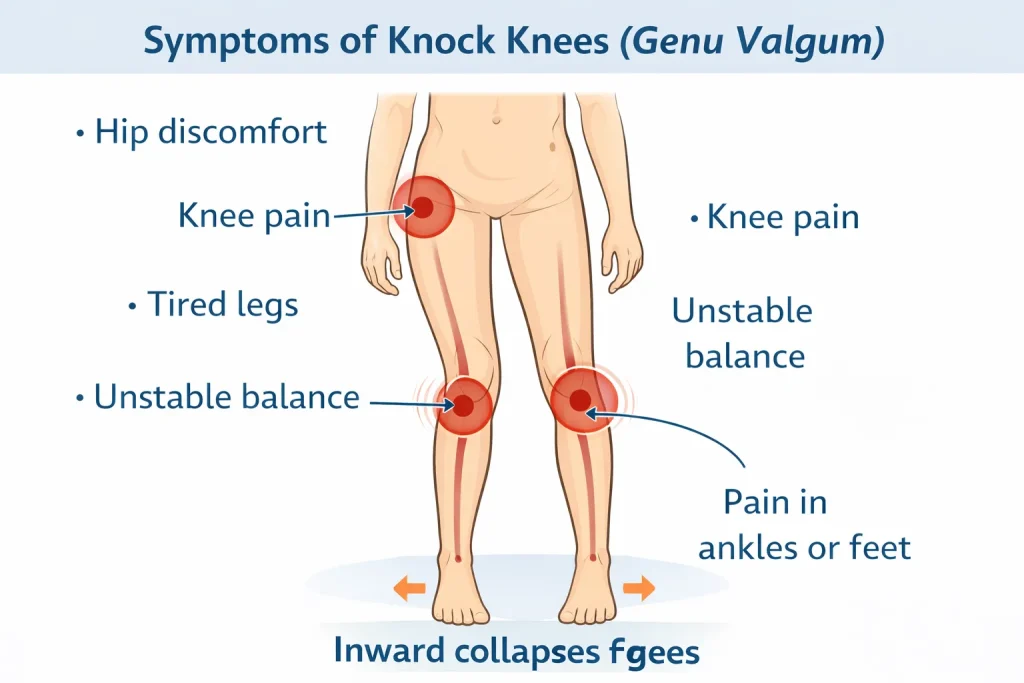
Many people think knock knees always cause pain. That is not true.
Some people have knock knees and feel fine. But others start getting symptoms over time, especially adults.
Common symptoms
- Knee pain, especially after walking or standing for long periods
- Pain in the front of the knee, near the kneecap
- Tired legs even after short activity
- Trouble running or climbing stairs
- Feeling like the knees “collapse inward” while walking
- Bad balance or unstable walking
Other symptoms you may notice
- Hip discomfort after walking
- Pain around the ankles or feet
- Flat feet, along with inward knees
- Uneven wear on shoes
Think about it like a shopping trolley wheel.
If the wheel is slightly tilted, it will still roll. But it will not roll smoothly. It will wobble, and the wheel may wear out faster.
In the same way, the knee joint can get stressed when the alignment is not balanced.
Knock Knees and Hip Pain
Many people do not connect hip pain with knock knees. But the two are often related.
When the knees point inward, the hips also rotate slightly. This puts extra strain on the hip muscles and hip joint. Over time, this can cause:
- aching pain around the outer hip
- tightness in the hip flexors
- discomfort when walking long distances
If you already have knock knees and notice hip pain alongside knee pain, this connection should be evaluated together by a specialist.
What Causes Knock Knees?
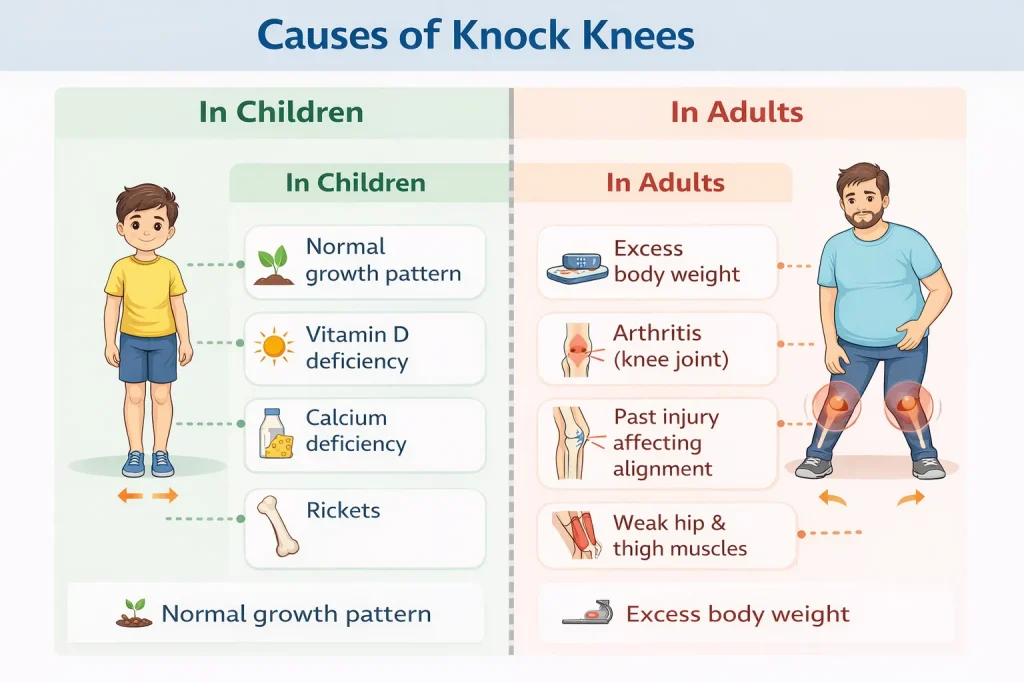
This is the biggest search topic. People type:
- What causes knock knees
- reasons for knock knees
- Why do I have knock-kneed knees
- Knee knocking causes
- Causes for knock knees in adults
The causes can be different in children and adults. Let’s break it down.
Knock Knees in Children: Is It Normal?
Yes, in many children, knock knees can be normal during growth.
Children’s legs go through different shapes as they grow. It’s like how a young tree bends slightly but becomes straighter later as it grows.
Many children develop mild knock knees during early childhood. Most of them improve naturally as their bones get longer and stronger.
When knock knees may be normal
- The child has no pain
- The child walks normally
- Both legs look similar
- The condition is not getting worse
When parents should be careful
A doctor should check the child if:
- Knock knees are severe
- One leg is more affected than the other
- The child has pain or limps
- The condition is increasing year by year
- The child falls often
- The child has signs of weak bones
Common causes of knock knees in children
- Normal growth pattern
- Vitamin D deficiency
- Calcium deficiency
- Rickets
- Growth plate issues
- Past infection affecting bone growth
- Injury near the knee
A simple blood test and bone examination can sometimes help find the real cause.
Toddler Knock Knees: When Should Parents Worry?
It is very common for toddlers between the ages of 3 and 5 to have knock knees. The legs naturally go through a slight inward phase during this age.
Most children straighten out by age 7 to 8 years without any treatment.
However, parents should consult a doctor if:
- The gap between the ankles is very wide
- Knock knees appear only on one side
- The child has pain or falls very often
- The condition is getting worse instead of better
- There are other signs, like slow growth or low energy
Early observation does not mean an emergency. But early evaluation gives peace of mind and rules out any underlying bone or nutritional problem.
What Causes Knock Knees in Adults?
Knock knees in adults usually do not appear “just like that.” They often develop due to years of pressure, posture issues, or joint problems.
Here’s a simple way to understand it.
Imagine a door hinge. If the hinge becomes loose, the door will not close properly. It will tilt and rub against the frame.
The knee is similar. When joints and muscles lose balance, the knee may start pointing inward.
Common causes in adults
- Extra body weight
- Arthritis in the knee joint
- An old fracture that healed in the wrong alignment
- Weak hip and thigh muscles
- Flat feet that affect knee posture
- Knee ligament issues
- Long-term poor walking pattern
Adults also have a higher chance of pain because their joints have already been under stress for years of stress.
Genu Valgum Muscle Weakness and Imbalance
One of the most overlooked causes of knock knees – especially in adults – is muscle weakness and imbalance.
When certain muscles are weak, the knee does not get enough support and starts collapsing inward.
The key muscles involved are:
- Gluteus medius – a hip muscle that controls inward collapse of the knee
- Quadriceps – especially the inner quad (VMO), which guides the kneecap
- Hip abductors – pull the thigh outward, opposing inward collapse
- Calf and ankle muscles – support the foot arch and lower chain alignment
Think of these muscles like a team of ropes holding a tent pole upright. If one rope loosens, the pole leans.
Genu valgum muscle imbalance often involves weak hip muscles and tight inner thigh muscles working together to push the knee in. This is why physiotherapy and targeted exercises can make a real difference in mild and moderate cases.
Types of Knock Knees
Doctors often group knock knees into a few categories.
1) Physiological knock knees
This is usually seen in children.
- It is often mild
- It improves with growth
- It needs monitoring, not surgery
2) Pathological knock knees
This is caused by an underlying issue.
- It can get worse over time
- It may cause pain or walking difficulty
- It needs treatment based on the cause
3) Unilateral and bilateral knock knees
- Bilateral: both legs affected
- Unilateral: one leg is affected more than the other
If one leg looks much more inward, it needs proper evaluation. Sometimes, it can point to injury or uneven bone growth.
Mild Knock Knees vs Severe Knock Knees
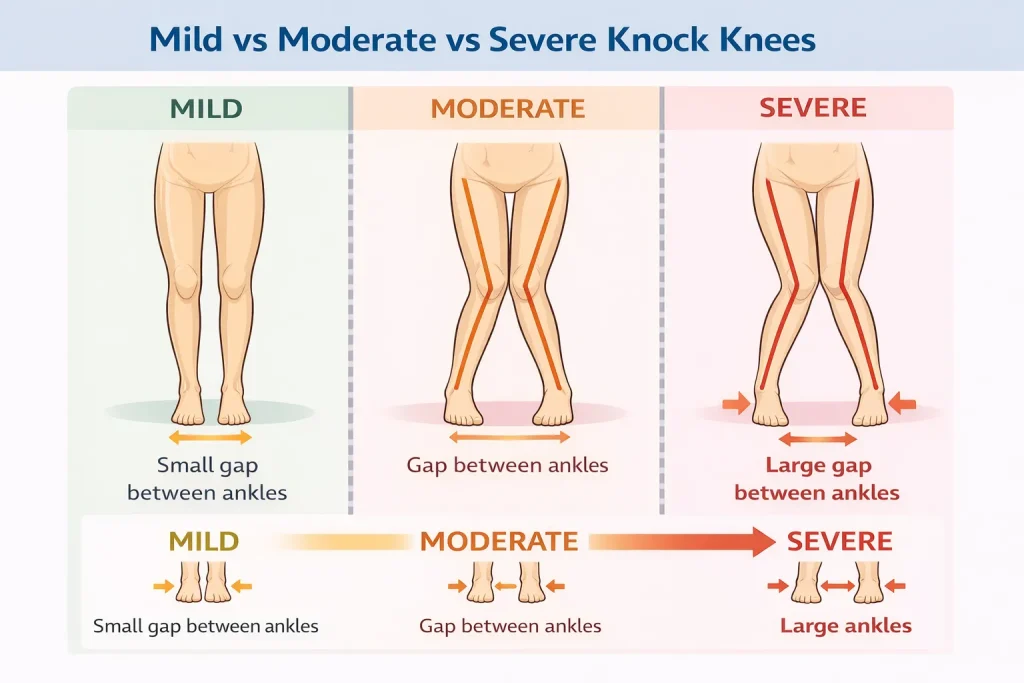
Not all knock knees need treatment. Some need only observation. Some need active care.
Mild knock knees
- Slight inward angle
- No pain
- No walking issue
- No joint stress signs
In such cases, simple strengthening exercises and posture correction may help.
Moderate knock knees
- Visible inward bending
- Some pain after activity
- Slight walking imbalance
These cases may need physiotherapy, footwear correction, and regular follow-up.
Severe knock knees
- Clearly visible X-shaped legs
- Persistent knee pain
- Walking difficulty
- High risk of joint wear
These cases may need surgical correction, especially in adults.
Why Knock Knees Can Cause Knee Pain
Your knee joint is designed to carry weight evenly. In knock knees, weight does not spread evenly.
It shifts to one side. Over time, that side can wear out faster.
This can lead to:
- pain during walking
- pain around the kneecap
- stiffness after long activity
- early signs of arthritis in some patients
Think of it like a car tyre.
If the wheel alignment is off, the tyre will wear out more on one side. Even if the car drives fine today, the problem will grow over time.
That is why early assessment matters.
Knock Knees and Osteoarthritis
One of the long-term concerns with untreated severe genu valgum is the development of knee osteoarthritis.
When the knee is constantly pushed inward, the outer part of the knee joint takes more load than the inner part. Over the years, this uneven pressure breaks down the cartilage faster on one side.
This can lead to:
- progressive knee pain
- stiffness in the morning
- difficulty bending or straightening the knee
- joint swelling that does not go away
In older adults with knock knees and arthritis together, treatment planning becomes more complex. A specialist evaluation is essential to decide whether realignment, physiotherapy, or joint replacement is the right approach.
How Knock Knees Are Diagnosed
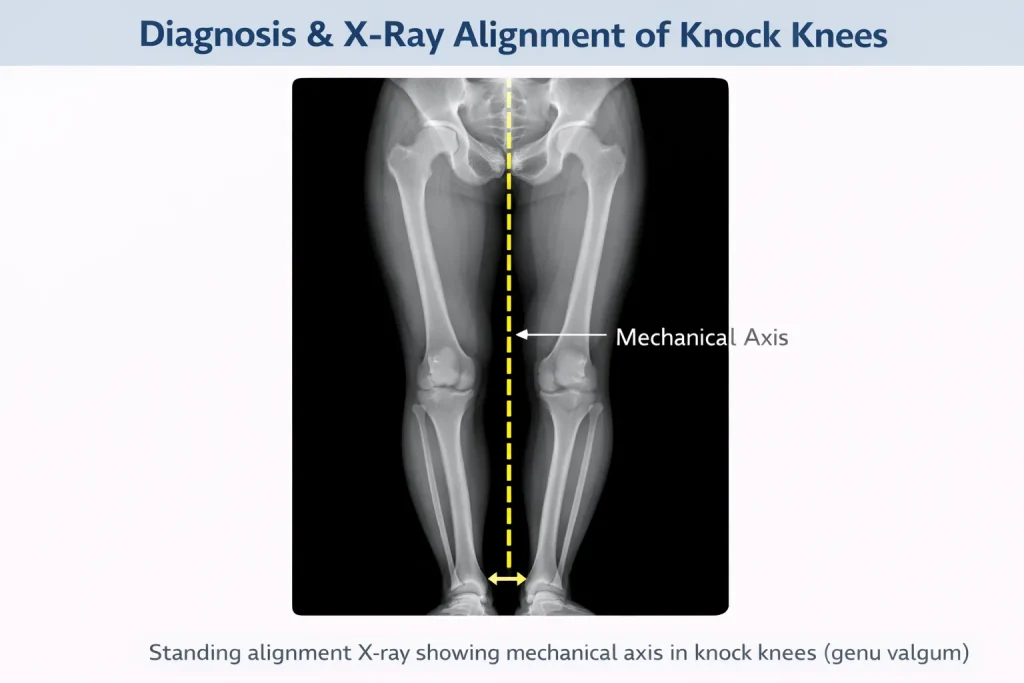
A doctor does not just look at your legs and decide. A proper diagnosis involves checks and measurements.
1) Clinical examination
The doctor will check:
- How you stand
- how you walk
- knee stability
- hip posture
- foot alignment
- muscle strength
Sometimes, knock knees are not only about bone shape. They can also be made worse by weak muscles.
2) Measurement tests
Doctors often measure the gap between the ankles when the knees touch. This helps understand how strong the inward angle is.
3) X-rays for alignment
In many cases, especially in adults, the doctor may suggest a standing alignment X-ray. This shows the full leg line and helps plan treatment correctly.
This is important because two people can look similar from the outside, but have different causes inside.
Knock Knee Test in the Indian Army / Agniveer Medical
A very common question searched online is whether knock knees disqualify a person from joining the army or other defence forces.
In Indian Army and Agniveer medical tests, knock knees are evaluated as part of the musculoskeletal examination.
A candidate is typically checked for:
- visible inward bending of the knees
- gap between ankles while standing with knees together
- functional impact on walking and running
Knock knees are generally considered a disqualifying condition in defence medical exams if the deformity is beyond accepted limits. However, mild physiological knock knees without pain or functional difficulty may be evaluated on a case-by-case basis.
If you are preparing for a defence medical and are concerned about your knee alignment, it is strongly recommended to get a formal evaluation and understand your degree of deformity well in advance.
Genu Valgum Gait Pattern
One of the visible signs of knock knees is a change in walking pattern – called the genu valgum gait.
In a normal gait, the knee tracks forward over the foot during each step. In genu valgum gait:
- The knees may come close together or even touch while walking
- The feet may point slightly outward to compensate
- The hips may sway more than usual to maintain balance
- There may be a slight “waddling” pattern in severe cases
Over time, this abnormal gait can cause extra stress on the:
- knee joint
- hip joint
- lower back
- ankle and foot
A gait assessment by a physiotherapist or orthopedic specialist helps identify these issues early. It also helps design a more targeted rehabilitation programme.
Does Flat Foot Cause Knock Knees?
Yes. Flat feet and knock knees are closely connected.
When the arch of the foot collapses, the ankle tends to roll inward. This is called pronation. When the ankle rolls inward, it pulls the shin bone inward too. This in turn pushes the knee inward, which can look like or worsen knock knees.
This is why people who have both flat feet and knock knees often see better results when both conditions are treated together.
Treatment for this combination may include:
- arch-support insoles or custom orthotics
- ankle and foot strengthening exercises
- knee and hip strengthening
- gait retraining
Simply treating the knee without addressing flat feet may give limited results. A proper lower limb assessment is the best way to understand what is driving the inward alignment.
Genu Valgum and Running
People with knock knees often ask: “Can I still run? Will running make it worse?”
The answer is – it depends on the severity.
Mild knock knees and running: Many people with mild genu valgum run without problems. But form matters. If the knee collapses inward during each running stride, it increases stress on the knee joint and can lead to pain or injury over time.
Common running-related issues with knock knees:
- Runner’s knee (patellofemoral pain)
- IT band syndrome
- Shin splints
- Ankle pain from compensating
Tips for running with knock knees:
- Strengthen hip and glute muscles before increasing mileage
- Choose shoes with good arch support and motion control
- Avoid sudden increases in speed or distance
- Work with a physiotherapist on running form
Running is not automatically harmful with knock knees. But running with poor form and weak hips can speed up joint wear. Getting a gait evaluation before training for long-distance running is a smart step.
Treatment for Knock Knees (Genu Valgum)
The best part is that there are many ways to manage knock knees.
But the treatment depends on:
- the age of the person
- Severity of knock knees
- pain level
- cause (vitamin deficiency, arthritis, injury)
- daily activity level
Let’s go step by step.
Non-Surgical Treatment for Knock Knees
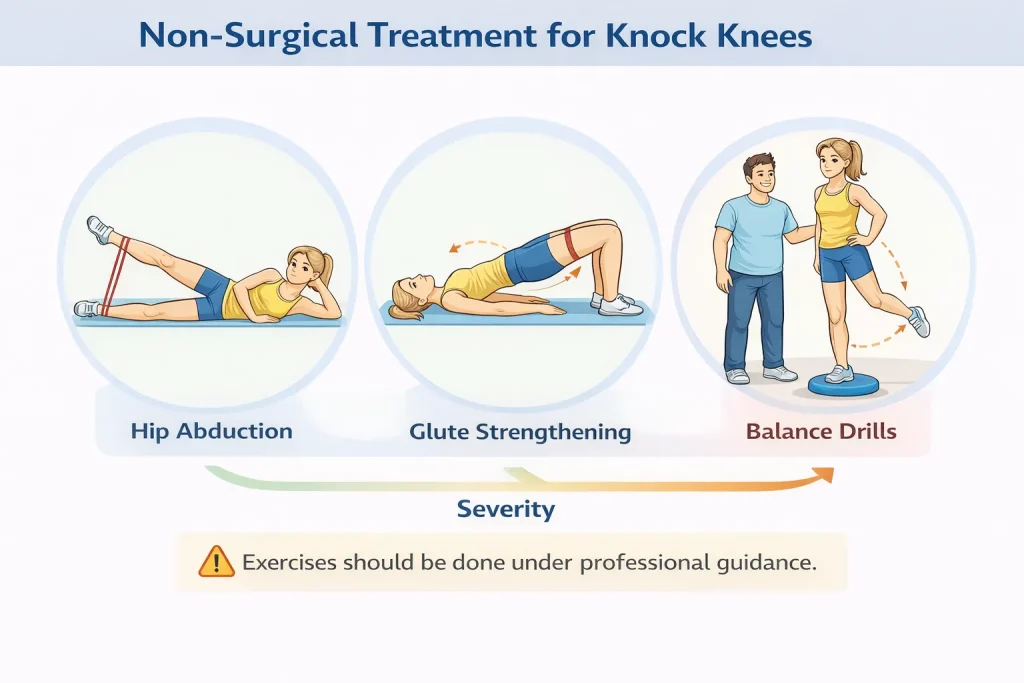
Non-surgical treatment is usually the first step, especially for mild and moderate cases.
1) Physiotherapy for knock knees
Physiotherapy helps improve the control and posture of the knee.
It focuses on:
- strengthening weak muscles
- stretching tight muscles
- improving walking pattern
- improving balance
A simple way to understand this is like controlling a shopping bag.
If one side of the bag is heavy, it tilts. But if you balance the load, it becomes stable. Physiotherapy helps “balance” the muscles around your knee and hips.
2) Exercises for knock knees
Exercises are usually designed to strengthen the muscles that stop the knee from collapsing inward.
Most plans focus on:
- hip muscles
- glute muscles
- thigh muscles
- ankle stability
These exercises are best done under guidance because wrong form can increase pain.
Best Exercises to Fix Knock Knees in Adults
Here are some of the most commonly recommended exercises for genu valgum. These are not a replacement for professional guidance, but give you an idea of what a physiotherapy plan may include.
1. Side-Lying Hip Abduction Lie on your side. Slowly raise the top leg upward and bring it back down. This strengthens the hip abductor muscles that control knee alignment.
2. Clamshell Exercise Lie on your side with knees bent. Open the top knee like a clamshell while keeping feet together. This targets the gluteus medius – one of the most important muscles for preventing knee collapse.
3. Single-Leg Squat (Wall Support) Stand near a wall for support. Slowly lower onto one leg while keeping the knee tracking over the foot. This builds quad and hip strength together.
4. Monster Walk with Band Place a resistance band around your knees or ankles. Walk sideways in a squat position. This works the hips and knees together.
5. Step-Up with Knee Control Step onto a low platform with one foot. Make sure the knee does not fall inward as you step up. Step back down slowly. Repeat on both sides.Important note: These exercises work best when pain is mild or absent. If you have significant pain or severe deformity, exercises should be designed and monitored by a physiotherapist.
3) Weight management
Extra weight puts extra pressure on the knees.
If you are overweight, your knee has to carry more load every step. For knock knees, this load becomes uneven.
Even small weight loss can help reduce pain and stress.
Knock Knees After Weight Loss
A common question is whether losing weight can reduce knock knees.
The honest answer is that weight loss alone does not change bone alignment. The bones themselves will not shift back to a straight position just by losing weight.
However, weight loss can:
- significantly reduce the load on the knee joint
- reduce pain during walking
- make exercises and physiotherapy more effective
- slow down joint wear
So while weight loss is not a cure for genu valgum, it is a very important part of managing symptoms and protecting the joint long-term.
4) Footwear and orthotics
Some people have flat feet. Flat feet can make the ankle roll inward, and that can pull the knee inward too.
In such cases:
- shoe inserts
- arch support
- better footwear
may help improve the walking pattern and reduce pain.
5) Posture and daily habits
Sometimes small things help more than we expect.
Helpful habits include:
- Avoid standing with knees locked inward
- Don’t sit with knees falling inward
- Avoid deep squats if painful
- Choose walking surfaces that feel stable
Knock Knee Treatment in Adults: Can It Be Corrected?
This is a common question:
Can knock knees be corrected in adults?
The honest answer is yes, but it depends on the situation.
In adults, treatment goals are often:
- reduce pain
- improve balance and walking
- protect the knee joint from early wear
- correct alignment if needed
Adults with mild knock knees
May improve with:
- physiotherapy
- exercises
- weight control
- footwear correction
Adults with severe knock knees
May need surgery when:
- pain is ongoing
- Walking is affected
- The knee joint is wearing unevenly
- arthritis is starting
So yes, knock knees can be fixed in adults, but the plan must match the cause and severity.
Can Knock Knees Be Fixed After Age 25?
Yes, correction is possible after age 25. However, the approach is different from children.
In growing children, guided growth techniques use the natural growth process to gradually correct alignment. Once growth is complete, the same approach is no longer possible.
In adults above 25:
- Mild cases can still respond well to physiotherapy and targeted exercises
- Moderate to severe cases that cause pain or joint damage may require osteotomy surgery
- There is no age limit for surgical correction if the patient is otherwise healthy
The key point is that age 25 is not a cutoff for treatment. Early evaluation and a plan suited to your current condition is more important than age alone.
Do Braces Help for Knock Knees?
Some people search for knee braces and supports. Braces may help in selected cases.
Braces can:
- provide support during walking
- reduce discomfort during activity
- guide knee position slightly
But braces do not permanently change bone alignment in adults. They are usually supportive tools, not a complete cure.
When Is Surgery Needed for Knock Knees?
Surgery is not always needed. But it becomes an option when:
- Knock knees are severe
- Pain is affecting daily life
- Deformity is worsening
- joint damage is developing
- Non-surgical methods are not helping enough
The goal of surgery is to correct the alignment so the knee carries weight in a balanced way.
Surgical Treatment Options for Knock Knees
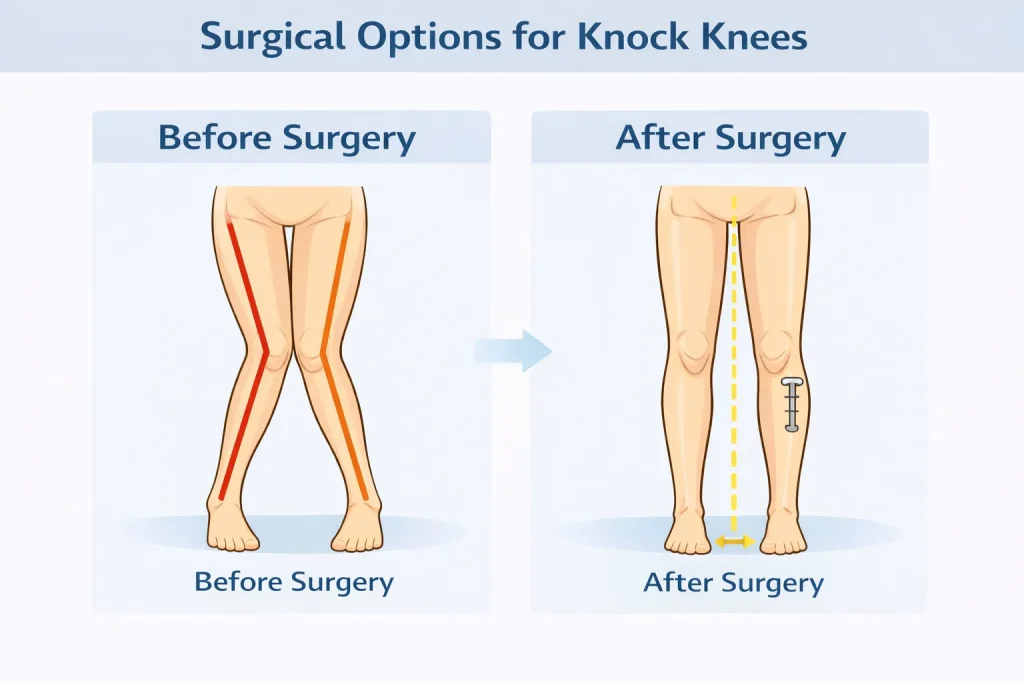
Surgery depends on age and bone maturity.
1) Guided growth (in growing children)
If a child still has growth left, doctors may use guided growth methods to help correct alignment gradually over time.
This is considered when the deformity is large and likely won’t improve on its own.
2) Osteotomy (in adults)
In adults, bones do not grow longer. So the alignment is corrected by osteotomy.
In simple words, osteotomy is:
- correcting the bone angle
- placing it in better alignment
- fixing it so it heals in the corrected position
This reduces uneven pressure and improves function.
3) Knee replacement (in advanced arthritis)
If a patient has severe arthritis along with knock knees, knee replacement may be considered. This is usually for older patients or advanced joint damage cases.
Cost of Knock Knee Surgery in India
The cost of knock knee surgery in India varies depending on:
- type of surgery (guided growth, osteotomy, or knee replacement)
- city and hospital
- whether one or both legs are involved
- implant quality and surgeon experience
Generally speaking:
- Guided growth surgery in children tends to be less expensive and minimally invasive
- Osteotomy in adults involves more complexity and has a moderate to higher cost range
- Knee replacement for advanced arthritis combined with knock knees is the most expensive option
India offers significantly more affordable surgical options compared to many Western countries, with equivalent quality of care at specialized orthopedic centres. An online consultation with a specialist can help you understand the specific cost estimate for your situation.
Knock Knees in Teenagers
While many children outgrow knock knees by age 8 to 10, some teenagers continue to have noticeable genu valgum. This is more common in girls.
In teenagers, knock knees may be linked to:
- a growth spurt that changes leg proportions
- early weight gain
- weak hip and thigh muscles
- flat feet
- vitamin D deficiency during rapid growth
Most teenagers with mild knock knees do not need surgery. Targeted physiotherapy, exercises, and footwear corrections can help significantly.
However, if a teenager has knee pain, difficulty with physical education, or visibly worsening alignment, a specialist evaluation is recommended. Guided growth procedures can still be an option in teenagers who have not yet completed bone growth.
Knock Knees in Women and Girls
Knock knees are more commonly noticed in women and girls compared to men. This is partly because of differences in:
- Pelvic width – women naturally have a wider pelvis, which creates a larger inward angle from the hip to the knee (called the Q-angle)
- Hormonal flexibility – increased joint laxity in women can allow more inward knee movement
- Muscle patterns – differences in hip and thigh muscle strength between men and women can influence knee alignment
Women with knock knees often notice more symptoms during:
- pregnancy (due to weight gain and joint relaxation)
- prolonged standing or walking
- activities like running, cycling, or stair climbing
This does not mean knock knees in women are always a problem. But it does mean women should pay attention to knee alignment, hip strength, and footwear as part of overall joint health.
Recovery and Results
Recovery time depends on the treatment approach.
For physiotherapy and exercises
- Pain relief may start in weeks
- strength improves over time
- Better posture can take a few months
For surgery
- Recovery happens in stages
- Walking support may be needed early
- Physiotherapy is important after surgery
Think of recovery like building stamina.
You don’t become strong in one day. You improve step by step.
Do’s and Don’ts for Knock Knees
Do’s
- keep a healthy weight
- strengthen hips and thighs
- wear supportive shoes if needed
- walk with an upright posture
- Get evaluated if pain increases
Don’ts
- Ignore knee pain for months
- force painful workouts
- follow random exercises without proper form
- Delay medical help if walking gets worse
Knock Knees vs Bow Legs (Opposite of Knock Knees)
The opposite of knock knees is bow legs, also called genu varum.
- In bow legs, knees stay apart, and ankles come closer.
- In knock knees, knees touch, and ankles stay apart.
Both can cause joint stress. Both need proper evaluation if severe.
Genu Valgum vs Genu Varum: Side-by-Side Comparison
| Feature | Genu Valgum (Knock Knees) | Genu Varum (Bow Legs) |
| Knee position | Knees turn inward | Knees bow outward |
| Ankle position | Ankles stay apart | Ankles come closer |
| Leg shape | X-shaped | O-shaped |
| Joint stress | Outer knee (lateral compartment) | Inner knee (medial compartment) |
| Common age | Young children and teenagers | Young children and older adults |
| Common cause | Vitamin D deficiency, obesity, growth | Rickets, arthritis, old fractures |
Understanding this difference helps in getting the right diagnosis from the start.
Knobby Knees vs Knock Knees
Many people confuse these two terms.
Knobby knees
This usually means knees look bony or prominent. It can happen due to:
- low fat around the knee
- low muscle
- natural body shape
Knock knees
This is a real alignment condition where the knees bend inward.
So, they are not the same. A doctor can confirm which one it is.
Knock Knees and Hypermobile Knees
Some people with knock knees also have hypermobile knees, meaning their knee joints bend more than normal.
Hypermobility means the ligaments around the joint are more flexible than average. In the knee, this can contribute to:
- increased inward collapse of the knee during walking
- feeling of unstable or “wobbly” knees
- pain after prolonged standing or activity
- clicking or popping sensations in the knee
How to test for knee hypermobility at home: When you stand, try to straighten your knees fully. If they bend slightly backward (hyperextend) beyond a straight line, this may indicate hypermobility.
People with both knock knees and hypermobile joints need a slightly different physiotherapy approach. Exercises focus more on stability and joint control rather than pure flexibility training.
When Should You See a Doctor for Knock Knees?
You should consult a specialist if:
- You have knee pain while walking
- Knock knees are increasing over time
- You feel unstable or unbalanced
- One leg looks more inward
- You struggle with stairs or running
- Your child has severe knock knees or limping
Getting checked early can help avoid future problems, especially in adults.
Knock Knees Treatment with Dr. Divya Ahuja (Mumbai, Thane, Navi Mumbai)
Knock knees can be mild or can slowly cause joint stress. A proper evaluation helps you understand what exactly is happening and what can be done safely.
Dr. Divya Ahuja offers evaluation and treatment planning for knock knees (genu valgum), including:
- posture and gait assessment
- alignment measurement and imaging guidance
- non-surgical correction plans
- deformity correction options when needed
Patients across Mumbai, Thane, and Navi Mumbai can consult for guidance based on symptoms, severity, and long-term joint health.
Conclusion
Knock knees (genu valgum) are common. Sometimes it is harmless. But sometimes it causes pain and affects walking.
The key is simple. Don’t ignore symptoms. If you feel discomfort, imbalance, or worsening alignment, get it checked.
With the right treatment plan, most people can improve how they walk, reduce pain, and protect their knees for the long term.
FAQs
How do I know if I have knock knees at home?
Stand straight with your knees touching naturally. If there is a clear gap between your ankles, you may have knock knees (genu valgum). A proper doctor check is still important to confirm the severity and actual cause.
What causes knock knees in adults who never had them as a child?
Knock knees in adults can develop due to weight gain, weak hip muscles, flat feet, old injuries, or early arthritis. Over time, these factors can change walking posture and push the knees inward during daily movement.
Can mild knock knees be corrected without surgery?
Yes, mild knock knees can often improve with physiotherapy, posture correction, and strengthening exercises for the hips and thighs. Supportive footwear and weight management also help reduce inward knee collapse and improve walking comfort.
Why do my knees knock together when I walk or run?
Knees may knock together because the leg alignment bends inward and muscles around hips and thighs cannot control the movement properly. Flat feet and poor running form can also increase inward knee pressure during fast walking or running.
Does knock-knee pain get worse with age?
It can. If knock knees cause uneven pressure on the knee joint, joint wear may increase over time. This can lead to worsening pain, stiffness, and early arthritis, especially if body weight is high or activity is stressful.
What is the best exercise for knock knees in adults?
The best exercises usually strengthen hip and glute muscles, because they support knee alignment during walking. A physiotherapist may suggest simple movements like side leg raises and controlled squats with correct posture based on your condition.
Can flat feet cause knock knees and inward leg bending?
Yes, flat feet can contribute to knock knees. When the foot arch collapses inward, the ankle and knee may also move inward. Proper shoe support, orthotics, and strengthening exercises can reduce this effect and improve leg alignment.
When should I worry about knock knees in children?
You should worry if knock knees are severe, painful, worsening with time, or present more on one side. If the child limps, falls often, or has signs of weak bones, a medical evaluation is recommended for safe treatment planning.
Can knock knees be fully corrected in adulthood?
In many adults, symptoms and walking patterns can improve a lot with physiotherapy and lifestyle changes. However, severe genu valgum caused by bone alignment may need surgery for full correction, especially when pain and joint damage are present.
What is the difference between knock knees and bow legs?
Knock knees (genu valgum) means knees bend inward and touch, while ankles stay apart. Bow legs (genu varum) are the opposite, where knees stay apart, and legs curve outward. Treatment depends on the type and severity.
Are knock knees allowed in the Indian Army or Agniveer?
Significant knock knees are generally disqualifying in Indian Army and Agniveer medicals. Mild cases may be assessed individually. A formal evaluation before the medical exam is recommended.
Can knock knees cause problems while running?
Yes. Running with knock knees can cause runner’s knee, IT band pain, and shin splints. Proper running form, supportive footwear, and hip strengthening reduce injury risk significantly.
Is knock-knee a genetic condition?
Knock knees can have a genetic component, but they are more commonly caused by nutritional deficiencies, posture habits, weight, or underlying joint conditions rather than purely inherited factors.
Can knock knees cause slouching or back pain?
Yes. Knock knees alter the lower limb alignment, which can affect posture up the chain – including the hips, pelvis, and lower back – leading to slouching or back discomfort over time.
What is physiological genu valgum?
Physiological genu valgum is normal inward knee alignment seen in children aged 3 to 6 years during development. It resolves on its own without treatment in most healthy children by age 7 to 8.
Do knock knees get worse with age in adults?
Without treatment, moderate to severe knock knees can worsen over time due to increasing joint wear and muscle weakness. Regular monitoring and early management help slow progression effectively.
What is the medical term for knock knees?
The medical term for knock knees is genu valgum. It may also be called valgus knee deformity, knee valgus, or inward knee alignment in clinical settings.