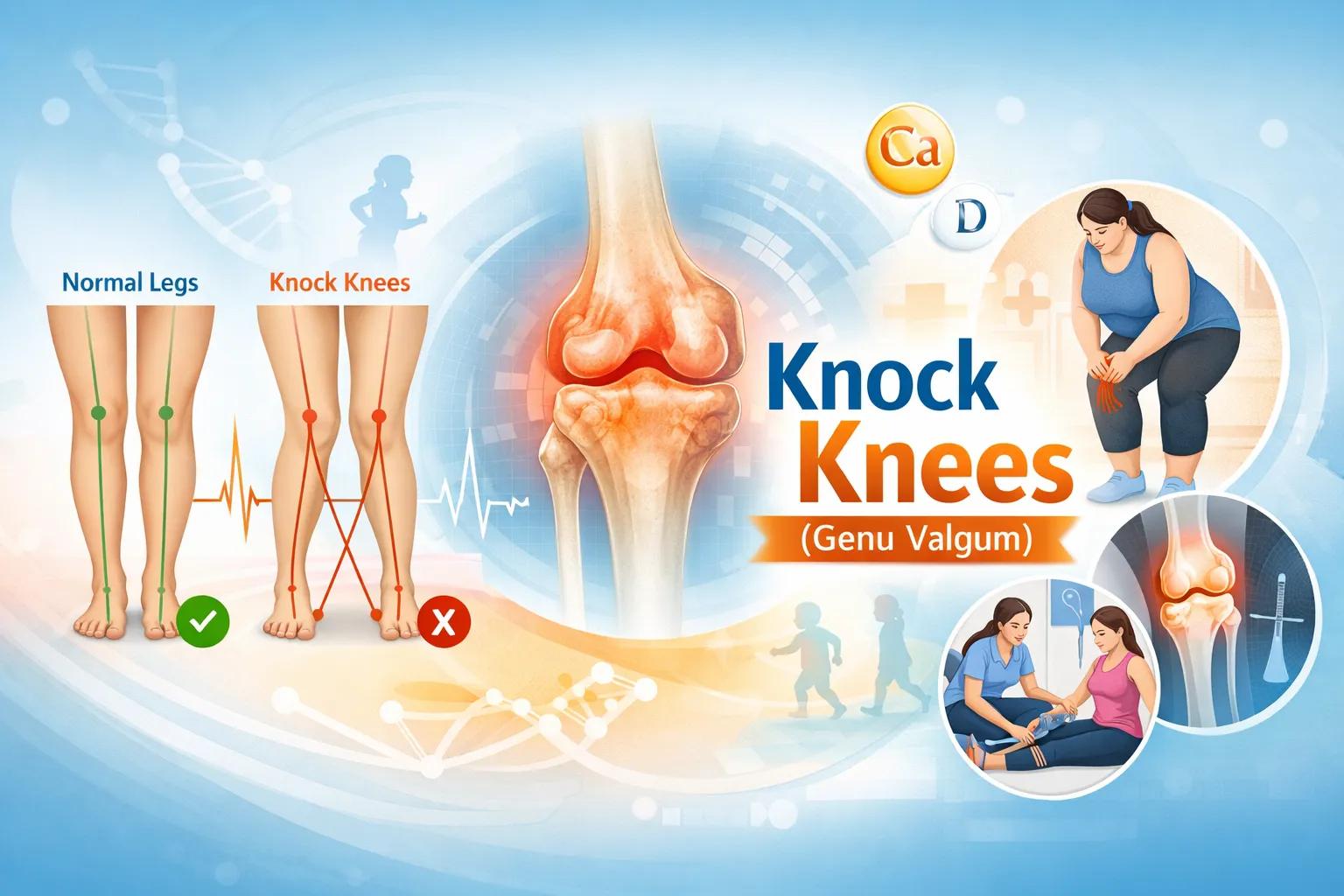
If you stand in front of a mirror and notice your knees touching each other while your ankles stay apart, you might be dealing with knock knees. Many people call it knee knocking, inward knees, or knees bending inward. The medical name for this condition is genu valgum.
Now, don’t worry. Seeing knock knees does not always mean something is seriously wrong. In children, it can even be a normal part of growth. But in teenagers and adults, knock knees can sometimes cause pain, balance problems, and extra stress on the knee joint.
In this blog, we will talk about knock knees in a very simple way. No complicated words. No confusing medical language. We will cover what it is, why it happens, how to check it, and what treatments can help. We’ll also explain when you should visit a doctor, and what options exist if exercises and physiotherapy are not enough.
Table of Contents
What are Knock Knees (Genu Valgum)?
Knock knees means your knees point inward instead of facing straight. Because of this, your knees come closer to each other than they should.
Here’s a simple way to imagine it.
Think of your legs like two straight poles holding up a roof. If those poles start leaning inward, the roof will still stand. But the load will not be evenly balanced. One side will take more pressure. Over time, that side may start to wear out.
That is what can happen inside the knees when they bend inward too much.
Knock knees are also called:
- Knock-knees
- Genu valgum
- Knee valgus
- Valgus knee deformity
- Knock-kneed posture
- Inward-bending knees
- Knees that turn in
It is not just about appearance. Sometimes, it is only a visual issue. But in many cases, it can affect the way a person walks and moves.
Normal Knees vs Knock Knees: How to Tell the Difference
A lot of people ask, “Are my knees normal or not?”
This is a fair question. Because not every small inward angle is a problem.
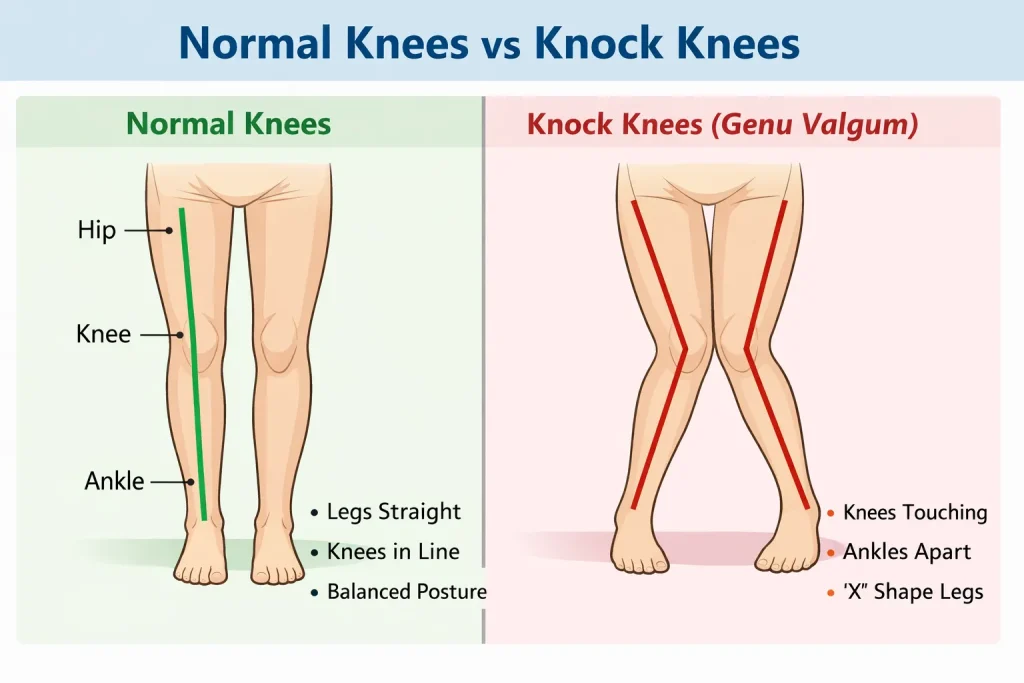
Normal knee alignment usually looks like this
- The legs appear mostly straight.
- The knees are in line with the hips and ankles.
- Your weight feels balanced on both feet.
Knock knees usually look like this
- The knees move inward and may touch each other.
- The ankles stay apart.
- The legs can look like an “X” shape.
- Walking may look slightly different.
Here’s a small example.
If you draw a straight line from your hip to your ankle, the knee should stay close to that line. In knock knees, the knee moves inside that line.
Some people have mild knock knees and no pain at all. They walk normally and live a normal life. That’s why looking at the leg is not enough. You also have to look at symptoms and body function.
How to Know If You Have Knock Knees (Simple Home Test)
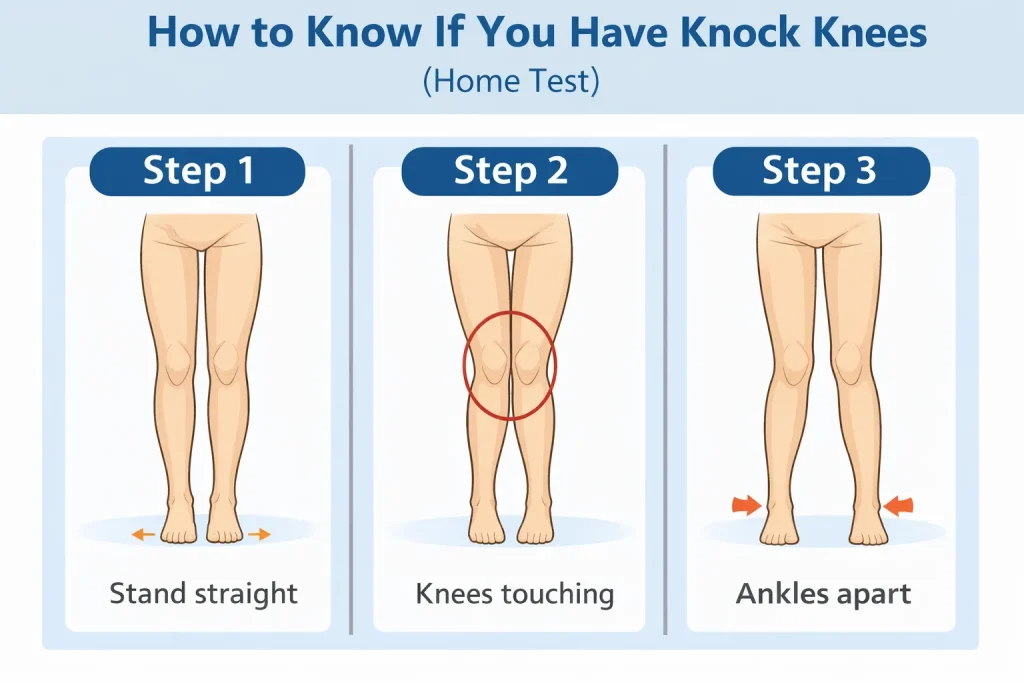
You don’t need any fancy equipment for a basic check. You can do a simple test at home in under one minute.
Home test for knock knees
- Stand straight with your feet pointing forward.
- Try to bring your knees together naturally.
- Now look at your ankles.
If your knees touch but your ankles do not touch, that can suggest knock knees.
Another simple check is walking.
If your knees seem to “bump” into each other while walking, you may have knee knocking.
But remember one thing. This home test only gives a clue. It does not tell you how severe it is. It also does not tell you the cause.
For that, you need a proper medical evaluation.
Common Symptoms of Knock Knees
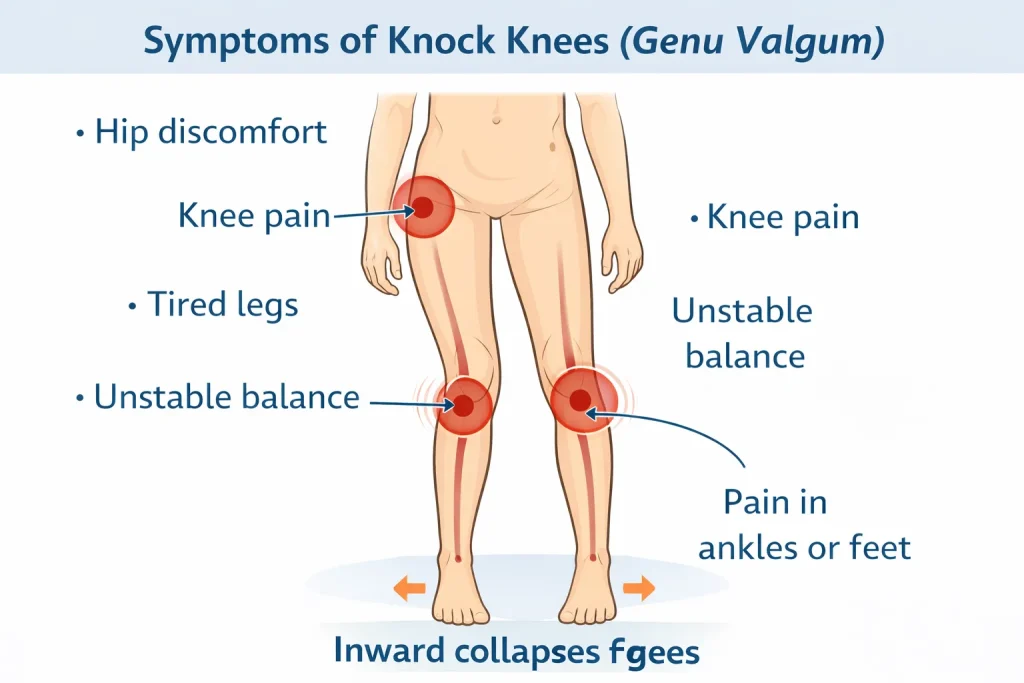
Many people think knock knees always cause pain. That is not true.
Some people have knock knees and feel fine. But others start getting symptoms over time, especially adults.
Common symptoms
- Knee pain, especially after walking or standing for long periods
- Pain in the front of the knee, near the kneecap
- Tired legs even after short activity
- Trouble running or climbing stairs
- Feeling like the knees “collapse inward” while walking
- Bad balance or unstable walking
Other symptoms you may notice
- Hip discomfort after walking
- Pain around the ankles or feet
- Flat feet, along with inward knees
- Uneven wear on shoes
Think about it like a shopping trolley wheel.
If the wheel is slightly tilted, it will still roll. But it will not roll smoothly. It will wobble, and the wheel may wear out faster.
In the same way, the knee joint can get stressed when the alignment is not balanced.
What Causes Knock Knees?
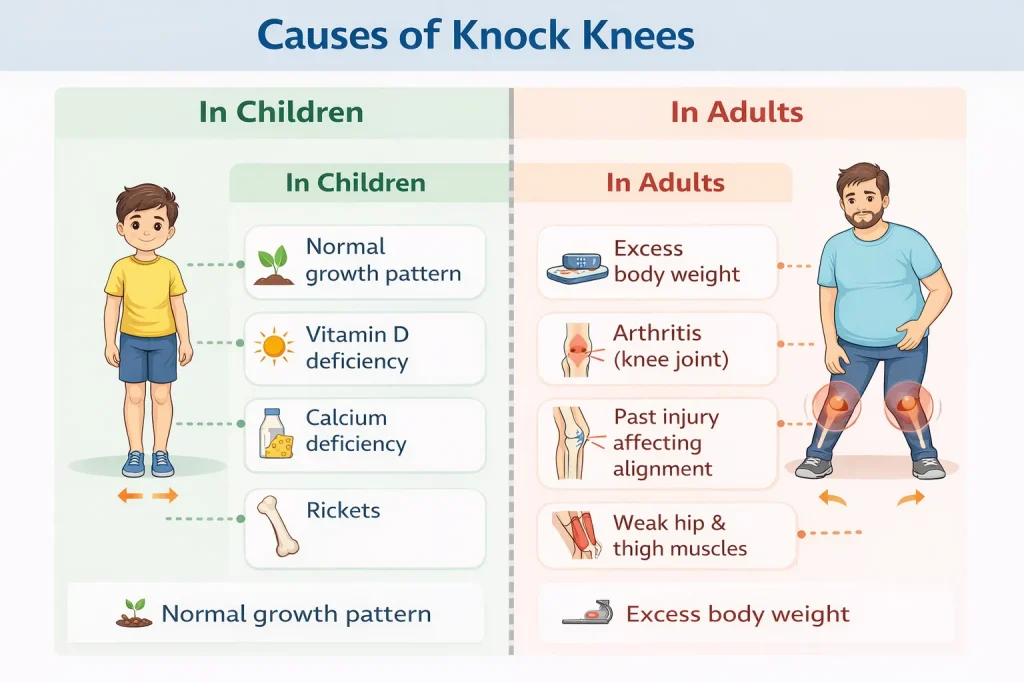
This is the biggest search topic. People type:
- What causes knock knees
- reasons for knock knees
- Why do I have knock-kneed knees
- Knee knocking causes
- Causes for knock knees in adults
The causes can be different in children and adults. Let’s break it down.
Knock Knees in Children: Is It Normal?
Yes, in many children, knock knees can be normal during growth.
Children’s legs go through different shapes as they grow. It’s like how a young tree bends slightly but becomes straighter later as it grows.
Many children develop mild knock knees during early childhood. Most of them improve naturally as their bones get longer and stronger.
When knock knees may be normal
- The child has no pain
- The child walks normally
- Both legs look similar
- The condition is not getting worse
When parents should be careful
A doctor should check the child if:
- Knock knees are severe
- One leg is more affected than the other
- The child has pain or limps
- The condition is increasing year by year
- The child falls often
- The child has signs of weak bones
Common causes of knock knees in children
- Normal growth pattern
- Vitamin D deficiency
- Calcium deficiency
- Rickets
- Growth plate issues
- Past infection affecting bone growth
- Injury near the knee
A simple blood test and bone examination can sometimes help find the real cause.
What Causes Knock Knees in Adults?
Knock knees in adults usually do not appear “just like that.” They often develop due to years of pressure, posture issues, or joint problems.
Here’s a simple way to understand it.
Imagine a door hinge. If the hinge becomes loose, the door will not close properly. It will tilt and rub against the frame.
The knee is similar. When joints and muscles lose balance, the knee may start pointing inward.
Common causes in adults
- Extra body weight
- Arthritis in the knee joint
- An old fracture that healed in the wrong alignment
- Weak hip and thigh muscles
- Flat feet that affect knee posture
- Knee ligament issues
- Long-term poor walking pattern
Adults also have a higher chance of pain because their joints have already been under stress for years of stress.
Types of Knock Knees
Doctors often group knock knees into a few categories.
1) Physiological knock knees
This is usually seen in children.
- It is often mild
- It improves with growth
- It needs monitoring, not surgery
2) Pathological knock knees
This is caused by an underlying issue.
- It can get worse over time
- It may cause pain or walking difficulty
- It needs treatment based on the cause
3) Unilateral and bilateral knock knees
- Bilateral: both legs affected
- Unilateral: one leg is affected more than the other
If one leg looks much more inward, it needs proper evaluation. Sometimes, it can point to injury or uneven bone growth.
Mild Knock Knees vs Severe Knock Knees
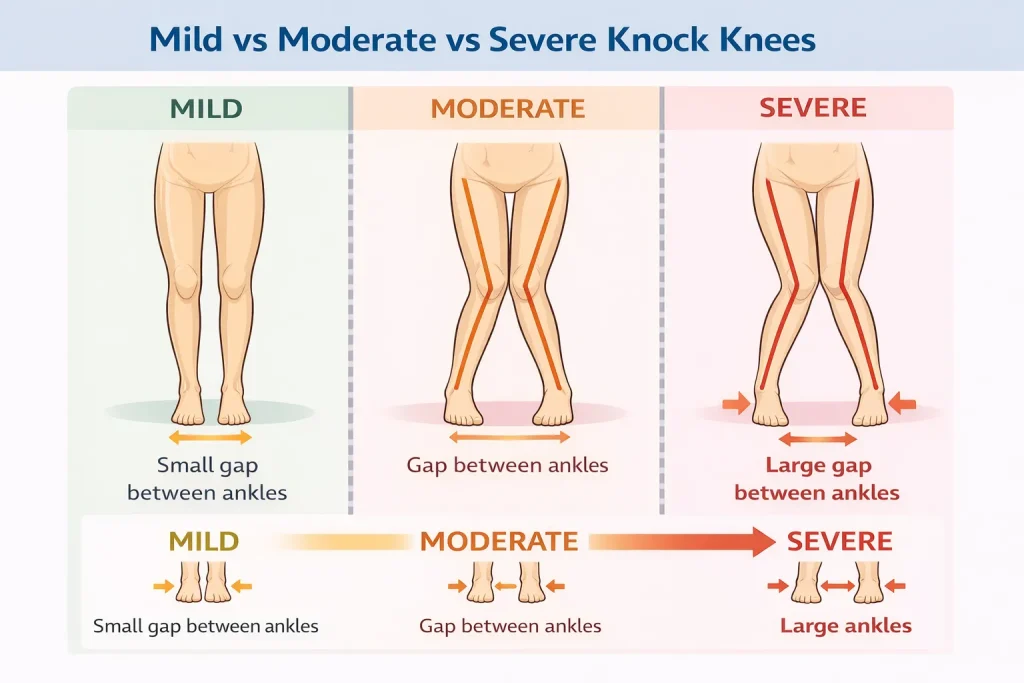
Not all knock knees need treatment. Some need only observation. Some need active care.
Mild knock knees
- Slight inward angle
- No pain
- No walking issue
- No joint stress signs
In such cases, simple strengthening exercises and posture correction may help.
Moderate knock knees
- Visible inward bending
- Some pain after activity
- Slight walking imbalance
These cases may need physiotherapy, footwear correction, and regular follow-up.
Severe knock knees
- Clearly visible X-shaped legs
- Persistent knee pain
- Walking difficulty
- High risk of joint wear
These cases may need surgical correction, especially in adults.
Why Knock Knees Can Cause Knee Pain
Your knee joint is designed to carry weight evenly. In knock knees, weight does not spread evenly.
It shifts to one side. Over time, that side can wear out faster.
This can lead to:
- pain during walking
- pain around the kneecap
- stiffness after long activity
- early signs of arthritis in some patients
Think of it like a car tyre.
If the wheel alignment is off, the tyre will wear out more on one side. Even if the car drives fine today, the problem will grow over time.
That is why early assessment matters.
How Knock Knees Are Diagnosed
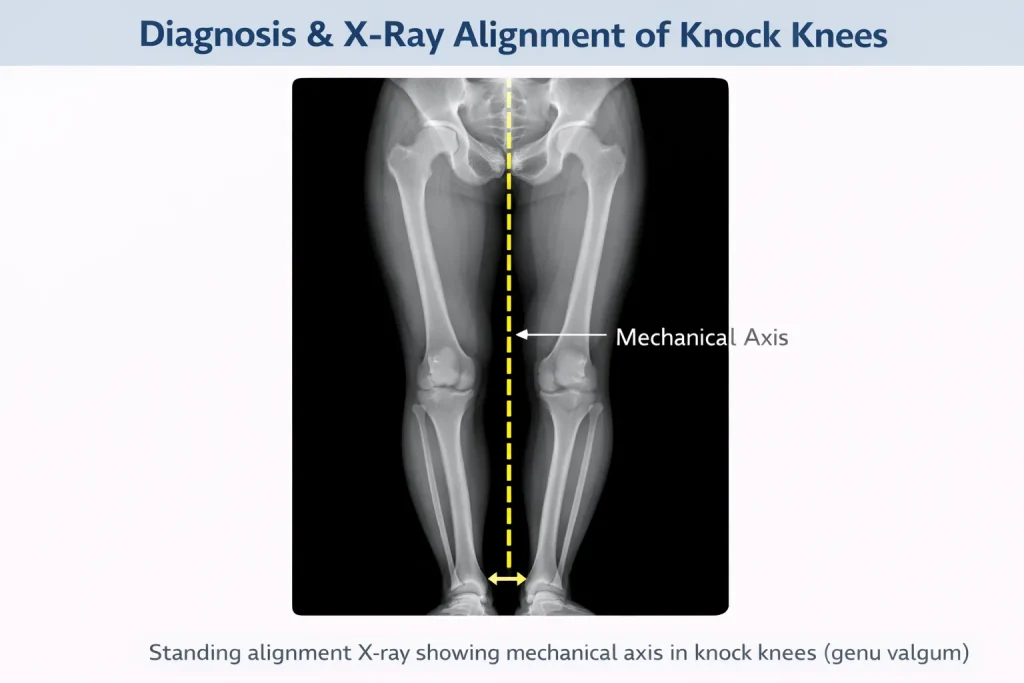
A doctor does not just look at your legs and decide. A proper diagnosis involves checks and measurements.
1) Clinical examination
The doctor will check:
- How you stand
- how you walk
- knee stability
- hip posture
- foot alignment
- muscle strength
Sometimes, knock knees are not only about bone shape. They can also be made worse by weak muscles.
2) Measurement tests
Doctors often measure the gap between the ankles when the knees touch. This helps understand how strong the inward angle is.
3) X-rays for alignment
In many cases, especially in adults, the doctor may suggest a standing alignment X-ray. This shows the full leg line and helps plan treatment correctly.
This is important because two people can look similar from the outside, but have different causes inside.
Treatment for Knock Knees (Genu Valgum)
The best part is that there are many ways to manage knock knees.
But the treatment depends on:
- the age of the person
- Severity of knock knees
- pain level
- cause (vitamin deficiency, arthritis, injury)
- daily activity level
Let’s go step by step.
Non-Surgical Treatment for Knock Knees
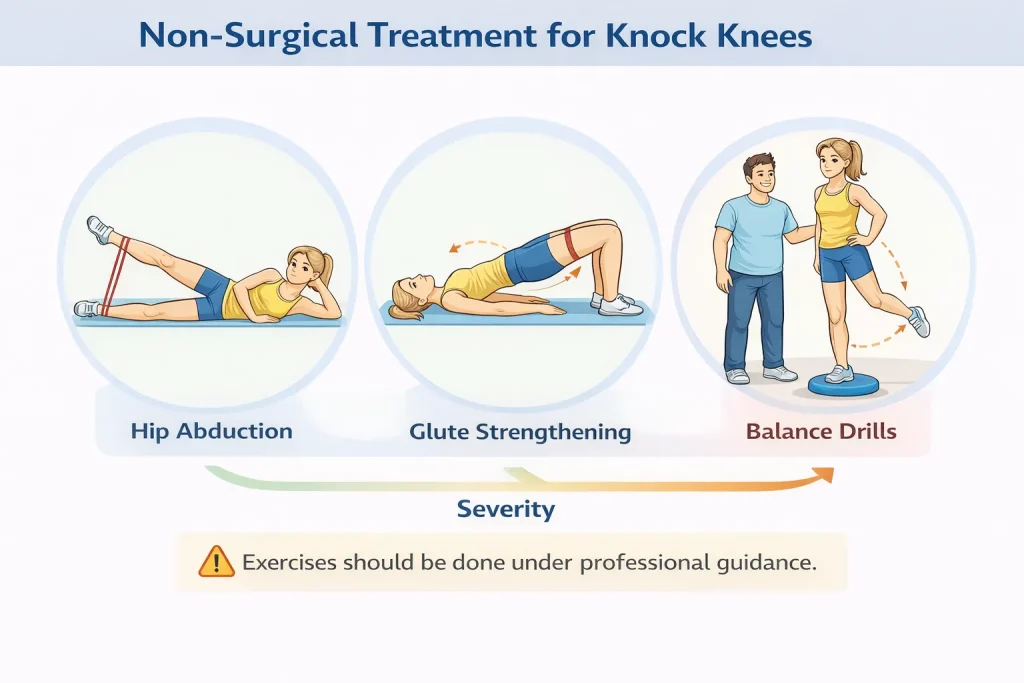
Non-surgical treatment is usually the first step, especially for mild and moderate cases.
1) Physiotherapy for knock knees
Physiotherapy helps improve the control and posture of the knee.
It focuses on:
- strengthening weak muscles
- stretching tight muscles
- improving walking pattern
- improving balance
A simple way to understand this is like controlling a shopping bag.
If one side of the bag is heavy, it tilts. But if you balance the load, it becomes stable. Physiotherapy helps “balance” the muscles around your knee and hips.
2) Exercises for knock knees
Exercises are usually designed to strengthen the muscles that stop the knee from collapsing inward.
Most plans focus on:
- hip muscles
- glute muscles
- thigh muscles
- ankle stability
These exercises are best done under guidance because wrong form can increase pain.
3) Weight management
Extra weight puts extra pressure on the knees.
If you are overweight, your knee has to carry more load every step. For knock knees, this load becomes uneven.
Even small weight loss can help reduce pain and stress.
4) Footwear and orthotics
Some people have flat feet. Flat feet can make the ankle roll inward, and that can pull the knee inward too.
In such cases:
- shoe inserts
- arch support
- better footwear
may help improve the walking pattern and reduce pain.
5) Posture and daily habits
Sometimes small things help more than we expect.
Helpful habits include:
- Avoid standing with knees locked inward
- Don’t sit with knees falling inward
- Avoid deep squats if painful
- Choose walking surfaces that feel stable
Knock Knee Treatment in Adults: Can It Be Corrected?
This is a common question:
Can knock knees be corrected in adults?
The honest answer is yes, but it depends on the situation.
In adults, treatment goals are often:
- reduce pain
- improve balance and walking
- protect the knee joint from early wear
- correct alignment if needed
Adults with mild knock knees
May improve with:
- physiotherapy
- exercises
- weight control
- footwear correction
Adults with severe knock knees
May need surgery when:
- pain is ongoing
- Walking is affected
- The knee joint is wearing unevenly
- arthritis is starting
So yes, knock knees can be fixed in adults, but the plan must match the cause and severity.
Do Braces Help for Knock Knees?
Some people search for knee braces and supports. Braces may help in selected cases.
Braces can:
- provide support during walking
- reduce discomfort during activity
- guide knee position slightly
But braces do not permanently change bone alignment in adults. They are usually supportive tools, not a complete cure.
When Is Surgery Needed for Knock Knees?
Surgery is not always needed. But it becomes an option when:
- Knock knees are severe
- Pain is affecting daily life
- Deformity is worsening
- joint damage is developing
- Non-surgical methods are not helping enough
The goal of surgery is to correct the alignment so the knee carries weight in a balanced way.
Surgical Treatment Options for Knock Knees
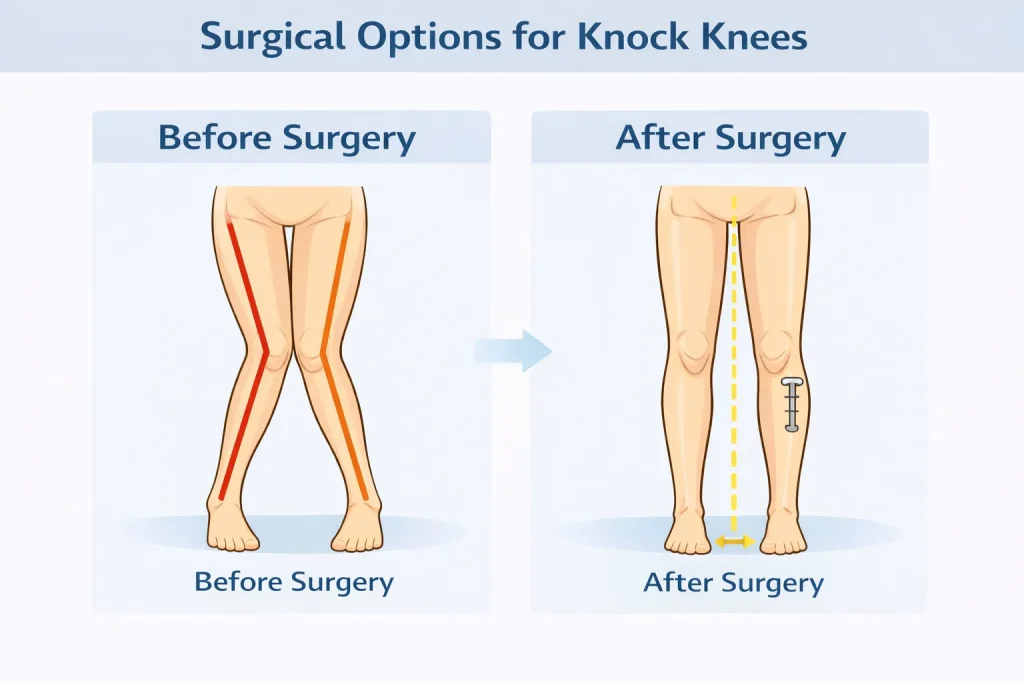
Surgery depends on age and bone maturity.
1) Guided growth (in growing children)
If a child still has growth left, doctors may use guided growth methods to help correct alignment gradually over time.
This is considered when the deformity is large and likely won’t improve on its own.
2) Osteotomy (in adults)
In adults, bones do not grow longer. So the alignment is corrected by osteotomy.
In simple words, osteotomy is:
- correcting the bone angle
- placing it in better alignment
- fixing it so it heals in the corrected position
This reduces uneven pressure and improves function.
3) Knee replacement (in advanced arthritis)
If a patient has severe arthritis along with knock knees, knee replacement may be considered. This is usually for older patients or advanced joint damage cases.
Recovery and Results
Recovery time depends on the treatment approach.
For physiotherapy and exercises
- Pain relief may start in weeks
- strength improves over time
- Better posture can take a few months
For surgery
- Recovery happens in stages
- Walking support may be needed early
- Physiotherapy is important after surgery
Think of recovery like building stamina.
You don’t become strong in one day. You improve step by step.
Do’s and Don’ts for Knock Knees
Do’s
- keep a healthy weight
- strengthen hips and thighs
- wear supportive shoes if needed
- walk with an upright posture
- Get evaluated if pain increases
Don’ts
- Ignore knee pain for months
- force painful workouts
- follow random exercises without proper form
- Delay medical help if walking gets worse
Knock Knees vs Bow Legs (Opposite of Knock Knees)
The opposite of knock knees is bow legs, also called genu varum.
- In bow legs, knees stay apart, and ankles come closer.
- In knock knees, knees touch, and ankles stay apart.
Both can cause joint stress. Both need proper evaluation if severe.
Knobby Knees vs Knock Knees
Many people confuse these two terms.
Knobby knees
This usually means knees look bony or prominent. It can happen due to:
- low fat around the knee
- low muscle
- natural body shape
Knock knees
This is a real alignment condition where the knees bend inward.
So, they are not the same. A doctor can confirm which one it is.
When Should You See a Doctor for Knock Knees?
You should consult a specialist if:
- You have knee pain while walking
- Knock knees are increasing over time
- You feel unstable or unbalanced
- One leg looks more inward
- You struggle with stairs or running
- Your child has severe knock knees or limping
Getting checked early can help avoid future problems, especially in adults.
Knock Knees Treatment with Dr. Divya Ahuja (Mumbai, Thane, Navi Mumbai)
Knock knees can be mild or can slowly cause joint stress. A proper evaluation helps you understand what exactly is happening and what can be done safely.
Dr. Divya Ahuja offers evaluation and treatment planning for knock knees (genu valgum), including:
- posture and gait assessment
- alignment measurement and imaging guidance
- non-surgical correction plans
- deformity correction options when needed
Patients across Mumbai, Thane, and Navi Mumbai can consult for guidance based on symptoms, severity, and long-term joint health.
Conclusion
Knock knees (genu valgum) are common. Sometimes it is harmless. But sometimes it causes pain and affects walking.
The key is simple. Don’t ignore symptoms. If you feel discomfort, imbalance, or worsening alignment, get it checked.
With the right treatment plan, most people can improve how they walk, reduce pain, and protect their knees for the long term.
FAQs
How do I know if I have knock knees at home?
Stand straight with your knees touching naturally. If there is a clear gap between your ankles, you may have knock knees (genu valgum). A proper doctor check is still important to confirm the severity and actual cause.
What causes knock knees in adults who never had them as a child?
Knock knees in adults can develop due to weight gain, weak hip muscles, flat feet, old injuries, or early arthritis. Over time, these factors can change walking posture and push the knees inward during daily movement.
Can mild knock knees be corrected without surgery?
Yes, mild knock knees can often improve with physiotherapy, posture correction, and strengthening exercises for the hips and thighs. Supportive footwear and weight management also help reduce inward knee collapse and improve walking comfort.
Why do my knees knock together when I walk or run?
Knees may knock together because the leg alignment bends inward and muscles around hips and thighs cannot control the movement properly. Flat feet and poor running form can also increase inward knee pressure during fast walking or running.
Does knock-knee pain get worse with age?
It can. If knock knees cause uneven pressure on the knee joint, joint wear may increase over time. This can lead to worsening pain, stiffness, and early arthritis, especially if body weight is high or activity is stressful.
What is the best exercise for knock knees in adults?
The best exercises usually strengthen hip and glute muscles, because they support knee alignment during walking. A physiotherapist may suggest simple movements like side leg raises and controlled squats with correct posture based on your condition.
Can flat feet cause knock knees and inward leg bending?
Yes, flat feet can contribute to knock knees. When the foot arch collapses inward, the ankle and knee may also move inward. Proper shoe support, orthotics, and strengthening exercises can reduce this effect and improve leg alignment.
When should I worry about knock knees in children?
You should worry if knock knees are severe, painful, worsening with time, or present more on one side. If the child limps, falls often, or has signs of weak bones, a medical evaluation is recommended for safe treatment planning.
Can knock knees be fully corrected in adulthood?
In many adults, symptoms and walking patterns can improve a lot with physiotherapy and lifestyle changes. However, severe genu valgum caused by bone alignment may need surgery for full correction, especially when pain and joint damage are present.
What is the difference between knock knees and bow legs?
Knock knees (genu valgum) means knees bend inward and touch, while ankles stay apart. Bow legs (genu varum) are the opposite, where knees stay apart, and legs curve outward. Treatment depends on the type and severity.