

Table of Contents
Twisted your ankle? Read this before you panic.
Twisting your ankle is one of the most common injuries people experience while walking on uneven surfaces, stepping off a curb, running, playing sports, or even moving quickly inside the house. In many cases, it happens in a split second. One wrong step, the ankle rolls inward or outward, and suddenly there is sharp pain, swelling, or difficulty putting weight on your foot.
If you are reading this, chances are you are dealing with a twisted ankle, a sprained ankle, or swelling that just doesn’t seem to go away. Maybe your ankle swelled up suddenly, or it has been swollen for a week, and you are wondering whether this is normal. You may also be asking questions like: How long does a sprained ankle take to heal? How bad is my sprained ankle? Or can I treat this at home without surgery?
This guide answers all of those questions in one place.
In this article, you will learn:
- What actually happens when you twist your ankle
- The difference between a twisted ankle and a sprained ankle
- Signs that show how severe your injury is
- The sprained ankle recovery timeline, step by step
- Healing stages of ligament injury explained simply
- How to treat a sprained or twisted ankle at home
- When swelling or pain is not normal
- Recovery timelines for high ankle sprains, foot sprains, and thumb sprains
By the end, you will know what to do now, what to expect next, and when to see a doctor.
What Happens When You Twist Your Ankle?

When you twist your ankle, the joint moves beyond its normal range of motion. This usually happens when the foot rolls inward (most common) or outward while your body weight is still on it.
Inside your ankle are strong bands of tissue called ligaments. Their job is to hold the bones together and keep the joint stable. When an ankle twist happens suddenly, these ligaments stretch too far. In mild cases, they are overstretched. In more serious cases, they partially or completely tear.
This is why an ankle twist injury often causes:
- Sudden ankle twist pain
- Ankle twist swelling within minutes or hours
- Difficulty bearing weight
- Pain that increases over the first 24–48 hours
Swelling happens fast because small blood vessels are damaged along with the ligaments. Fluid leaks into nearby tissue, causing the ankle to swell and sometimes bruise.
Want to know more about Human Anatomy and Joints?
Twisted Ankle vs Sprained Ankle: Are They the Same?

Many people use these terms interchangeably, but there is a small difference.
A twisted ankle describes how the injury happened.
A sprained ankle describes what was injured.
Twisted ankle
- Refers to the sudden movement
- Pain may be mild or severe
- Swelling may or may not appear
- Sometimes heals quickly
Sprained ankle
- Means ligament damage has occurred
- Usually involves swelling and bruising
- Can cause joint instability
- Requires structured recovery
In simple words : most twisted ankles are actually sprained ankles, even if the sprain is mild.
Common Sprained Ankle Symptoms
Sprained ankle symptoms vary depending on severity, but commonly include:
- Pain around the ankle joint
- Swelling and bruising around the foot and ankle
- Difficulty walking or putting weight on the foot
- Ankle stiffness after sprain
- Tenderness when touched
- Ankle pain while walking after a sprain
If your ankle swelled up suddenly or pain increases instead of improving after a few days, the injury may be more than mild.
Ankle Swollen for a Week: Is This Normal?
One of the most common concerns is persistent swelling.
Yes, ankle swelling after a sprain can last longer than people expect. Mild sprains often swell for several days. Moderate and severe sprains can stay swollen for 1–3 weeks or more.
However, you should be cautious if:
- The ankle swelling is not going down at all
- Swelling is increasing instead of reducing
- There is severe pain at night
- You cannot bear weight after several days
In such cases, the issue could be a severe ankle sprain, a high ankle sprain, or rarely, a fracture or blood clot.
How Bad Is My Sprained Ankle?
Doctors classify sprained ankles into three grades based on ligament damage.
Grade 1: Mild ankle sprain
- Ligaments stretched but not torn
- Mild pain and swelling
- Little to no instability
- Minor ankle sprain recovery time: 1–2 weeks
Grade 2: Moderate ankle sprain
- Partial ligament tear
- Noticeable swelling and bruising
- Pain while walking
- Moderate ankle sprain healing time: 3–6 weeks
Grade 3: Severe ankle sprain
- Complete ligament tear
- Severe swelling and bruising
- The joint feels unstable
- Severe ankle sprain recovery time: 8–12 weeks or more
Knowing your grade helps set realistic recovery expectations.
Sprained Ankle Healing Stages (Ligament Healing)
Ligaments heal in predictable phases. Understanding this helps reduce anxiety and prevents rushing recovery.

1. Inflammation Phase (First few days)
- Pain, swelling, warmth
- The body sends blood and healing cells
- Rest is critical
2. Repair Phase (1–3 weeks)
- New collagen fibers form
- Swelling slowly reduces
- Gentle movement begins
3. Remodeling Phase (Weeks to months)
- Ligaments regain strength
- Balance and stability return
- Risk of re-injury decreases
Skipping proper care at any stage increases the risk of chronic ankle sprain or long-term instability.
Sprained Ankle Recovery Timeline (Realistic Expectations)
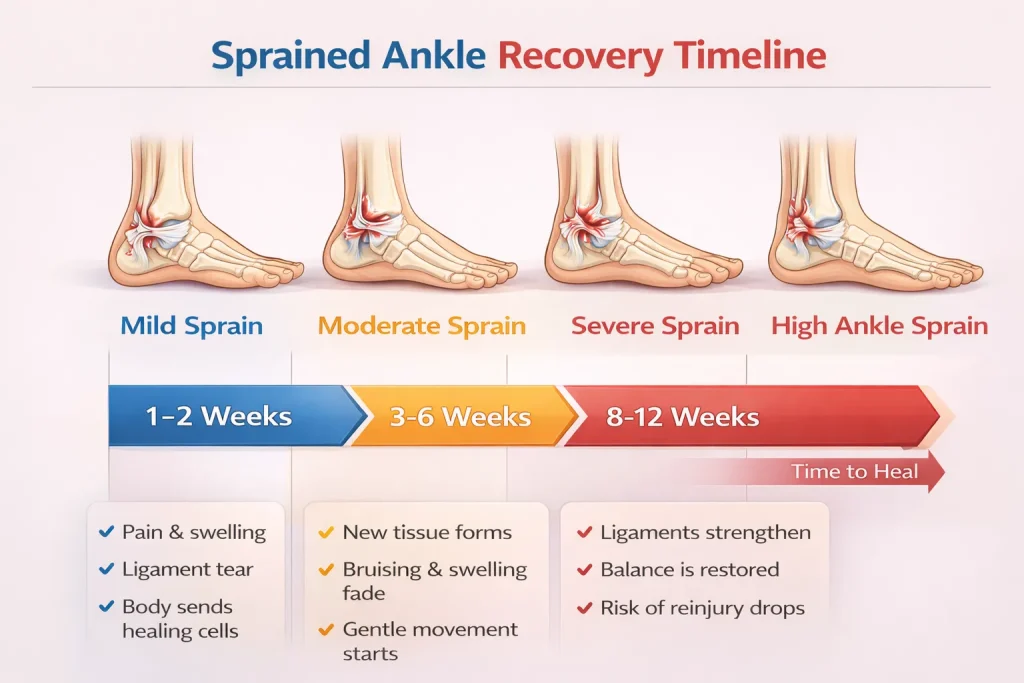
How long does a sprained ankle take to heal?
| Injury Type | Expected Recovery Time |
| Mild sprain | 1–2 weeks |
| Moderate sprain | 3–6 weeks |
| Severe sprain | 8–12 weeks |
| High ankle sprain | 10–16 weeks |
Full recovery means pain-free walking, normal range of motion, and stability—not just reduced swelling.
Can You Walk on a Sprained Ankle?
This depends on severity.
- Mild sprains: Light walking is often okay after a few days
- Moderate sprains: Walking may be painful and should be limited
- Severe sprains: Walking too early can worsen damage
If walking causes sharp pain or limping, reduce weight-bearing and focus on healing first.
High Ankle Sprain: Why It Takes Longer

A high ankle sprain affects ligaments between the tibia and fibula (lower leg bones). This injury often happens when the foot twists outward.
High ankle sprain symptoms
- Pain above the ankle joint
- Pain while walking or climbing stairs
- Less visible swelling
- Longer healing time
High ankle sprain recovery time is longer because these ligaments stabilize the entire lower leg during walking.
Sprain on Bottom of Foot (Foot Sprain)

Not all ankle-area pain comes from the ankle itself.
A foot sprain involves ligaments in the midfoot or plantar area.
Symptoms include:
- Pain in the arch or bottom of the foot
- Swelling after walking
- Difficulty pushing off while walking
Foot sprain recovery timeline
- Mild: 2–4 weeks
- Moderate: 6–8 weeks
Foot sprains heal more slowly because the foot bears weight constantly.
How to Treat a Sprained or Twisted Ankle at Home
Most ankle sprains heal without surgery if treated correctly.
The RICE Method (First 48–72 hours)

Rest
Avoid activities that cause pain. Do not “push through” early.
Ice
Apply ice for 20 minutes, 3–4 times daily. Ice helps reduce swelling and pain.
Compression
Use an ankle sprain bandage or support wrap. Compression helps control swelling.
Elevation
Keep the ankle elevated above heart level whenever possible.
This combination is the foundation of ankle sprain home treatment.
Additional Home Care Tips
- Avoid uneven surfaces
- Wear supportive footwear
- Do gentle range-of-motion exercises after the pain has reduced
- Use strengthening exercises gradually
Never ignore pain that worsens with activity.
Ankle Sprain Pain at Night: Why It Happens
Pain at night is common because:
- Swelling increases when lying still
- Blood flow changes
- Lack of distraction makes pain more noticeable
Elevating the ankle and using ice before bed often helps.
When Should You See a Doctor?

Seek medical care if:
- You cannot bear weight after 48–72 hours
- Pain or swelling keeps worsening
- Ankle sprain not healing after several weeks
- Numbness, extreme bruising, or deformity appears
Early diagnosis prevents long-term issues.
Sprained Thumb & Thumb Sprain Rehab
Sprains are not limited to the ankles.
A sprained thumb joint happens when the thumb ligaments stretch or tear.
Thumb sprain rehab includes:
- Rest and splinting
- Ice and compression
- Gradual strengthening
Ignoring thumb sprains can affect grip strength long-term.
Preventing Future Ankle Sprains
Once you’ve had one sprain, the risk of another increases.
Prevention tips:
- Strengthen ankle muscles
- Improve balance
- Warm up before the activity
- Avoid worn-out footwear
Strong ankles are stable ankles.
Frequently Asked Questions
How long does a sprained ankle take to heal completely?
A sprained ankle usually takes 1–2 weeks if mild, 3–6 weeks if moderate, and 8–12 weeks or longer if severe. Complete healing means no pain, full range of motion, and ankle stability—not just reduced swelling.
Why is my ankle swollen for a week after a sprain?
An ankle can remain swollen for a week or more because ligament healing takes time. Ongoing swelling is common in moderate sprains. However, if swelling is not reducing or pain is worsening, medical evaluation is advised.
Can I walk on a sprained ankle during recovery?
You can walk on a sprained ankle only if pain allows and there is no limping. Mild sprains typically allow for light walking after a few days. Walking too soon after moderate or severe sprains can delay healing and increase the risk of re-injury.
How do I know how bad my sprained ankle is?
Severity depends on pain, swelling, bruising, and the ability to bear weight. Mild sprains cause minor discomfort, while severe sprains involve intense pain, instability, and difficulty walking. Persistent symptoms beyond a week often indicate a higher-grade sprain.
What is the fastest way to reduce ankle swelling after a sprain?
The fastest way to reduce ankle swelling is using the RICE method—rest, ice for 20 minutes, compression with a bandage, and elevation above heart level. This controls inflammation and prevents excessive fluid buildup in injured tissues.
How long does a high ankle sprain take to heal?
A high ankle sprain usually takes 10–16 weeks to heal because it affects deeper stabilizing ligaments between the lower leg bones. Recovery is slower than a regular ankle sprain, especially if walking or sports are resumed too early.
What are the healing stages of a sprained ankle?
A sprained ankle heals in three stages: inflammation (pain and swelling), repair (new ligament tissue forms), and remodeling (strength and stability return). Each stage is essential, and skipping rehabilitation can lead to chronic ankle instability.
Is ankle pain at night normal after a sprain?
Yes, ankle pain at night is common after a sprain. Swelling increases when lying still, and reduced movement makes pain more noticeable. Elevating the ankle and applying ice before sleep often helps reduce nighttime discomfort.
When should I see a doctor for an ankle sprain?
You should see a doctor if you cannot bear weight, swelling does not reduce after 7–10 days, pain worsens, or the ankle feels unstable. These signs may indicate a severe sprain, fracture, or ligament tear.
How long does a foot sprain take to heal compared to an ankle sprain?
A foot sprain often takes longer than an ankle sprain because the foot bears weight constantly. Mild foot sprains heal in 2–4 weeks, while moderate injuries may take 6–8 weeks, especially if walking continues during recovery.